tiktoken review
tiktoken 0.14.0 is OpenAI's byte pair encoding implementation, with Python bindings over a Rust core. It maps text to token IDs for supported OpenAI vocabularies, decodes IDs to bytes or text, resolves an encoding from a model name, controls special-token handling, and processes batches across threads. This release adds Python 3.15 wheels, expands GPT-5-family model recognition, and updates dependencies. Tokenization runs locally after the vocabulary has been obtained. It does not understand language, calculate another provider's tokens, or reproduce the full billable shape of a structured API request.
tiktoken 0.14.0 installed in 0.4 seconds and used 9 MB across 7 packages, with a working native import and no audit findings in our sandbox. Use it for local OpenAI BPE work after caching the vocabulary; do not use its text count as another provider's tokenizer or a guaranteed API bill.
We installed it
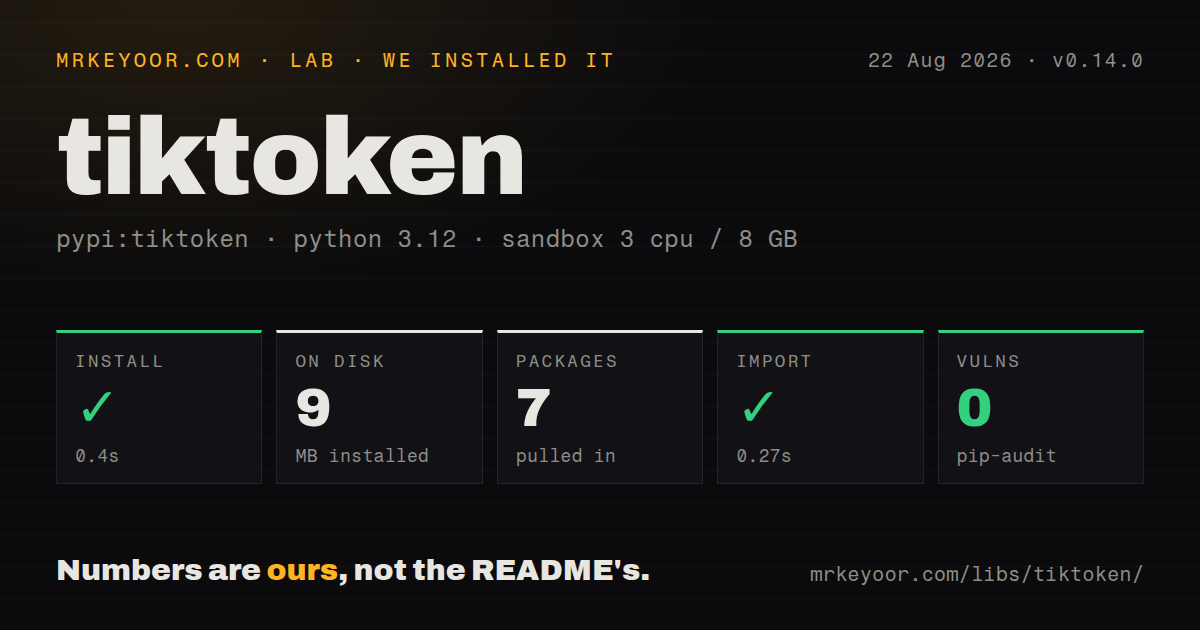
| Install | ✓ · 0.4s | 7 packages on disk · 9 MB |
| Import | ✓ | import tiktoken in 0.27s · compiled extensions · py.typed · requires Python >=3.9 |
| Known vulns | 0 | (pip-audit) |
Answers from our run
Does tiktoken install cleanly?
Yes. In a fresh container with an empty cache, pip install tiktoken finished in 0.4s, leaving 7 packages and 9 MB on disk. pip-audit reported no known vulnerabilities.
What does tiktoken need to run?
Python >=3.9, and a platform wheel with compiled extensions. In our run import tiktoken succeeded in 0.27s, and the package ships py.typed for type checkers.
tiktoken or tokenizers: which should you use?
tokenizers: Pick it for Hugging Face tokenizer artifacts and vocabularies outside OpenAI's model families. tiktoken 0.14.0 installed in 0.4 seconds and used 9 MB across 7 packages, with a working native import and no audit findings in our sandbox.
When should you not use tiktoken?
The target is Claude, Llama, Mistral, Gemma, or another non-OpenAI family. Use that model's tokenizer or supported counting endpoint.
Discussed on
- hnShow HN: TokenDagger – A tokenizer faster than OpenAI's Tiktoken281 points
- hnTiktoken: OpenAI’s Tokenizer153 points
- hnTokenMonster: Ungreedy tokenizer, outperforming tiktoken by 35%10 points
- hnChatGPT BPE Tokenization in Postgres with pg_tiktoken extension6 points
- hnShow HN: Quicktok, an exact BPE tokenizer 7x faster than tiktoken3 points
Use it if
- Local code needs text token IDs or boundaries for a supported OpenAI model vocabulary.
- Chunking and truncation must follow the exact BPE encoding selected for the target model.
- A large document batch can benefit from the Rust core and `encode_batch()` worker threads.
- A custom encoding can follow the documented `tiktoken_ext` discovery convention.
- The target is Claude, Llama, Mistral, Gemma, or another non-OpenAI family. Use that model's tokenizer or supported counting endpoint.
- A number must match final server billing for messages, tools, images, or audio. Encoding supplied text omits request wrappers and provider-side rules.
- No compatible wheel exists and the deployment cannot compile Rust extensions. This package ships native `.so` code.
- The team expects a full API manual. Advanced behavior is documented through README examples, source docstrings, and separate Cookbook material.
- Production blocks outbound traffic and the required vocabulary was not placed in `TIKTOKEN_CACHE_DIR` during the image build.
Setup reality
We installed tiktoken 0.14.0 in a fresh Python 3.12 Bookworm container in 0.4 seconds. Seven packages occupied 9 MB, import tiktoken took 0.27 seconds, and pip-audit reported zero known vulnerabilities. The package has 3 direct dependencies, requires Python 3.9 or newer, contains py.typed, and declares the MIT License. It also ships compiled .so extensions, so a platform without a matching wheel needs a Rust build environment.
Tokenization itself needs no API key or service account. Loading a named encoding can fetch its vocabulary on first use and then cache it. Point TIKTOKEN_CACHE_DIR at persistent writable storage, or populate that exact directory while building an offline image. A successful import only proves the extension loaded; it does not prove that o200k_base or another requested vocabulary is already present. Blocked egress and ephemeral caches otherwise turn the first real call into a failure or repeated download.
encoding_for_model() consults a model mapping bundled in release 0.14.0. It knows additional GPT-5-family names, but a later model may still raise KeyError. Unknown names should fail closed unless the application has an explicitly reviewed fallback encoding. Text length from tiktoken is not provider-neutral. It also cannot include message framing, tool schemas, images, audio, or server accounting unless application code models those inputs separately.
encode() rejects recognized special strings unless the caller allows them; encode_ordinary() treats the same bytes as ordinary text. Make that choice deliberately for untrusted input. One token can contain an incomplete UTF-8 sequence, so use decode_single_token_bytes() when inspecting individual IDs. Truncating IDs may stop inside a word even when the decoded prefix is valid. Custom encodings that copy private attributes such as _pat_str inherit implementation risk; use a tiktoken_ext package when name-based registration is required.
Patterns
Round-trip ordinary text encode-and-decode
import tiktoken

encoding = tiktoken.get_encoding('o200k_base')
tokens = encoding.encode('hello world')
assert encoding.decode(tokens) == 'hello world'
`o200k_base` defines the ID mapping in this example. Another vocabulary can produce different IDs and a different length for identical text.
Resolve an encoding by model name select-model-encoding
import tiktoken

encoding = tiktoken.encoding_for_model('gpt-5')
print(encoding.name)
Model lookup uses the mapping shipped with tiktoken. A newer unknown name raises `KeyError`; only a reviewed fallback should bypass that failure.
Measure one text string count-text-tokens
encoding = tiktoken.encoding_for_model('gpt-5')
count = len(encoding.encode(text))
The result covers only `text`. Message framing, tool schemas, images, audio, and provider-side rules can add billable usage.
Cut text at a token limit truncate-token-budget
def truncate(text, encoding, limit):
    ids = encoding.encode(text)
    return encoding.decode(ids[:limit])
A token boundary is not necessarily a word boundary. Calculate the input allowance after reserving the model budget needed for instructions and output.
Tokenize several documents encode-batch
encoding = tiktoken.get_encoding('o200k_base')
batches = encoding.encode_batch(documents, num_threads=8)
`num_threads=8` asks the Rust core to parallelize the batch. Short documents can make coordination cost larger than the work, so benchmark the workload.
Choose a special-token policy handle-special-text
encoding = tiktoken.get_encoding('cl100k_base')
plain = encoding.encode_ordinary('text <|endoftext|>')
allowed = encoding.encode('<|endoftext|>', allowed_special={'<|endoftext|>'})
`encode()` refuses recognized special strings by default. Add an allowed token only when the application deliberately assigns it special meaning.
Inspect byte pieces safely inspect-token-bytes
encoding = tiktoken.get_encoding('o200k_base')
for token in encoding.encode('Tokenization'):
    print(token, encoding.decode_single_token_bytes(token))
An individual ID can represent only part of a UTF-8 character. `decode_single_token_bytes()` preserves those bytes without a lossy text conversion.
Populate the vocabulary cache during build warm-offline-cache
# Run while the image has network access
# TIKTOKEN_CACHE_DIR=/app/tiktoken-cache python -c "import tiktoken; tiktoken.get_encoding('o200k_base')"
Runtime must point at this populated absolute directory. Loading the Python extension does not download `o200k_base`; requesting the encoding does.
Return token IDs as a NumPy array encode-to-numpy
encoding = tiktoken.get_encoding('o200k_base')
ids = encoding.encode_to_numpy(text)
This method returns a NumPy array for numeric consumers. The ordinary `encode()` path returns Python token IDs in a list.
Display educational BPE steps teach-bpe-merges
from tiktoken._educational import SimpleBytePairEncoding

encoding = SimpleBytePairEncoding.from_tiktoken('cl100k_base')
encoding.encode('hello aaaaaaaaaaaa')
`_educational` exposes merge steps for learning and debugging. Production tokenization should use the regular `Encoding` implementation.
Alternatives
| Package | Registry | Pick it when |
|---|---|---|
| tokenizers | PyPI | Pick it for Hugging Face tokenizer artifacts and vocabularies outside OpenAI's model families. |
| transformers | PyPI | Pick `AutoTokenizer` when tokenization belongs inside a complete model-loading and inference stack. |
| sentencepiece | PyPI | Pick it for models distributed with SentencePiece vocabularies and training workflows. |
More ai / ml guides
openai · mcp · huggingface-hub · @modelcontextprotocol/sdk · scikit-learn · langchain · the whole shelf →
How this guide is made: grounded in the library's documentation, release notes, changelog, and issue history, on a fixed rubric — not a hands-on install of every release. The 50 most-downloaded entries are additionally install-verified in clean containers. Corrections: contact the desk.