sentencepiece review
SentencePiece 0.2.2 trains Unigram or BPE tokenizers from raw Unicode text and applies the learned model during inference. Our Python 3.12 install loaded a compiled, typed extension in 0.25 seconds. The .model file holds piece IDs, normalization, segmentation, and special-symbol settings; encoded spaces use U+2581 so decoding can restore their positions. Version 0.2.2 replaces the Python wrapper's SWIG layer with pybind11, adds native NumPy input and output, character and byte offsets, parallel_encode, and GIL release around C++ work. It also validates trie offsets and alignment bounds in malformed models.
Our SentencePiece 0.2.2 install took 0.2 seconds, occupied 3 MB as one compiled package, imported in 0.25 seconds, and had no audit findings, making it practical when you own vocabulary training. Keep the exact .model beside the neural checkpoint; retraining or sampled inference changes the piece-ID contract.
We installed it
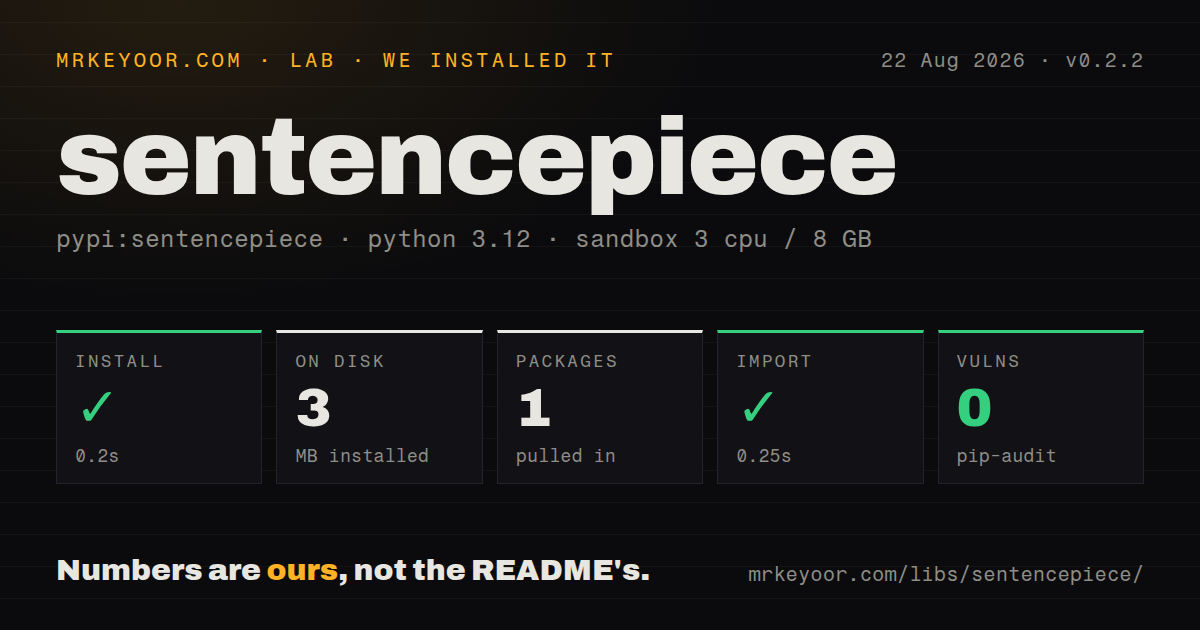
| Install | ✓ · 0.2s | 1 package on disk · 3 MB |
| Import | ✓ | import sentencepiece in 0.25s · compiled extensions · py.typed · requires Python >=3.9 |
| Known vulns | 0 | (pip-audit) |
Answers from our run
Does sentencepiece install cleanly?
Yes. In a fresh container with an empty cache, pip install sentencepiece finished in 0.2s, leaving 1 package and 3 MB on disk. pip-audit reported no known vulnerabilities.
What does sentencepiece need to run?
Python >=3.9, and a platform wheel with compiled extensions. In our run import sentencepiece succeeded in 0.25s, and the package ships py.typed for type checkers.
sentencepiece or tokenizers: which should you use?
tokenizers: Choose it for Hugging Face pretrained assets, offset tracking, and configurable processing stages. Our SentencePiece 0.2.2 install took 0.2 seconds, occupied 3 MB as one compiled package, imported in 0.25 seconds, and had no audit findings, making it practical when you own vocabulary training.
When should you not use sentencepiece?
An existing hosted model requires its published tokenizer assets; training a new SentencePiece vocabulary creates different IDs even at the same vocabulary size
Use it if
- SentencePiece 0.2.2 can learn a fixed Unigram or BPE vocabulary directly from raw multilingual sentences
- Training and serving must share one model file with identical piece IDs and normalization rules
- Subword regularization or BPE dropout is part of the neural model's training plan
- One tokenizer model needs to run from Python and native runtimes without a language-specific pre-tokenizer
- An existing hosted model requires its published tokenizer assets; training a new SentencePiece vocabulary creates different IDs even at the same vocabulary size
- SentencePiece 0.2.2 requires Python >=3.9, excluding a deployment pinned to Python 3.8
- The wheel contains .so extensions, so a pure-Python target or an architecture without a matching wheel inherits a native-build problem
- Hugging Face tokenizers fits a pipeline centered on pretrained assets, post-processing templates, and its offset abstractions
- enable_sampling changes segmentation between calls and is unsuitable for deterministic caches, evaluation, or serving unless that randomness is deliberate
- Retraining changes the .model token contract; old encoded data and an existing embedding matrix cannot safely consume new piece IDs
Setup reality
We installed sentencepiece 0.2.2 in 0.2 seconds in a fresh, unprivileged Python 3.12 Bookworm sandbox with 3 CPUs and 8 GB of RAM. One package occupied 3 MB, and pip-audit found zero known vulnerabilities. The distribution declares 5 direct dependencies, requires Python >=3.9, contains .so extensions, and ships py.typed. import sentencepiece completed in 0.25 seconds. Our measurement recorded the license as unknown; current PyPI metadata and the repository declare Apache-2.0.
Training needs representative raw sentences and a fixed vocab_size. Unigram is the default model type. With hard_vocab_limit enabled, an unsupported size raises instead of quietly emitting fewer pieces. Decide character_coverage, byte_fallback, normalization, special IDs, and user-defined symbols before training. Padding has no ID by default. Those choices become part of the model file and must agree with the neural model's embedding table.
SentencePieceTrainer normally writes .model and .vocab. sentence_iterator and model_writer can keep the 0.2.2 model in memory, but deployment still needs the exact bytes used for training. Repeating the same flags does not recreate learned piece IDs. Version 0.2.2 checks corrupted trie offsets, bad alignment spans, null characters in pieces, and pathological N-best searches; outside model files still enter native code.
Batch encode and parallel_encode can use several CPU threads because C++ work releases the GIL. The project notes that conversion back to Python lists remains GIL-bound, so scaling stops before thread count becomes a free multiplier. Native NumPy support can avoid some Python-object traffic. enable_sampling intentionally returns different segmentations; keep it in training augmentation and use deterministic encode for evaluation, cached features, and serving.
Patterns
Train an 8,000-piece Unigram model train-unigram-model
import sentencepiece as spm

spm.SentencePieceTrainer.train(
    input='corpus.txt',
    model_prefix='tokenizer',
    vocab_size=8000,
)
# tokenizer.model and tokenizer.vocab
hard_vocab_limit makes training fail when the corpus cannot support 8,000 pieces; keep tokenizer.model with the checkpoint.
Encode pieces and IDs, then decode encode-and-decode
import sentencepiece as spm

processor = spm.SentencePieceProcessor(model_file='tokenizer.model')
pieces = processor.encode('I saw a telescope.', out_type=str)
ids = processor.encode('I saw a telescope.', out_type=int)
assert processor.decode(ids) == 'I saw a telescope.'
U+2581 marks spaces in piece strings, while tokenizer.model fixes normalization and numeric IDs.
Train a 16,000-piece BPE model train-bpe-model
spm.SentencePieceTrainer.train(
    input='corpus.txt',
    model_prefix='bpe',
    vocab_size=16000,
    model_type='bpe',
)
Unigram is the default; model_type='bpe' learns different pieces and IDs from the same corpus.
Reserve ID 3 for padding configure-special-ids
spm.SentencePieceTrainer.train(
    input='corpus.txt',
    model_prefix='model',
    vocab_size=8000,
    pad_id=3,
    user_defined_symbols=['<mask>', '<sep>'],
)

ids = processor.encode('hello', out_type=int, add_bos=True, add_eos=True)
Padding starts disabled; pad_id=3 and every other special ID must match the model configuration and embeddings.
Draw 3 segmentations for training sample-subword-segmentations
for _ in range(3):
    print(processor.encode(
        'New York',
        out_type=str,
        enable_sampling=True,
        alpha=0.1,
        nbest_size=-1,
    ))
enable_sampling can return different IDs on each call, so keep it out of deterministic evaluation and serving.
Train without corpus or model files train-from-iterator
import io
import sentencepiece as spm

model_bytes = io.BytesIO()
spm.SentencePieceTrainer.train(
    sentence_iterator=iter(sentences),
    model_writer=model_bytes,
    vocab_size=8000,
)
processor = spm.SentencePieceProcessor(model_proto=model_bytes.getvalue())
sentence_iterator and model_writer replace file paths; persist the resulting bytes beside the trained model.
Add byte fallback to a multilingual model handle-rare-characters
spm.SentencePieceTrainer.train(
    input='multilingual.txt',
    model_prefix='multi',
    vocab_size=32000,
    character_coverage=0.9995,
    byte_fallback=True,
)
character_coverage=0.9995 and byte fallback consume vocabulary slots, so test them against the corpus's actual scripts.
Encode one batch on 8 threads encode-batch-with-threads
encoded = processor.encode(
    texts,
    out_type=int,
    num_threads=8,
)
# list[list[int]] in input order
C++ work uses 8 threads, while conversion to Python list objects remains GIL-bound and eventually caps scaling.
Alternatives
| Package | Registry | Pick it when |
|---|---|---|
| tokenizers | PyPI | Choose it for Hugging Face pretrained assets, offset tracking, and configurable processing stages |
| tiktoken | PyPI | Choose it for OpenAI-compatible BPE encodings instead of training a new tokenizer |
| subword-nmt | PyPI | Choose it when an existing workflow depends on subword-nmt codes and scripts |
More ai / ml guides
openai · mcp · huggingface-hub · @modelcontextprotocol/sdk · scikit-learn · tiktoken · the whole shelf →
How this guide is made: grounded in the library's documentation, release notes, changelog, and issue history, on a fixed rubric — not a hands-on install of every release. The 50 most-downloaded entries are additionally install-verified in clean containers. Corrections: contact the desk.