Zeron manages 8 agent families from one local engine
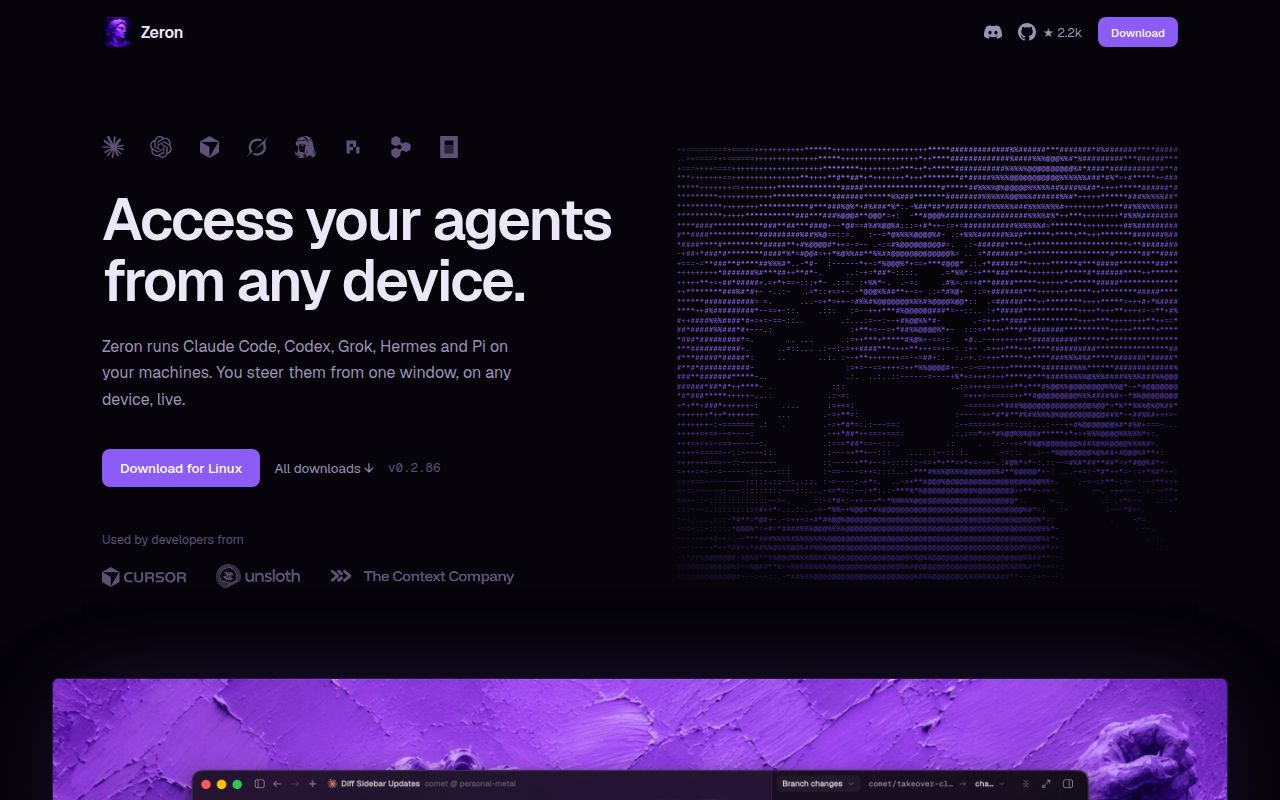
Zeron puts Claude Code, Codex, Cursor, Devin, Grok, Hermes, Pi, and Antigravity sessions behind one desktop interface and daemon. It adds a session list, terminals, diffs, worktrees, agent account switching, and a headless mode for an always-on machine. The useful distinction is ownership: those agents remain separate programs with separate accounts. Zeron discovers, installs, launches, and displays them. It does not supply their models or replace their provider bills.
A new installation starts local-only and needs no Zeron account or network connection. Sessions stay in the local profile, and logging in later does not upload or import them. That is a sensible default for private code. The Linux installer starts the daemon immediately and configures it across reboots. macOS uses a desktop release, while Windows currently ships as a portable ZIP.
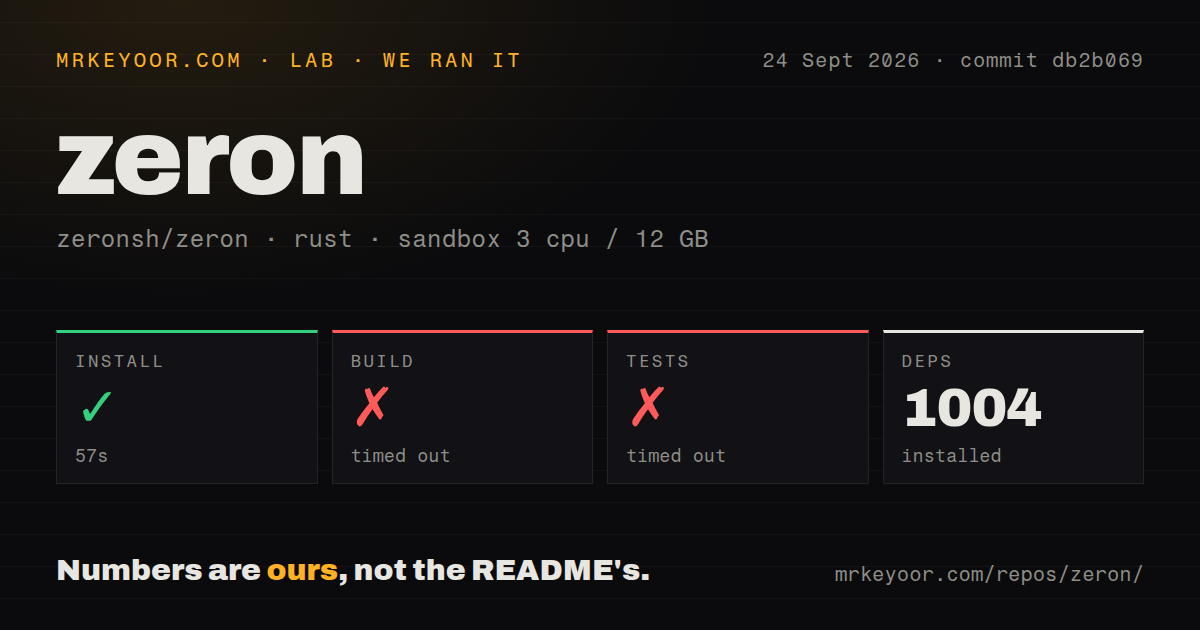
The 1,004-package source install is the hard route
commit db2b069 was a 57.5 MB checkout containing 1,410 files and roughly 329,097 lines of source. The Cargo workspace has 13 members covering the engine, sync, RPC, desktop UI, MCP server, theme system, syntax handling, and update path. It also pins Git revisions of Zeron's GPUI forks. That structure explains why a clean source build asks much more of a machine than the one-line binary installer.
The repository had 8 CI workflows when measured, with no Dockerfile and no top-level tests directory. Linux source builds also inherit native UI dependencies. If you only want to run agents, take the packaged release. Build from source when you intend to change the Rust engine or desktop itself, and budget for a cold Cargo graph rather than treating it like a small command-line crate.
What happened when we ran it
Our sandbox installed 1,004 packages in 57 seconds. The build then reached the 900-second limit and was terminated before producing a success or compiler error. We used an unprivileged container with 3 CPUs, 12 GB of RAM, and the lab-rust:1 image. The timeout is the finding: this checkout did not complete a cold build inside 15 minutes on that machine.
The test command also timed out after 900 seconds. Its final lines showed Rust still compiling vte, ropey, lsp-types, gpui_linux, zeron-ui, x11rb-protocol, and other crates. No test assertion had failed in the visible tail, and no pass count was available. We cannot call the suite broken or passing. We can say a fresh runner may spend its entire 15-minute allowance compiling before tests begin.
Optional sync trusts every signed-in device with workspace files
Local and synced profiles stay separate across restarts. Once you sign in, a device can follow or drive agents running on another signed-in machine. The host checks relative paths, containment, symlinks, and write conflicts before remote file operations. This gives a laptop useful control over a VPS or workstation without moving the whole checkout.
The trust boundary is broad by design. A synced peer can list, read, and write workspace files, and enabling Show ignored files can expose .env. Only .git is always excluded. The architecture also lists end-to-end encryption and a supported self-hosted backend contract as deferred work. Use sync for your own trusted machines, not as a casual collaboration layer between people with different access rights.
The MCP server exists, but automatic agent injection is unfinished
zeron mcp serves Model Context Protocol tools over stdin and stdout through the local engine on port 27654 by default. Its tools can list devices, projects, harnesses, models, and chats, then create, read, message, wait for, interrupt, or archive sessions. This creates a path for one agent to coordinate work handled by another Zeron chat.
The MCP documentation is unusually candid about the missing link. The server and 13 tools exist, but harnesses still launch with empty MCP configuration, so automatic per-agent injection is follow-up work. You can use the server explicitly today. Do not read the design document as proof that Claude Code or Codex automatically receives these orchestration tools on every Zeron session.
Platform support differs most around the browser and agent discovery
Linux's sidebar browser needs WebKitGTK 4.1 and JSON-GLib packages, which the installer does not install or validate. It copies CPU-addressable frames into the GPUI scene, so animated pages carry extra conversion and upload work. Windows has no integrated browser at this revision and opens navigation in the external browser. These limits do not block chat, terminal, or diff features.
Agent discovery can also depend on what is already installed. Open issue 336 reports that multiple Codex installations may lead Zeron to select a stale executable and hide useful app-server errors. The harness documentation separates installation from authentication, and an install action can still fail if it needs elevation or interaction. Check the chosen agent version before blaming Zeron's session layer.
Same-day v0.2.86 activity shows a fast-moving project
GitHub recorded v0.2.86 and a repository push on September 24, 2026. The repository had 2,203 stars, 60 open issues, and 92 open pull requests when fetched. That is active maintenance and a large amount of unfinished work at once. The latest release polished the Settings modal, while same-day discussions covered browser rendering, Cursor plan mode, and multi-window support.
Zeron earns its place after agent sessions start disappearing into a thicket of terminal tabs. The packaged release avoids the 30 minutes our build and test attempts spent compiling. Stay local-only first. Add sync only after deciding that every signed-in device may read the workspace, ignored files included.