Choose controller-runtime when you own the reconciliation logic
Kubernetes controller-runtime compiled in our sandbox, then its test command failed. That split matters if you're choosing the library for a new operator: the source can build without establishing that the resulting controller behaves correctly against an API server. The more consequential commitment is accepting its reconciliation model and version policy.
The project supplies Go libraries for building Kubernetes controllers, programs that repeatedly bring cluster resources toward a desired state. Its README points new projects toward Kubebuilder or Operator SDK. Starting directly with controller-runtime makes sense when you already have a Go application and want to decide how its controller pieces fit together. Starting with scaffolding makes more sense when you need a new project's structure as well.
What happened when we ran it
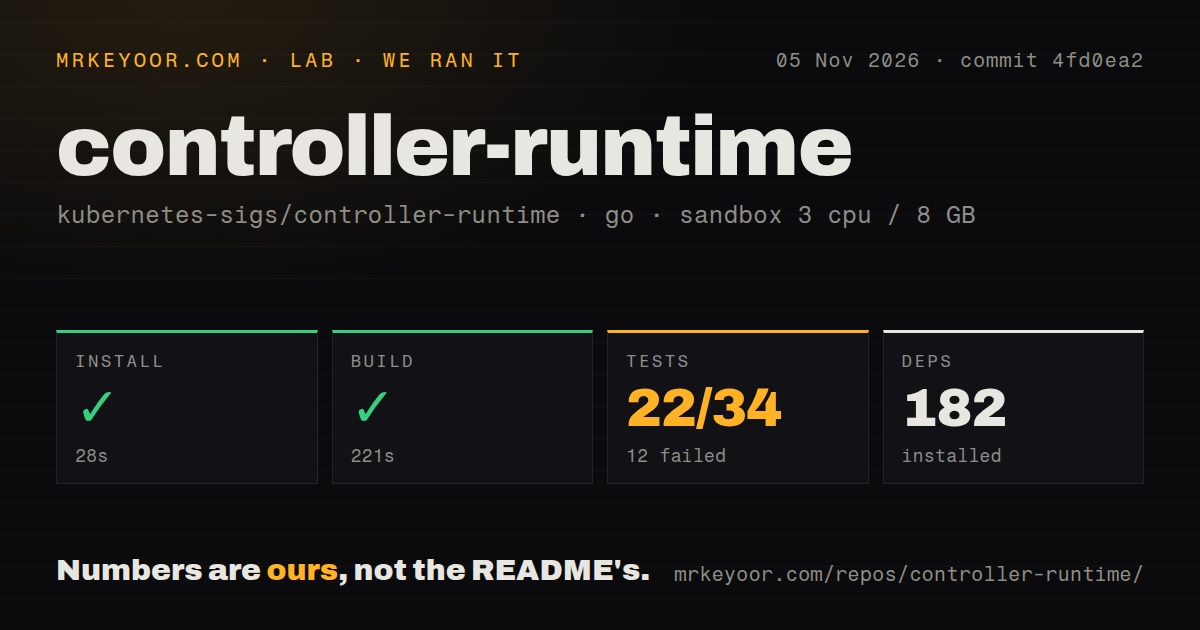
Our sandbox installed controller-runtime in 28 seconds and built it in 221 seconds at commit 4fd0ea2 on November 5, 2026. The Go test command exited 1 after 113 seconds. The recorded summary reports 22 passed and 12 failed out of 34. It does not establish that those entries represent individual test cases, so read them as the run's summary rather than a complete case inventory.
The supplied tail names TestSource failures under pkg/source and pkg/webhook. It also shows successful package lines, including webhook admission, authentication and conversion. There is no underlying error explaining the failures. Missing binaries, a Go mismatch or a product defect would each require evidence absent from this excerpt. The failed command is a reason to investigate before adoption, without assigning it a cause.
The record lists 182 dependencies, 471 repository files and approximately 87,756 source lines in a 3.2 MB checkout. The sandbox configuration specified 3 CPUs, 8 GB of RAM and image golang:1.24-bookworm. That label does not establish the actual Go or operating-system version. The scan found 7 CI workflow files, no Dockerfile and no tests directory. Package-level test output plainly exists despite the directory finding. No vulnerability audit result was supplied.
Minor upgrades can change your Go APIs
The README explicitly permits breaking changes between minor versions and disallows them in patch versions. It also says each controller-runtime minor is supported with a specific client-go minor. Compatibility with other client-go minors is neither supported nor established by that policy.
Choose the library line alongside your Kubernetes Go dependencies. The current README's compatibility table pairs controller-runtime v0.25 with client-go v0.37 and a minimum Go version of 1.26. That is documentation for that line, not a claim about the toolchain used in our measured checkout. Copying a current version requirement onto an older sandbox run would confuse two different pieces of evidence.
For an existing operator, review dependency updates together and reserve time to examine breaking changes when crossing minor lines. A team requiring API stability across all minor upgrades has a concrete reason to decline this policy. A zero major version is explicit here, rather than a hidden maintenance surprise.
Reconciliation must tolerate stale observations
The FAQ says reconcile functions should be idempotent and should read the state they need before writing updates. It discourages branching business logic around whether an event was a create, update or delete. Events can be skipped or combined, so the useful unit of work is restoring the desired state for the object.
The same FAQ tells authors to assume information may be slightly out of date. Its examples include deterministic object names, which let the API server reject duplicate creation, and tracking actions when deterministic names are unavailable. If your design needs every read immediately after a write to reflect that write, this documented model needs attention before you choose the library.
Registering types is another application responsibility. The FAQ explains that a Scheme maps Go types to Kubernetes group-version-kinds, and your application should include the API groups it needs. Controller-runtime provides abstractions, but you still own the resource model and the behavior of the reconcile function.
Kubebuilder supplies a starting structure; client-go supplies direct clients
Kubebuilder is built on controller-runtime and controller-tools. Its README describes scaffolding APIs and controllers. Choose it when you want help starting a Kubernetes API project. It keeps the underlying library relationship, so it doesn't remove controller-runtime's compatibility obligations.
client-go documents a clientset, discovery and dynamic clients, authentication support, and controller cache tools. Choose it when direct Kubernetes API access is the job and you want to assemble the surrounding behavior yourself. Neither alternative was measured in this run, and neither is a demonstrated fix for our failed command.
Recent repository activity does not explain the failed suite
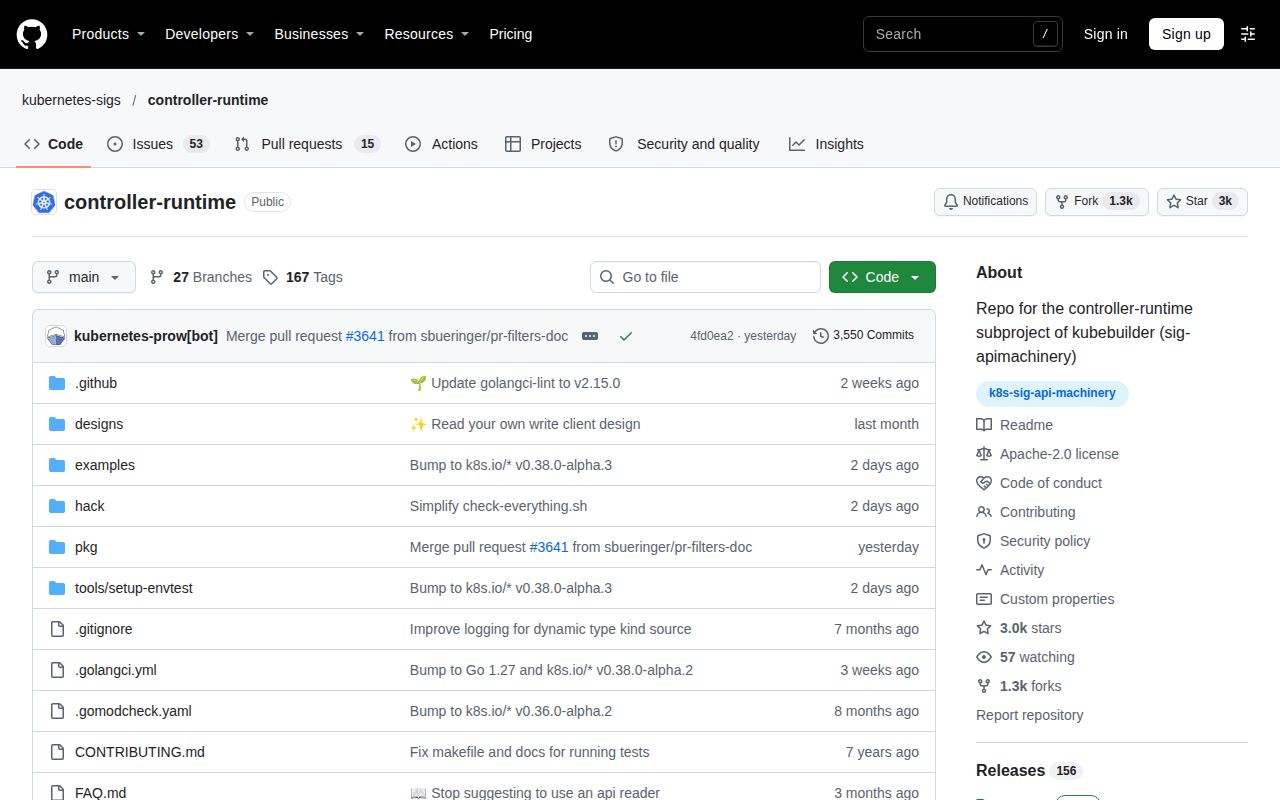
GitHub records the last push as November 5, 2026. The public activity feed also shows an issue and pull requests updated that day. Together they establish recent maintenance activity. The reported 68 open items include issues and PRs, and do not measure support speed or production adoption.
Documentation earns 4/5 on this review's scale: 1 means essential guidance is missing, 3 means a usable explanation with material omissions, and 5 means the instructions we need were independently checked. The README's compatibility matrix and FAQ's reconciliation advice support a 4 for detailed guidance that we haven't fully executed. Setup, community support quality and production maturity remain unassessed. Before adopting a dependency line, reproduce the failing command with complete output and check your own controller against the API behavior it will use.