Account switching is a clearer reason to try it than a passing web build
Watt Toolkit can switch between Steam accounts already logged in on the same PC, according to its English README. If you share a machine or keep separate accounts, that is a concrete reason to investigate it. The project also documents inventory management and local authentication tokens. Most features require an installed Steam client.
The repository is called SteamTools, and the application was formerly called Steam++. Its main README is Simplified Chinese, with a separate English version. Those names refer to the same toolkit. English readers can get an overview without translating the whole project, although the two feature lists disagree in places that affect an adoption decision.
Our recommendation is a focused trial of the account workflow you need. The available lab result covers a nested web interface, so it cannot tell you whether the desktop application handles your Steam accounts correctly.
What happened when we ran it
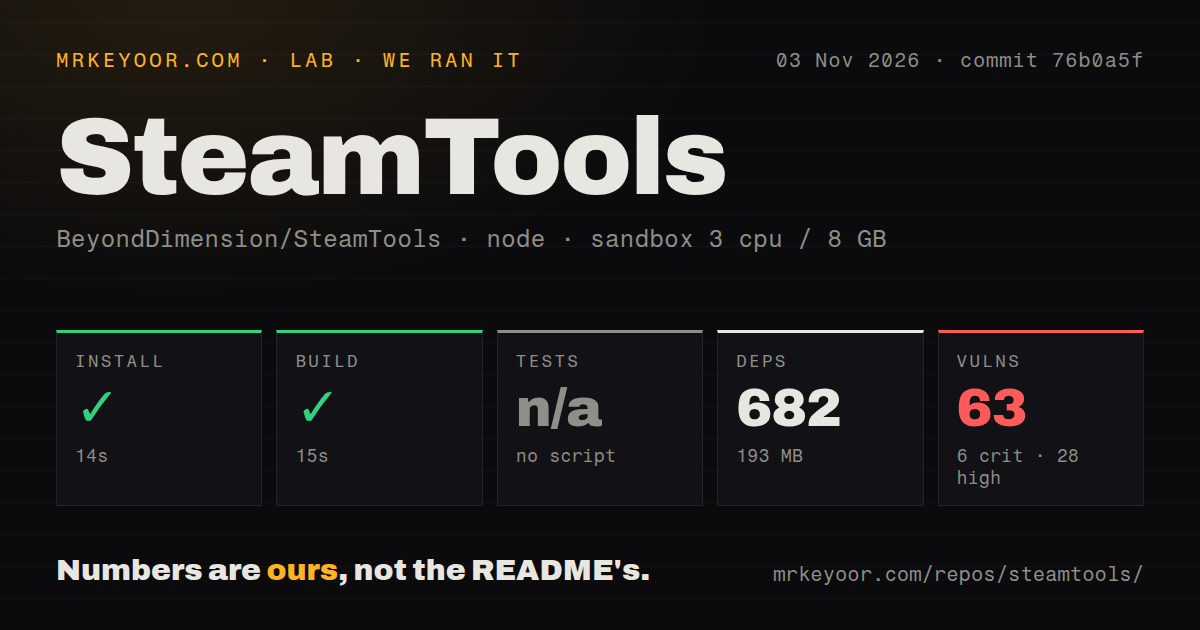
Our sandbox installed the npm project in ref/ArchiSteamFarm/ASF-ui/ in 14 seconds and built it in 15 seconds. That run used commit 76b0a5f on November 3, 2026. The configured sandbox had 3 CPUs, 8 GB RAM and image label lab-node:22. The label does not establish the actual Node or operating-system version.
The run recorded 682 dependencies occupying 193 MB. Tests were skipped because the selected project had no test script or target. This gives us a successful component build, without a passing test suite or a launched desktop client. The main repository's C# application was outside that measured build's scope.
The npm audit reported 63 known vulnerabilities: 6 critical, 28 high, 16 moderate and 13 low. These findings belong to the selected npm dependency tree. Without advisory details and an exposure assessment, we cannot say which are reachable in a released desktop application or prescribe a particular fix. They are reason to inspect that component before reusing it.
The checkout contained 11,359 files and about 1,073,652 source lines, occupying 319.2 MB. The scan found four CI workflow files, no Dockerfile and no tests directory. Those are repository-scan observations. They neither establish that upstream CI passes nor rule out checks elsewhere. None of these measurements covers network acceleration, account switching or token handling.
English documentation leaves an ASF question unresolved
The English README describes an ArchiSteamFarm integration for card farming inside the application. The Chinese README strikes through the corresponding automatic-farming section and labels a new version as under development. That disagreement makes the English feature list a poor basis for assuming the integration works in a particular download.
The 3.1.0 release notes mention a card-farming blacklist. That statement does not reconcile every integration detail across the two READMEs. If automated farming is your main requirement, confirm the installed version's behavior before choosing Watt Toolkit around it. A built ASF-ui directory does not settle the question.
Other boundaries are easier to read. The English README marks borderless game-window control as Windows-only. Its account-switching description applies to Steam accounts already logged in on the current PC. Someone expecting identical features on every listed platform, or account switching without prior local login, should stop and check those requirements first.
Local tokens deserve their own evaluation
The English README describes storing Steam authentication tokens on the computer. Moving that function onto a desktop changes which device you rely on for access. Our npm run did not examine token storage, recovery or account security, so we cannot recommend it as a verified replacement for your existing authenticator.
For an ordinary user, the README points to packaged downloads through the official site, Microsoft Store and GitHub releases. A source contributor has a different task: this is primarily a C# repository, and its development section lists desktop and mobile tooling. The nested npm installation is neither a full source-setup recipe nor a measured requirement for someone using a packaged application.
Separate tools fit narrower Steam jobs
ArchiSteamFarm describes its primary purpose as farming Steam cards across multiple accounts simultaneously. Its README says it can run without the Steam client and on machines without a desktop. Evaluate it directly when unattended farming is the job, especially while Watt Toolkit's integration documentation disagrees. We have no comparative reliability or resource-use result.
Steam ROM Manager adds non-Steam games to Steam in bulk and manages artwork assets and controller templates. Choose it for organizing emulator shortcuts or games from other stores. That is a different job from switching Steam accounts or storing authentication tokens, so the alternatives are useful by task rather than interchangeable feature lists.
A March release does not mean development stopped
The latest-release API returned version 3.1.0, published March 11, 2026. Repository metadata records a push on November 8, 2026, and the issue feed also contains November activity. That combination supports ongoing activity, without establishing response times or whether any individual report has been fixed.
Documentation receives 3/5 under our editorial scale: 1 means essential guidance is missing, 3 means useful instructions with material gaps, and 5 means detailed, consistent guidance across the assessed paths. English setup pointers and platform labels help, while the ASF disagreement prevents a higher rating. Setup ease, community support quality and application maturity remain unassessed because our component run and limited activity sample cannot support those judgments.
Start with one already logged-in Steam account and the packaged application's account-switching controls. Keep token migration as a separate decision until you've checked recovery and storage behavior on your own device.