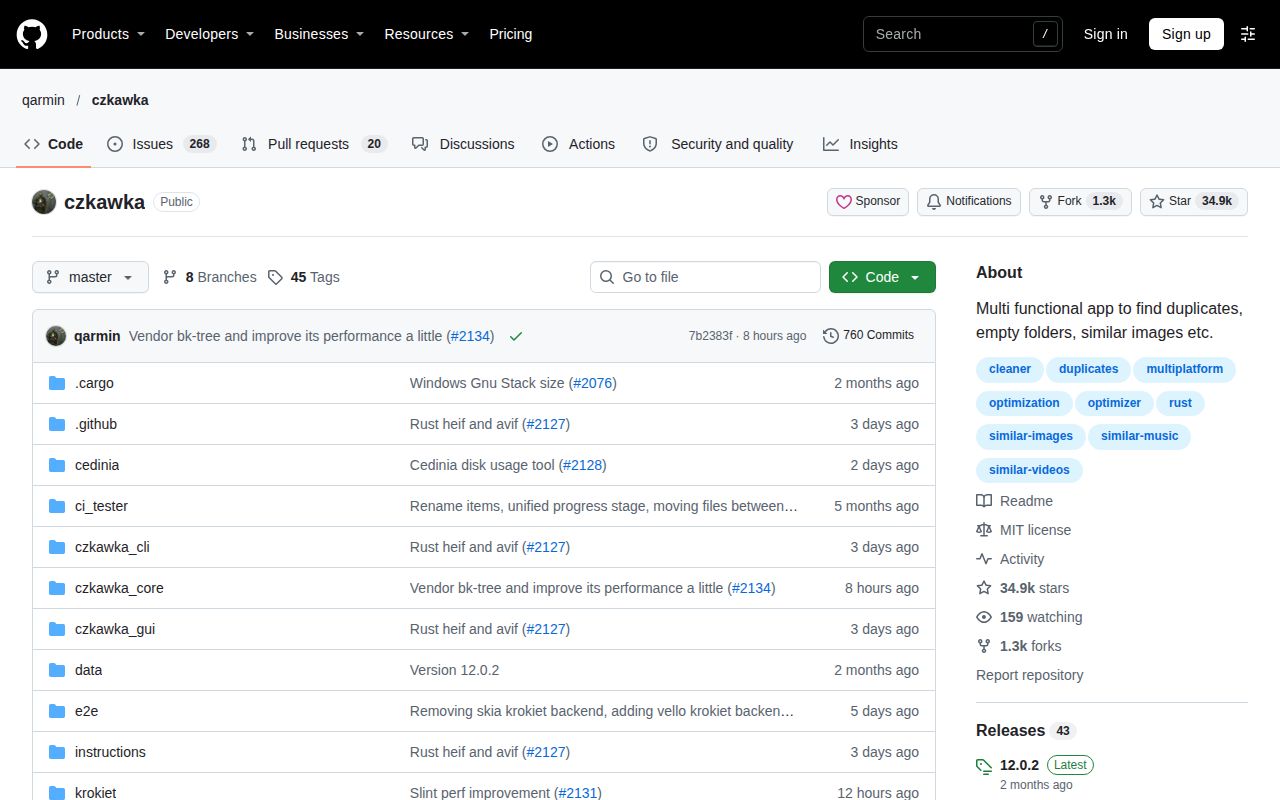
Choose Krokiet if you're arriving at Czkawka for a new desktop cleanup tool. The project's README says the older GTK frontend has reached its last release series and will receive no new binaries. The repository name survives, but choosing an interface now determines whether you're following the supported desktop path.
The Czkawka README lists duplicate detection by name, size or hash, plus similar-image searches and checks for broken files. That breadth is useful for a mixed archive: two identical backups and two resized photographs are different cleanup questions. We have no scan-quality or speed measurement here, so the feature list should guide a trial rather than settle it.
What happened when we ran it
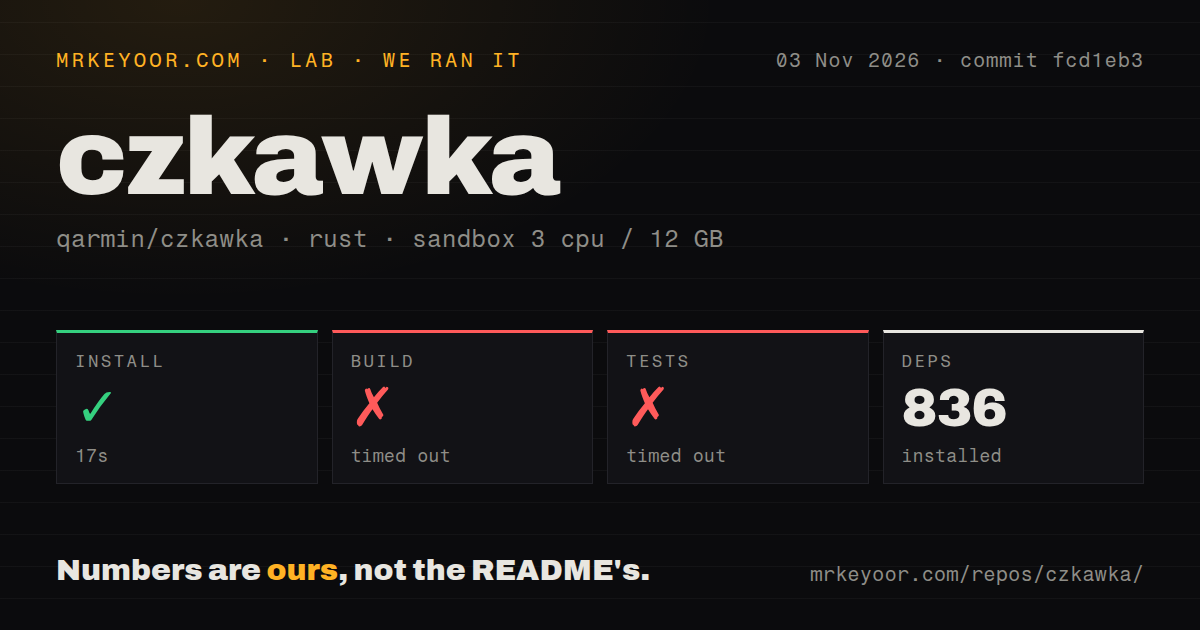
Our sandbox installed Czkawka commit fcd1eb3 in 17 seconds on November 3, 2026, recording 836 dependencies. The build timed out at 900 seconds. The test step separately timed out at 900 seconds.
The supplied test tail still shows compilation, including krokiet v12.0.2, czkawka_cli v12.0.2, gtk4 and czkawka_gui v12.0.2. It contains no completed test summary. We cannot report a pass count, call a particular test broken or infer why compilation had not finished. The time limit stopped the steps before their eventual outcomes were known.
The recorded configuration was 3 CPUs, 12 GB RAM and image lab-rust:1. That label doesn't establish the actual compiler or operating-system version. The checkout held 730 files, approximately 73,223 source lines and 11.2 MB. The repository scan found 5 CI workflow files, no Dockerfile and no tests directory. The absent directory does not establish an absence of Rust tests elsewhere in the source tree.
These results limit the source-build recommendation. They say nothing measured about scanning speed, duplicate accuracy or a downloaded Krokiet binary. Someone wanting a desktop cleanup utility should evaluate that binary route on its own merits rather than treat our capped source run as proof that the application fails to launch.
Krokiet replaces the older GTK desktop frontend
The 12.0.2 release repeats the GTK deprecation notice and identifies Krokiet as the primary, actively developed graphical application. The release also includes CLI input validation and a Krokiet option to start a scan through command-line arguments. The retirement of one frontend therefore does not mean the whole repository has stopped developing.
The repository's last push was November 6, 2026. Recent activity included pull requests about directory exclusion and hardware encoding. That combination supports ongoing work, without establishing release support quality or response times. An older release date alone would give the wrong impression here.
Cedinia is a separate Android interface using the same core. The main README says video tools aren't available there because ffmpeg is missing on Android. If your cleanup job is mostly duplicate videos on a phone, that is a reason to choose another workflow before transferring an archive or configuring a scan.
The binary route has different requirements
The Krokiet documentation lists prebuilt binaries for Windows 10/11, Mac and Linux. For Linux it specifies glibc 2.17 or newer and lists x86_64 and arm64. Those are upstream compatibility statements, not platforms verified in our sandbox.
Krokiet's README says prebuilt binaries have no mandatory runtime dependencies. Similar-video searches require ffmpeg at runtime. Decide whether video comparison is part of your job before assuming the downloaded executable covers every listed tool. Our source run neither exercised ffmpeg nor verified a renderer on a desktop display.
The project also warns that Czkawka has no official website and points users to its repository and supported distribution channels. Get the application from those links. For this trial, record the chosen asset and frontend so a later issue report identifies the actual application rather than only the umbrella repository name.
Similar images need a human keep-or-delete decision
The README distinguishes duplicates found by name, size or hash from images that look similar despite different resolution or watermarks. Use that distinction when evaluating results. A resized photograph may be expendable, while a watermarked delivery copy may serve a different purpose from its original.
Start with a copied folder containing examples you already understand. Inspect whether its results preserve the distinction you care about before removing files from the real archive. That is an evaluation recommendation, not a cleanup exercise completed by our lab. We haven't measured recovery behavior or verified that the program will always select the copy you would keep.
Redistribution deserves a separate check. The README says repository code is MIT-licensed, while the Krokiet and Cedinia applications are GPL-3.0-only because of Slint requirements. A company bundling a desktop application should read the applicable terms rather than infer a single license from the core source.
dupeGuru and fclones cover narrower choices
dupeGuru is a cross-platform graphical duplicate-file finder using Qt. Its README asks for help with platform maintenance and documentation. Evaluate the platform you need instead of assuming that switching GUI projects removes support questions.
fclones lets you inspect duplicate lists before removal and provides a dry-run option. It fits a shell workflow centered on identical files. We haven't compared either alternative's performance or accuracy with Czkawka. Choose a trial folder that exposes your actual decision: identical copies, visually similar images, or video comparisons. Then evaluate the frontend that will do that job.