tmux 3.7c keeps shell sessions alive after SSH drops
tmux 3.7c separates the terminal you see from the shell processes doing the work. One server manages sessions, each session can contain many windows, and every window can be split into panes. Detaching removes the client while the server continues running. Reattach later and the shells, editors, logs, and long commands are still there. That simple promise is why tmux remains useful on remote machines, even when a modern terminal already has local tabs.
The model also supports several clients on the same session. The manual says any number of tmux instances may connect, while a local socket carries traffic between each client and the server. This is practical for checking the same work from another terminal, and it gives integrations a process boundary they can target. Once every session is killed, the server exits. There is no account or hosted coordinator to maintain.
Ctrl-b exposes panes, windows, copy mode, and control mode
The 3.7c manual starts interactive control with Ctrl-b, followed by another key. A double quote splits the current pane top to bottom, percent splits left to right, c creates a window, and [ enters copy mode. The defaults cover pane movement, resizing, seven preset layouts, session selection, search, paste buffers, and zoom. Almost every binding can be changed, which is powerful after configuration and opaque before it.
Control mode gives programs a structured way to drive a tmux server instead of scraping a painted terminal. The command language can create sessions, target panes, run shell commands, wait for events, and format state. That is why tmux often sits underneath terminal dashboards and coding-agent managers. The tradeoff is a large interface whose primary reference is the tmux.1 manual, not a short task-based guide. Serious automation calls for reading the target and quoting rules carefully.
What happened when we ran it
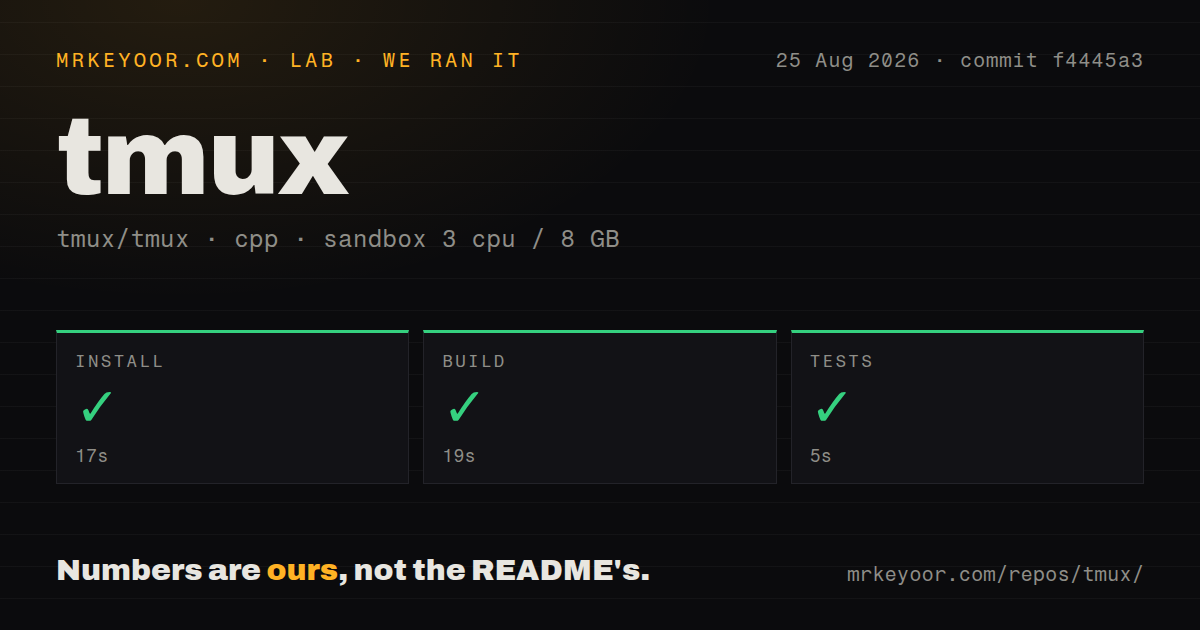
Our sandbox installed tmux in 17 seconds, built it in 19 seconds, and completed the test step successfully in 5 seconds. We used commit f4445a3 in a fresh unprivileged Debian container with 3 CPUs and 8 GB of RAM. The checkout occupied 4.9 MB and contained 543 files with roughly 132,255 source lines. Those are repository mechanics, not measurements of pane latency, memory use, or terminal rendering speed.
Our scan found 2 CI workflow files, no Dockerfile, and no tests directory. The successful test step still counts because it is the command outcome produced by the lab harness; directory names do not determine whether a project has checks. Nothing in the supplied measurement showed a failed install, compiler error, or test error. We did not benchmark interactive performance, nested sessions, clipboard paths, or behavior over a poor network connection.
A source build needs libevent 2.x and ncurses
The README names libevent 2.x, ncurses, a C compiler, make, pkg-config, and yacc or bison as build requirements. Building a release tarball is the familiar configure, make, and privileged install sequence. A checkout from version control adds autoconf and automake before autogen.sh. Optional utempter support can update login records. None of this is unusual for portable C, but it is more host preparation than the small 4.9 MB checkout suggests.
Package managers avoid most of that work, although tmux warns their packages may lag. The supported list covers OpenBSD, FreeBSD, NetBSD, Linux, macOS, and Solaris. Native Windows is absent. Terminal capability data also matters after installation: colors, keys, mouse handling, nested multiplexers, and clipboard handoff cross application boundaries. A binary appearing in PATH proves less than attaching to a session and exercising the bindings in the terminal you use daily.
Version 3.7c is active, but Unicode word selection is still literal
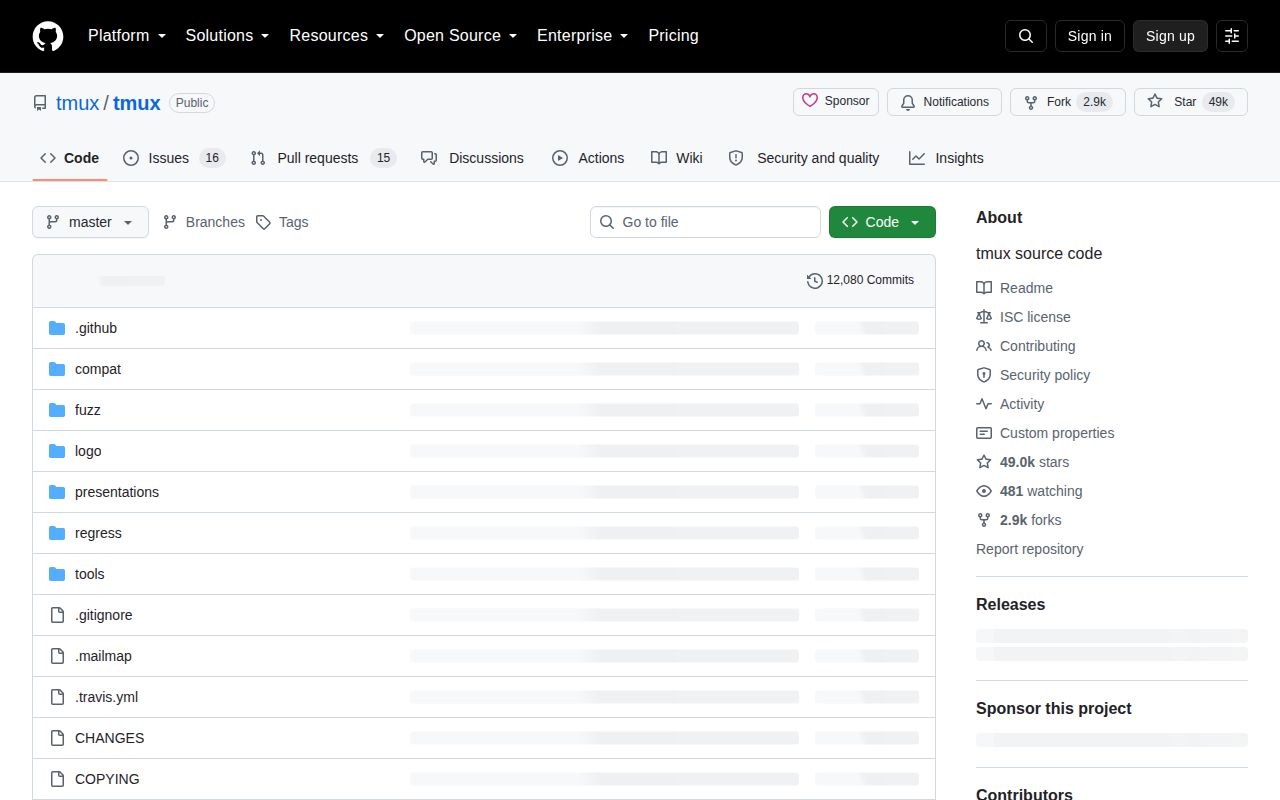
GitHub showed version 3.7c as the latest release on August 17, 2026, with 48,976 stars and 31 combined issues and pull requests when fetched. The repository was pushed on September 1, and recently updated work included merged pane-history changes plus closed reports about Sixel output and the status line. That pairing of a current push with moving issues and pull requests is stronger health evidence than the release tag alone.
Copy mode still has a specific international-text limitation. Issue 5558 explains that stable 3.7c treats word-separators as a literal character set and recognizes only tab and ordinary space in an internal whitespace rule. The report demonstrates surprising selection around no-break and ideographic spaces, then proposes opt-in Unicode-aware actions. Master has already changed Unicode whitespace handling for the next release, but the broader category-based selection request remained open when checked.
The 5-second test result makes tmux easy to trial, not easy to master
The clean 5-second test outcome removes one adoption worry: this measured checkout compiled and passed in the stated Debian sandbox. The harder cost is human. Prefix commands, target syntax, copy-mode keys, terminal options, and a long manual become part of the working environment. Existing dotfiles and plugins can make tmux feel personal, but they can also turn a teammate's terminal into unfamiliar equipment. Start with a small configuration and keep bindings visible until muscle memory forms.
Use tmux when a shell must outlive the connection that opened it, or when scripts need a stable terminal server. It earns its place on remote hosts and in keyboard-heavy development. Zellij asks less of a new user, and WezTerm can combine the emulator and multiplexer in one program. tmux is the better choice when portability, established command semantics, and integration support outweigh the learning curve.