Zed 1.16.2 is a native editor with collaboration built in
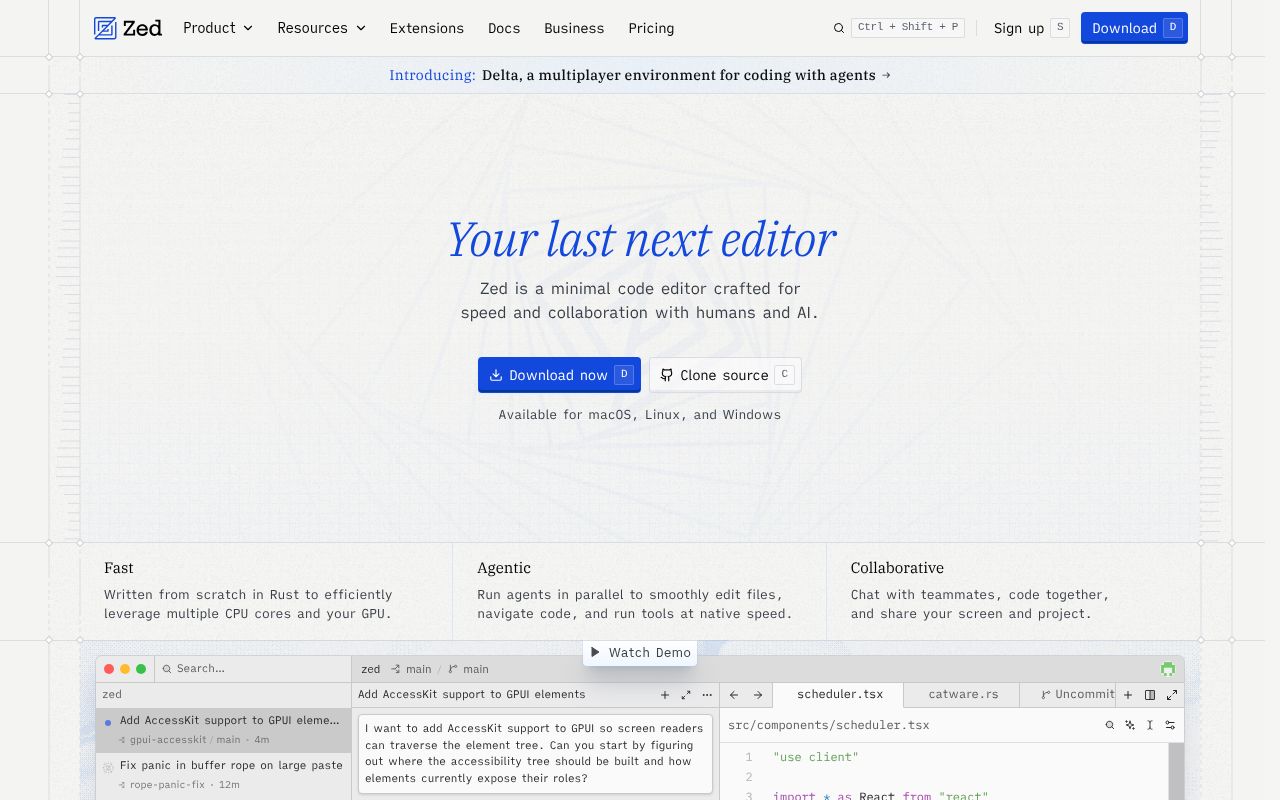
Zed 1.16.2 is available for macOS, Linux, and Windows. Its pitch is a fast native code editor with multiplayer editing, built by people associated with Atom and Tree-sitter. The source is largely Rust and includes the GPUI interface framework, editor, language integration, Git features, collaboration, extensions, and agent work. A web version is not available; the README points browser users to a tracking discussion. That platform boundary is clear and immediately rules out Chromebook-only or zero-install browser teams.
The repository had 89,202 stars and was pushed on August 25, 2026. Zed is no longer an interesting prototype with an uncertain desktop future. It has packaged downloads, platform-specific installation docs, a numbered stable release line, and a very busy public tracker. The editor's native architecture and shared editing are meaningful reasons to try it. Neither proves it will replace an existing setup whose value comes from years of extensions, remote environments, and personalized automation. Migration should follow actual workflows, not interface speed alone.
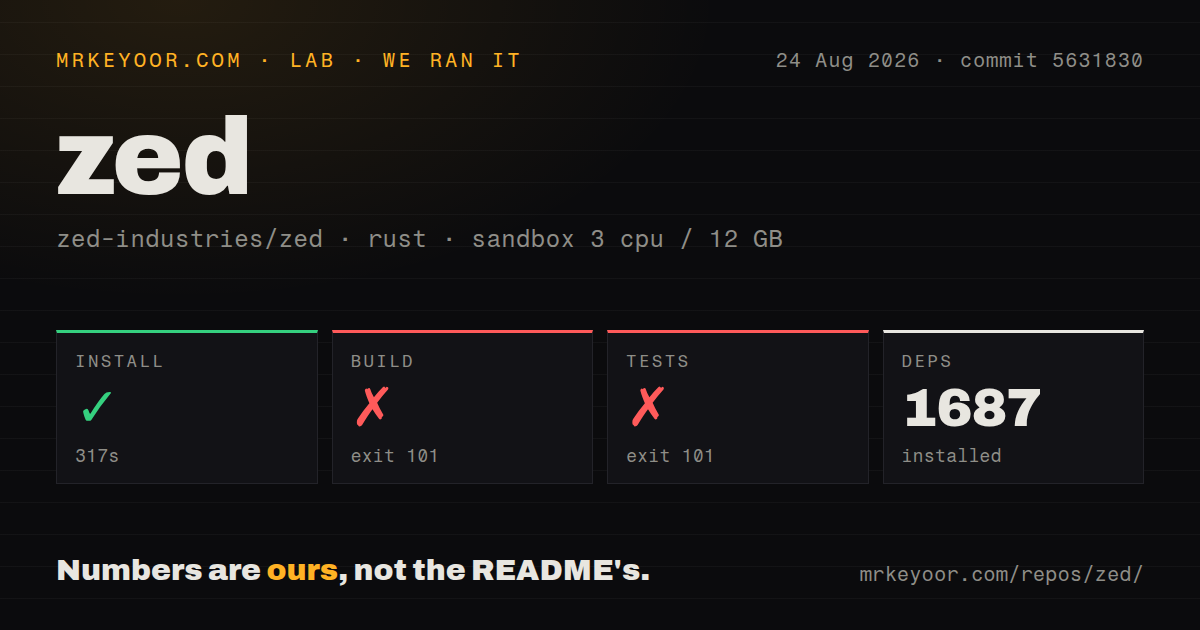
Our build failed after 844 seconds on a WebRTC download
Our sandbox cloned commit 5631830 and installed 1,687 Rust packages in 317 seconds. The build continued for 844 seconds before exiting with code 101. webrtc-sys attempted to download webrtc-linux-x64-release.zip from a Zed Industries GitHub release, the HTTP operation timed out, and its build script panicked after unwrapping that error. The log establishes a failed network fetch. It does not show that the Rust source or our system packages caused the failure.
The test attempt reached the same dependency and failed with exit 101 after 271 seconds. Its final lines again show an HTTP timeout while downloading WebRTC, followed by the build-script panic. There were no summary lines, so no passed or failed test count can be reported. A contributor starting from a fresh environment needs more than Cargo registry access: this dependency path also relies on a separate release asset being reachable during compilation. Pinning the source commit alone did not make our run self-contained.
A 1,595,777-line workspace makes published binaries the easy route
Our checkout contained 4,000 files, about 1,595,777 source lines, and occupied 82 MB before the installed Rust dependencies. The repository has 46 GitHub Actions workflows and a compose file, but no Dockerfile and no top-level tests directory. macOS, Linux, and Windows each have their own development guide. That division is appropriate for a native graphical application whose windowing, GPU, font, credential, and packaging behavior varies by operating system. It also means a generic Linux container is a limited representation of contributor setup.
Users can bypass this work through Zed's downloads or listed package-manager routes. That is the path we would choose for evaluation. Compile from source when changing the editor, auditing a patch, or developing GPUI itself, and budget for a large workspace plus external artifacts. The source is primarily GPL-3.0-or-later, with Apache-2.0 components where files say so. Anyone embedding code into another product should map those boundaries before assuming the whole tree has one permissive license.
WSL agents and Git history still have concrete gaps
Issue #48754 was updated on August 25 and is labeled as affecting many users: external agents including Claude Code, Codex, and Gemini CLI shut down unexpectedly when started from WSL. That is a serious exception for Windows developers whose code and command-line tools live in Linux. Another current report says custom OpenAI-compatible agent configuration misses parameters, and issue #62147 describes accept and reject controls that do nothing for some agent-produced diffs. Teams adopting Zed for AI work should replay their provider and review flow end to end.
Git behavior also deserves targeted checks. Issue #62863 reports that branch comparison can show 'No changes' when Git encounters multiple merge bases, swallowing the command failure. Issue #62757 says Go to Definition does nothing in historical commit tabs even though it works in the working tree. These are narrower than ordinary editing, but both can mislead a developer inspecting history. Zed's breadth is growing quickly enough that the edge cases now live in integrated workflows, not only in basic text rendering.
Same-day issue traffic supports the active release pace
Release 1.16.2 was published on August 24, 2026, one day before the source and issue activity we inspected. Its fixes included a potential extension filesystem sandbox escape, GitHub Enterprise Copilot Chat authentication, old extension language-server settings, and Flatpak command arguments. GitHub displayed 3,258 open issues and pull requests. That combined count is large, but same-day triage, reproducible labels, severity labels, and a current patch release show an operating project rather than an abandoned queue.
Our failed 844-second build prevents a clean recommendation for casual source contributors. It does not erase the case for using the released editor. Install Zed beside your current tool, open a representative project, test collaboration, language services, Git history, and whichever agent runs your code. Visual Studio Code remains safer when extension compatibility or browser and remote workflows dominate. Zed is the more interesting choice when a native interface and built-in collaboration are worth accepting a younger set of integrations.