Neovim turns Vim into an API-driven editor
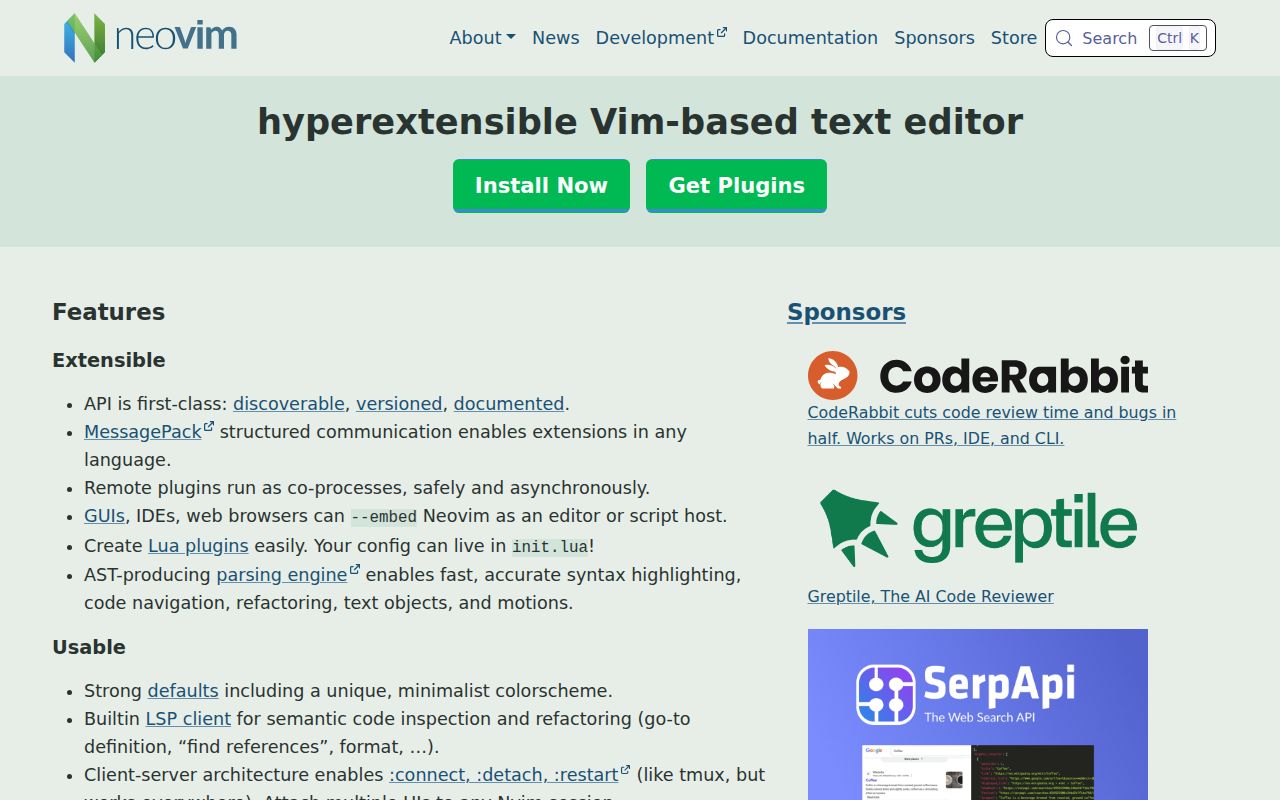
Neovim keeps Vim's modal editing model, then changes the machinery around it. The core supports asynchronous jobs, an embedded terminal, shared data between editor instances, and APIs that clients in languages from C to JavaScript can call. That makes Neovim useful as both a terminal editor and an engine for separate graphical interfaces. Most Vim plugins remain compatible, so switching does not require abandoning every familiar command or extension.
The repository also makes clear that this is an editor platform, not a completed IDE profile. Its 3,872 files and roughly 379,939 source lines include the C core, Vimscript runtime, Lua subsystem, RPC layer, terminal UI, generated code, documentation, and tests. You choose the language server, completion engine, file browser, debugger integration, colors, and mappings. That freedom is the attraction, but it also makes the quality of a Neovim setup partly your responsibility.
Lua and RPC give extension authors a clean target
Lua configuration is the practical reason many Vim users move. It lets plugin authors work against Neovim's APIs without forcing every feature through Vimscript. Remote clients can use the same API from C++, C#, Go, Java, JavaScript, Python, Ruby, and other documented languages. Modern GUIs can sit outside the core, while terminal users keep a compact editing process that works over SSH.
That architecture has a cost: a working editor configuration becomes a small software project. The 60.5 MB checkout is only the base. Plugins may bring their own Lua modules, parsers, language servers, formatters, or provider packages, none of which our lab measured. Neovim offers :checkhealth to expose missing providers and configuration problems, but it does not choose a coherent toolchain for you. Teams sharing a setup should pin plugin revisions and test upgrades together.
What happened when we ran it
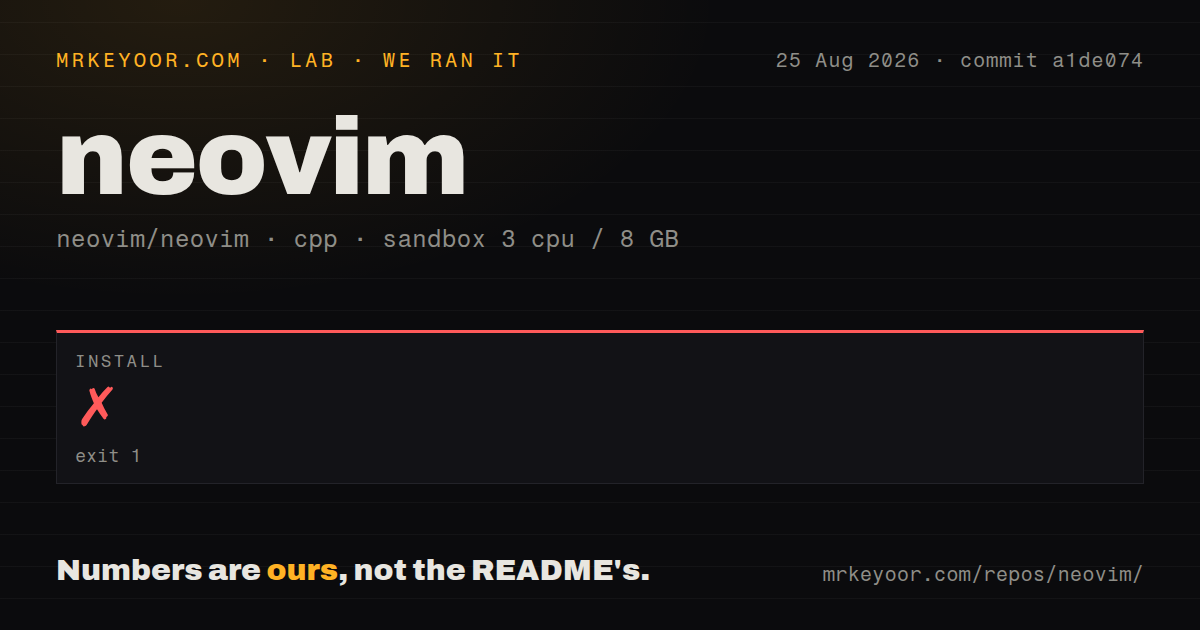
Our source install at commit a1de074 failed after 1 second in a fresh Debian container with 3 CPUs and 8 GB of RAM. CMake selected a Release build and found GNU Make at /usr/bin/gmake, then stopped during configuration. The log's specific error was that it could not find a Lua 5.1-compatible interpreter. No build or test stage ran after that failure.
This result does not show that Neovim cannot build on Debian. It shows that the source checkout did not turn into a working editor in our bare lab-cpp:1 image without more prerequisite work. The repository had 24 CI workflow files and a tests directory, but no Dockerfile that would define a matching development image. The build guide says to install prerequisites first and says bundled dependencies can then be downloaded into .deps.
Official packages avoid the source-build trap
The release route is much easier than the lab path. Neovim publishes archives for Windows, macOS, Linux x86_64, and Linux arm64, along with Windows installers and Linux AppImages. Homebrew and major Linux distributions also package it. No account, API credential, database, or background service is required. Downloading a binary and putting nvim on the path is enough to open the editor.
Platform constraints are documented rather than hidden. Windows support starts at version 8, the macOS archives require 10.15 or newer, and Linux AppImages may need FUSE. They can be extracted when FUSE is absent. The install guide warns that an AppImage may fail on a distribution more than 4 years old, while the release notes point users with older glibc to unsupported builds. Source builders face CMake, a compiler toolchain, Lua requirements, and platform-specific instructions.
Active releases reduce risk, but upgrades demand attention
The repository was pushed on August 26, 2026, and release v0.12.5 was published on August 23. GitHub listed 1,868 open issues and pull requests together, a large queue that fits a project of this size but should not be mislabeled as 1,868 confirmed defects. Recently updated issues covered the message interface, multicursor events, LSP handling of dollar signs in URIs, terminal persistence, and display behavior.
Maintenance signals are unusually strong: 24 workflow files, current commits, current releases, and detailed build instructions. The warning about breaking changes still deserves respect. A heavily customized configuration depends on plugin APIs, editor behavior, parsers, and external language tools. Read :help news, pin the editor version used in team images, and trial plugin updates before replacing a known-good setup. The official packages make rollback easier than a hand-built installation under /usr/local.
Choose Neovim when configuration is part of the product
Neovim v0.12.5 is a sensible choice for an experienced Vim user who wants better extension APIs, Lua, asynchronous work, and optional graphical clients. Its editor core is mature and actively maintained. The trade is ownership: Neovim supplies the mechanism, while you assemble the IDE experience and keep it working. That can produce an editor fitted closely to one developer's habits, or a shared configuration that a team can inspect like any other codebase.
Our 1-second failure is the reason to separate trying Neovim from developing Neovim. Most users should install the release package, run :checkhealth, add only the plugins they can support, and learn the built-in help before copying a large public configuration. Build contributors should follow the prerequisite list and expect CMake caches, bundled dependencies, test tooling, and platform details. Pick Helix for stronger defaults, Vim for widest server availability, or Emacs when editor programmability matters more than Vim compatibility.