Code OSS and Visual Studio Code have 2 licenses
The repository is Code OSS, the MIT-licensed source from which Microsoft develops Visual Studio Code. Microsoft's downloadable product adds branding and other customizations and ships under Microsoft's product license. That distinction matters for anyone planning a fork or redistribution. Cloning this tree does not recreate every service and commercial integration users associate with the official download, even though the editor's main code is developed here.
Code OSS is also much broader than a text editor component. The tree includes the workbench, Electron desktop host, browser build, terminals, debugging infrastructure, extension host, language support, remote-development machinery, and bundled extensions. Several related pieces live in separate repositories. A contributor must first locate the owning component and reproduce an issue without third-party extensions, because many apparent editor defects belong to an extension or another project.
A full container starts at 4 cores and 6 GB
Microsoft's contribution guide requires Node, Python for node-gyp, and a native C or C++ toolchain. Linux adds X11, keyboard, secret-storage, and Kerberos development headers. The provided Dev Container or Codespace should have at least 4 cores and 6 GB of RAM, with 8 GB recommended. The guide also warns against source paths containing spaces because native modules may fail to compile.
The .nvmrc file we fetched specified Node 24.18.0, while the general prerequisite says Node 22 or newer and tells contributors to follow the more precise file. That file can change with the repository. Using fnm use or another version manager before npm install is part of setup, not cleanup after a mysterious native failure. Platform compilers and Python must match node-gyp's own support rules as well.
What happened when we ran it
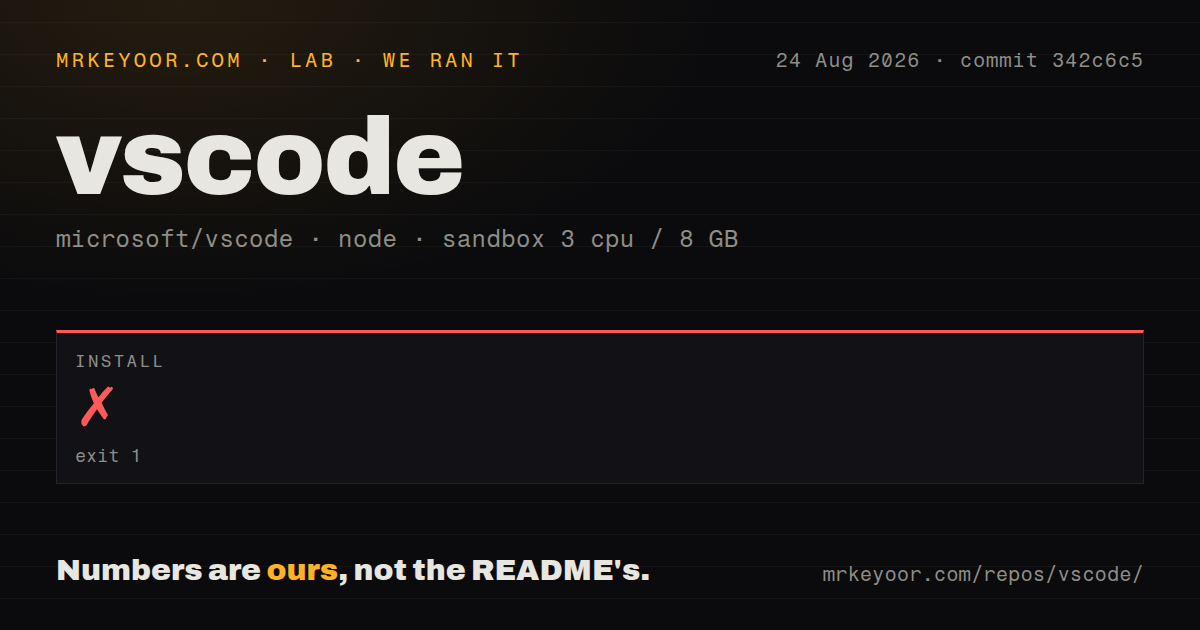
Our sandbox cloned commit 342c6c5 into an unprivileged environment with 3 CPUs and 8 GB of RAM. The checkout occupied 254.5 MB and contained 18,132 files with about 3,811,392 lines of source. The npm install ran for 505 seconds and then exited 1. Because installation failed, our harness did not proceed to a build or test command.
The final log lines show node-gyp rebuilding native-keymap 3.3.9. They report Node v24.19.0, node-gyp v12.4.0, Linux, and a failure in the module's directory. The provided tail does not include the earlier compiler diagnostic that triggered node-gyp's exit, so we cannot name the missing header, tool, or compatibility problem. The honest finding is a failed native dependency build after more than 8 minutes.
The repository has 15 CI workflow files, no top-level Dockerfile detected by the lab, and a tests directory. The README separately offers a development-container setup, which is a more deliberate environment than our generic Node image. Those project signals do not convert the failed install into a pass. They show where a contributor should go next: reproduce with the documented container or exact host prerequisites.
The development loop is a watch build
After npm install, contributors run npm run watch or the editor's build task and wait for the initial compilation to finish. A development desktop instance then launches from scripts on macOS, Linux, or Windows; separate scripts start the web and code-server forms. Unit tests use the platform test script, while smoke, UI, extension, lint, and remote tests have their own instructions. This is a product workbench with several execution targets, not one library test command.
Code OSS builds also lack access to the Visual Studio Marketplace. The guide advises side-loading VSIX files or obtaining extension builds from their authors. That is a practical limitation for internal distributions because extension installation is part of the product experience. VSCodium may save substantial packaging and service-configuration work if your goal is simply a community-built editor without Microsoft's branding.
Release 1.134.0 landed 6 days before our review
GitHub release 1.134.0 was published on August 19, 2026. The repository's last push was August 25, and GitHub showed 189,601 stars plus 20,110 open issues and pull requests combined. Same-day activity covered editor UI, agent sessions, terminals, Python environment activation, and managed settings. The queue is enormous, but current pushes and monthly releases show active processing rather than a dormant backlog.
The issue workflow is unusually structured for a public project: reports ask for versions, operating systems, extensions, reproducible steps, and console errors, while automation closes stale information requests and locks old closed threads. That process and the detailed build guide make contribution possible at this scale. Still, Code OSS is best approached for a specific component change. If you only want an editor, compiling Electron and native modules is the wrong purchase.