Follow the explanation with a kernel revision open
A kernel explanation becomes useful when you can find the code it describes. linux-insides walks you toward that code, but its README also marks most chapters as waiting for review. For someone studying Linux internals, keeping the chapter and a selected kernel revision together is part of using the book well.
The README identifies the project as a book-in-progress and lists C proficiency and prior assembly knowledge as requirements. This is an English reading resource, even though our lab detected a Python project in its repository. Treating its package metadata as the product description would send a learner in the wrong direction.
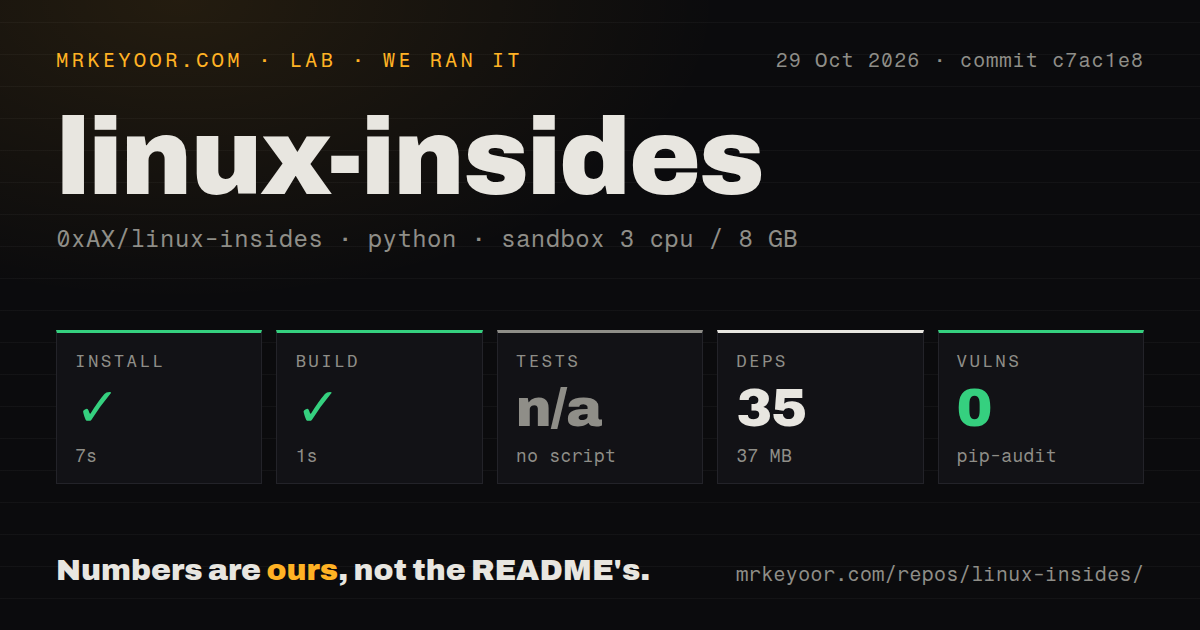
What happened when we ran it
Our October 29, 2026 linux-insides run installed in 7 seconds and built successfully in 1 second at commit c7ac1e8. The install recorded 35 dependencies and 37 MB on disk. Tests were skipped because the lab found no test script or target. That is a successful recorded build step, without a passing-test count or proof that chapter examples work.
The checkout contained 165 files, approximately 239 source lines and 11.8 MB. The scan detected 5 CI workflow files and a Dockerfile, with no tests directory. Those observations describe repository tooling. They don't measure the quality of a paragraph explaining memory addressing, nor do the recorded source lines measure how much teaching material the book contains.
pip-audit reported 0 known vulnerabilities. That result concerns the recorded environment and audit, without establishing a vulnerability-free project. It also says nothing about whether a linked kernel function still behaves as a chapter describes. A dependency audit and technical editing answer different questions.
The configured sandbox had 3 CPUs, 8 GB RAM and image label ghcr.io/astral-sh/uv:python3.12-bookworm. Actual runtime and operating-system versions require the raw toolchain logs. We have no kernel boot, code-example execution or learning-outcome measurement from this run. Reading the linked online edition does not require recreating this environment.
The boot chapter gives concepts room before showing code
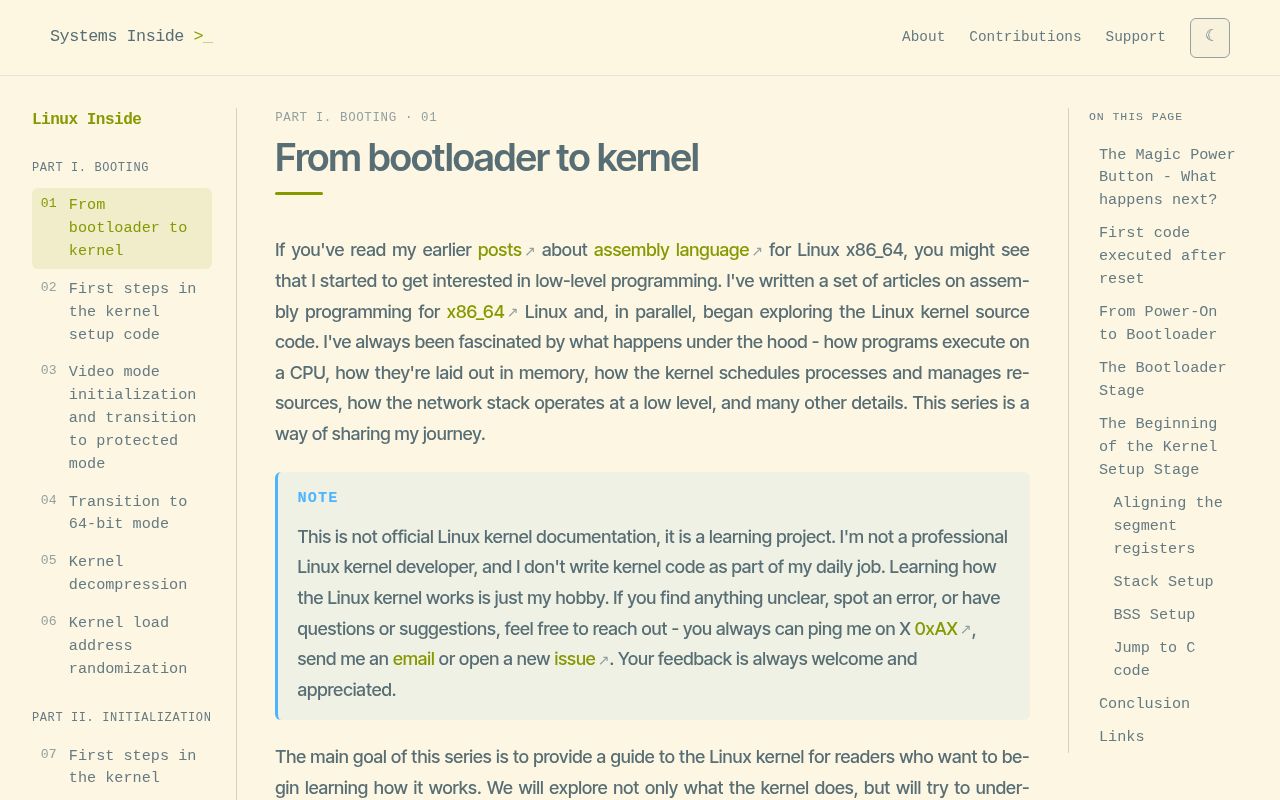
The opening boot chapter explains real-mode memory addressing before moving into the reset vector and firmware entry. It uses an address calculation to show how a segment and offset combine, then points to coreboot assembly and a linker script. The teaching choice is useful: an unfamiliar register gets an explanation before the source listing asks you to interpret it.
That is the reason I would try this book as a source-reading companion. You can stop at a named mechanism, inspect the linked implementation and return to the explanation. Our research sampled this chapter, not every argument across the book, so its readable progression cannot stand in for a technical audit of all chapters.
The same introduction explicitly says the series is a learning project and is not official kernel documentation. It recommends a Linux distribution for readers who want to experiment. If assembly syntax or C pointers already stop your reading, work on those prerequisites first. The author links an assembly series, but this review did not evaluate that separate material.
Chapter status matters more than the latest version label
The current README marks booting as updated while initialization, interrupts, system calls and memory management remain pending review. Several other chapters carry that status too. A reader interested in a specific subsystem should inspect its status before treating the whole book as equally current.
There is also a useful warning in the sampled pages themselves: the README's chapter-status heading and the boot introduction refer to different kernel-version targets. Those labels describe the author's stated revision work. They do not establish that every code reference has been checked against one matching tree. Before relying on a mechanism, record the chapter revision and find the corresponding implementation in the kernel source you chose.
GitHub reported the last push as October 26, 2026. Its recent activity feed included closed pull requests about boot-page explanations and upstream line ranges, as well as dependency tooling. That combination shows ongoing maintenance rather than grounds to declare the book abandoned. It does not prove all older explanations have been corrected or measure how quickly a new reader's question will receive an answer.
Official Linux material and xv6 answer different learning needs
The Linux kernel repository points readers toward subsystem documentation and contribution guidance. Use that tree when the question is what the actual Linux implementation does at a particular revision. linux-insides can supply an explanatory route into it, while the implementation remains what you need to inspect for version-specific behavior.
xv6 for RISC-V is a teaching operating system derived from Unix Version 6. Its README says simplification and clarification take priority over new features. Pick it when a teaching implementation is the goal. Its RISC-V focus also makes it a different architectural exercise from the x86 material sampled here. We did not run either alternative as part of this review.
The README warns that translations may diverge from the original. If you switch language editions, check their revision status separately. An English chapter's correction does not establish that a translated passage contains the same change.
The documentation rating uses a visible editorial scale: 1 means no navigable entry, 2 missing prerequisites or scope, 3 a useful documented path with material revision gaps, 4 consistent current coverage across sampled topics, and 5 independent verification across the book. linux-insides earns 3 because its prerequisites and revision gaps are explicit. The other dimensions remain unassessed.
Start with the boot chapter and keep notes on the symbols and source revision you follow. When an explanation and your tree disagree, stop at that mismatch and resolve it before carrying the assumption into the next chapter.