
One command takes ownership of most local web tooling
Vite+ puts Node management, package installation, development, static checks, tests, builds, library packaging, and monorepo task execution behind vp. Underneath, it combines Vite, Vitest, Oxlint, Oxfmt, Rolldown, tsdown, and Vite Task. A project can keep their settings in one vite.config.ts, including test patterns, lint ignores, formatting choices, cached tasks, and staged-file commands. The appeal is fewer tool-specific entry points and a shared set of defaults.
That convenience also concentrates change. Release v0.3.0 bundles Vite 8.2.2, Vitest 4.1.11, Rolldown 1.2.5, Oxlint 1.79.0, and Oxfmt 0.64.0. The README tells manual adopters to alias vite to Vite+'s core package and pin Vitest to the version reported by vp toolchain. If one project needs a newer test runner or an older formatter, the unified version policy becomes work rather than relief.
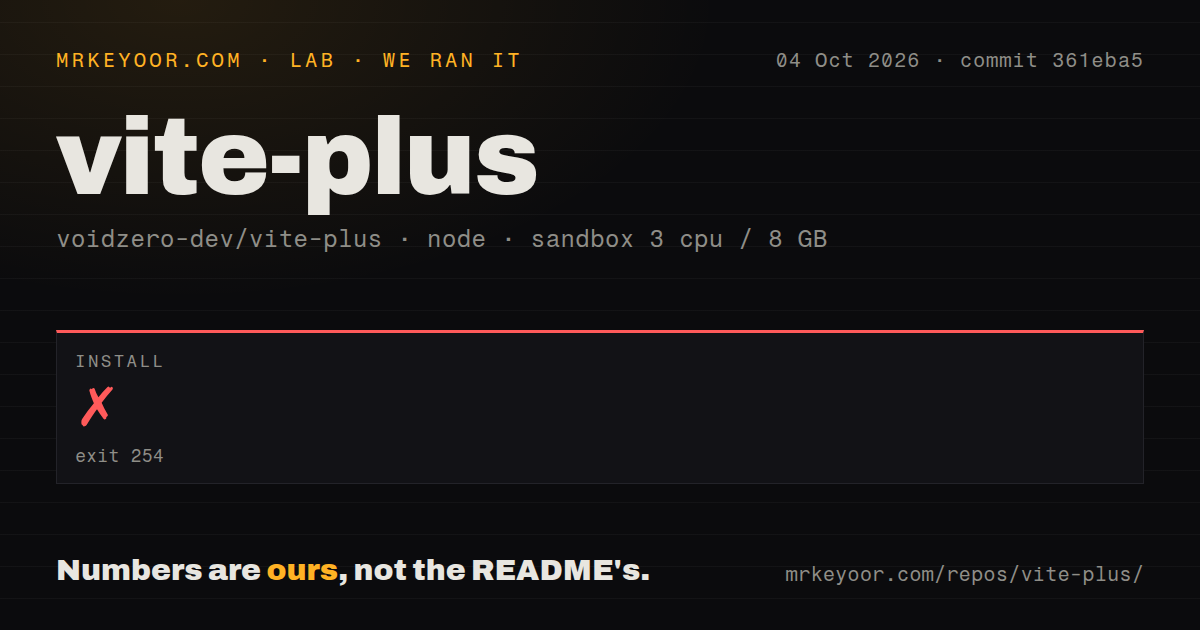
The source checkout could not finish its 16-second install
Our sandbox cloned commit 3380eb8 and ran pnpm across its 5 workspace projects. The lockfile passed the repository's supply-chain policy check. Installation then exited 254 after 16 seconds because pnpm could not open /work/repo/vite/patches/chokidar@3.6.0.patch. The log gives no further cause, so we cannot say whether the file was omitted, generated elsewhere, or expected from another checkout step.
The install failure prevented a build and test run. There are therefore no build timings, test counts, or passing-suite claims for this commit. The checkout contained 3,420 files, about 151,123 source lines, and 14.3 MB. Our scan found 24 CI workflow files and pnpm workspaces, but no Dockerfile or root tests directory. A busy CI setup does not turn this failed fresh install into a passing result.
Released binaries avoid the checkout path we hit
The README's ordinary install uses a shell script on Linux or macOS and PowerShell on Windows to place the global vp command. Once inside a project, Vite+ detects pnpm, npm, Yarn, or Bun from the package metadata and lockfile. vp create scaffolds work, vp migrate combines supported configuration, and setup-vp installs an exact release in GitHub Actions. Those paths consume published artifacts rather than asking every user to build this Rust and Node monorepo.
Version 0.3.0 changes where those artifacts live. Fresh Unix installs follow XDG directories, while Windows uses LocalAppData and AppData. Existing ~/.vite-plus installations stay in place, and VP_HOME keeps the old single-root layout. The release notes warn that vp implode removes every managed Node runtime, global package, config file, and cache. Treat that command as destructive and review hard-coded paths before reinstalling.
The migration merges configuration and changes dependency resolution
vp migrate can absorb supported Oxlint, Oxfmt, lint-staged, and tsup setup into the Vite+ arrangement. A tsup project moves toward vp pack and tsdown configuration. This is more invasive than renaming scripts. Overrides make dependencies resolve Vite through @voidzero-dev/vite-plus-core, and Vitest must match the copy bundled with the CLI to avoid separate mock and runner state.
Run migration on a branch and inspect every changed file. The 2026 Q3 plan still lists migration gaps for Vite 7, Vitest 3, Jest, Turborepo, Nx, Biome, and some monorepo layouts. Those unchecked items are stated goals, not shipped compatibility. Existing Vite projects with several plugins should prove dev, production build, preview, tests, and editor behavior before removing their old configuration.
Local task caching exists, while remote caching remains future work
vp run understands package dependencies and can cache task outputs locally. Configuration can name commands, environment variables, inputs, and outputs, letting the runner replay work when its fingerprint matches. This folds a monorepo concern into the same command used for one application. The Q3 issue says local caching is complete but lists remote caching and GitHub Actions cache support as work to add.
That distinction matters for CI. A developer may see quick local replays while every hosted job still starts without the desired shared cache. One open report also describes mode-dependent output patterns that repeatedly miss the cache under v0.2.9, though the reporter had not yet supplied the promised reproduction repository. Measure hit behavior with your real tasks and treat cache correctness as part of migration, not a bonus discovered later.
The 1.0 issue is an explicit warning about current stability
GitHub recorded 5,692 stars, 164 combined issues and pull requests, and a last push on August 29, 2026. Release v0.3.0 landed five days earlier. That is active development, and the detailed release notes are useful. It is also pre-1.0 development: issue 2405 says the team wants command names, flags, config keys, and generated-file locations to become stable with 1.0.
The same issue lists changes intended before that promise, including package-manager behavior, cache-directory lookup, binary conflicts, and IDE support. It places an MCP server outside Q3 and ties deployment to a separate Vite RFC. Vite+ has a coherent destination, but our missing-patch install shows why current adopters should pin versions and keep a rollback path. For most production teams, the released CLI deserves a contained trial before it deserves the whole toolchain.