
Nx pays off when scripts become a graph
Nx turns a workspace full of package scripts into a model of projects, targets, inputs, outputs, and dependencies. It can then cache completed work and run only tasks affected by a change. That is a practical improvement once a repository contains several applications and shared libraries. Developers keep familiar tools such as Vite, Webpack, Jest, or Vitest, while Nx decides which command needs to run and in what order.
The project also reaches beyond JavaScript. Its plugin list includes Gradle, Maven, .NET, and Go, and the implementation mixes TypeScript with performance-sensitive Rust. That breadth explains both its appeal and its weight. Our checkout at commit 9064aa9 contained 10,541 files and about 1,127,026 lines of source. Nx can coordinate a mixed company repository, but teams must maintain the project model and plugin versions that make that coordination accurate.
Existing workspaces can adopt it incrementally
The README recommends npx nx init for an npm, pnpm, or Yarn workspace. Nx can discover package scripts and begin caching their outputs without forcing a full repository conversion. A useful trial starts with one expensive, deterministic task: declare its inputs and outputs, then compare local and CI behavior. A migration that begins with every plugin and generator at once makes it difficult to tell which layer helped.
Release 23.1.2 arrived on August 26, 2026, with fixes across Angular, core graph handling, pnpm and Bun lockfiles, daemon security, Gradle, Maven, .NET, Expo, Next.js, and other plugins. That breadth also marks the upgrade surface. An Nx version can interact with your package manager, TypeScript, test runner, framework plugin, and CI configuration. Pin versions and use the supplied migrations instead of treating the CLI as an isolated development dependency.
What happened when we ran it
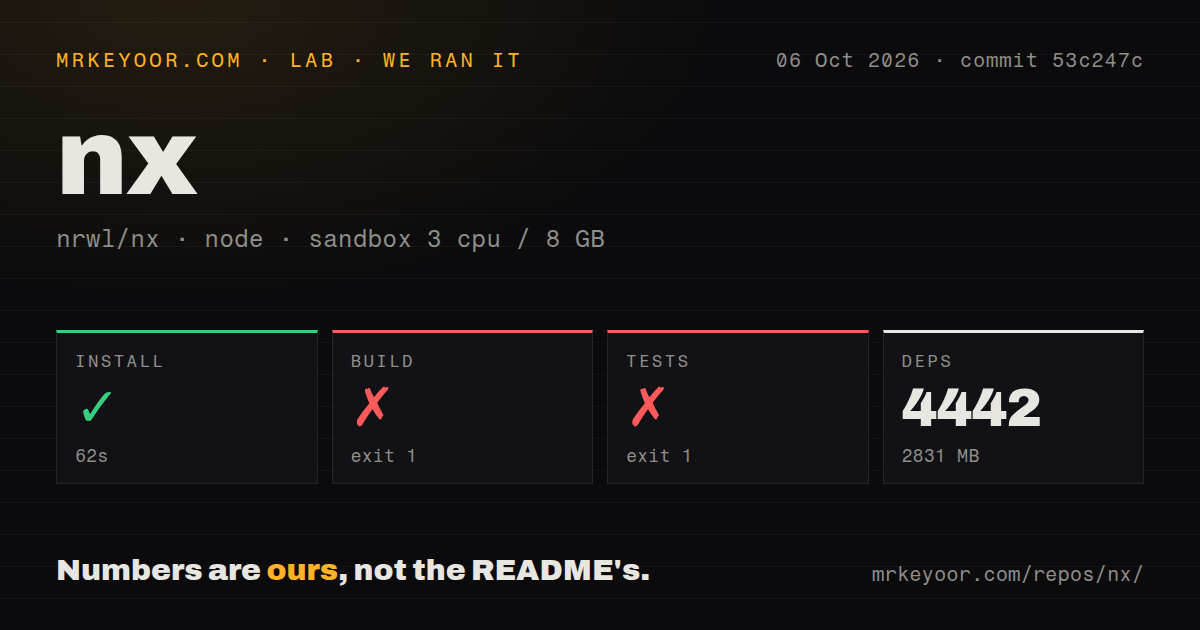
Our pnpm install succeeded in 89 seconds and pulled 4,313 packages, which occupied 3,120 MB on disk. The build ran for 119 seconds before Nx failed to process its project graph. The log first reported that the MSBuild analyzer could not run because spawning dotnet returned ENOENT, then the lifecycle command exited with status 1. We did not get a completed build from this environment.
The test command reached the same boundary after 40 seconds. It invoked nx run-many -t test, then project-graph processing failed because the MSBuild analyzer could not spawn dotnet. The suite did not produce a trustworthy passed or failed test count, so we are not turning a graph-construction failure into a claim about code quality. Both failures show that the Nx repository itself expects system tooling beyond Node 22 and pnpm.
Caching needs correct boundaries to be trustworthy
Nx's local value comes from remembering task output and calculating affected projects. A cache hit is only safe when the declared inputs include everything that can change the result, and outputs identify what can be restored. Generated files, environment-dependent configuration, and hidden external inputs can make a fast cache misleading. Teams should begin with tasks whose behavior they understand, inspect the graph, and keep nondeterministic work out of the cache until its inputs are explicit.
Nx Cloud adds remote caching, task distribution, automatic end-to-end test splitting, flaky-task handling, and a self-healing CI feature described in the README. These can reduce repeated CI work across machines, but they introduce a service decision alongside the open-source tool. Decide what data and artifacts may be stored remotely, how access is controlled, and whether the paid service remains acceptable at your build volume. The local CLI is useful without buying the entire hosted layer.
Plugin coverage is both strength and maintenance cost
Framework-aware plugins can discover tasks, set cache defaults, scaffold code, and understand project relationships better than a generic script runner. This helps in a large React, Angular, or mixed frontend repository. The same knowledge couples the workspace to plugin migrations and each framework's release cadence. A team needs an owner for upgrades and graph correctness, especially when generators modify shared configuration.
GitHub showed 471 open issues and pull requests on August 27, 2026, split into 296 issues and 175 pull requests by search. The number is a combined work queue, not a defect total. The repository was pushed on the same day. Search that queue for your exact plugin combination before a major migration because Nx's behavior depends heavily on the tools it is coordinating.
Pick Nx after the repository has earned it
Nx fits when slow CI, repeated work, and unclear project relationships are already observable problems. Its incremental adoption path lets a team prove value without rebuilding the repository. Polyglot support and framework-aware generators distinguish it from a thin task runner, while established migration tooling makes continued use plausible.
Turborepo is easier to explain when a JavaScript workspace mainly needs task caching. Bazel gives cross-language builds stricter, lower-level rules but asks for more explicit configuration. Rush fits organizations focused on dependency policy and package publishing. Nx occupies the middle: more workspace knowledge than a script cache, and more JavaScript ergonomics than a general build system. Our failed source run should not deter application users, but it should reset expectations for anyone planning to contribute upstream.