Vite makes the development server the center of frontend work
Vite has two main jobs. During development, it serves native modules and updates changed code through hot module replacement. For production, it runs a configured Rolldown build that emits deployable assets. The same project can add framework behavior through plugins and call Vite through typed JavaScript APIs. This is a smaller mental model than managing separate development, transformation, and bundling systems.
That central position means Vite is more consequential than its short configuration file suggests. Every developer starts it, tests often launch it, and production output passes through it. Our checkout at commit 2e8355d contained 2,793 files, about 108,886 source lines, and 17.5 MB. It is a maintained monorepo, not a thin command wrapper around one compiler.
A 17-second build passed, while the full test command did not
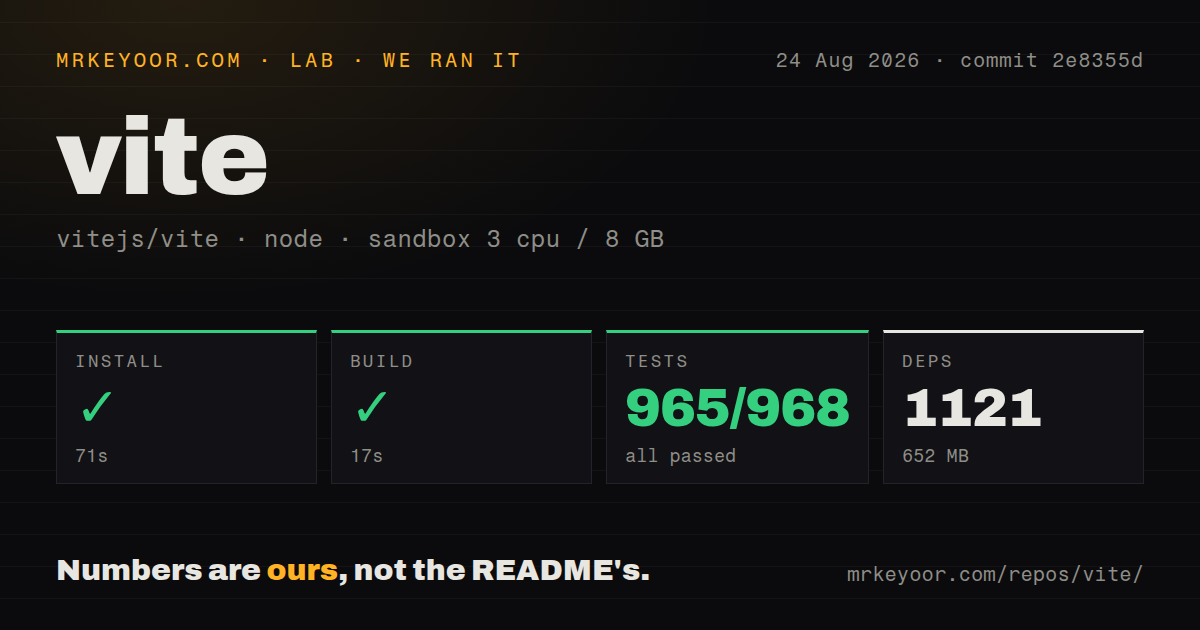
Our pnpm install completed in 71 seconds, adding 1,121 packages and using 652 MB on disk. The build then succeeded in 17 seconds. Those results came from an unprivileged lab-node:22 container with 3 CPUs and 8 GB of RAM. They show that the workspace resolved and compiled at the measured commit without additional system-package work recorded by the lab.
Tests ended with exit code 1 after 129 seconds. The supplied lab summary recorded one Vitest report with 965 passed, 0 failed, and 3 skipped out of 968. The tail from the broader command reported 36 failed, 1,099 passed, and 172 skipped across 1,307 tests, with 8 failed files out of 108. Both records belong to the same supplied measurement, and the overall command failed.
What happened when we ran it
Our 129-second test command failed, and several failures in the tail were under playground/fs-serve, including cross-origin denial and fetchModule file-access cases. The repeated concrete error was connect ECONNREFUSED 127.0.0.1:5173. The log establishes that those test clients could not connect to that address. It does not establish why the server was absent, so blaming Vite, container networking, startup order, or resource pressure would go beyond the evidence.
The checkout had 13 CI workflow files and monorepo workspaces. Our scan found no Dockerfile and no tests directory at the root, even though the executed test command reached playground suites elsewhere in the tree. Contributors should follow Vite's own guide and targeted commands rather than assume one generic command reproduces CI. For product users, the successful 17-second build is more relevant than the upstream repository's full contributor suite.
Rolldown output needs project-level compatibility checks
The README now names Rolldown as the production bundler. Vite preconfigures it and exposes a plugin interface familiar to the surrounding ecosystem. Most applications should start with defaults, then add only the framework plugin and any asset or transform behavior they can explain. A copied configuration tends to survive long after the package that required it disappears.
Migration still deserves a real comparison. Build both the old and new project, inspect generated chunks, source maps, CSS order, worker assets, dynamic imports, and server-side rendering output. Open issue 23377 reports an imported worker missing from a build manifest, which is a specific reminder that uncommon asset graphs need coverage. Do not generalize that report to every worker build; turn your own worker and manifest expectations into tests.
Development networking has enough knobs to expose host differences
Vite's development server handles host binding, proxies, WebSockets, hot updates, file-system access, and cross-origin rules. Those defaults protect local development while supporting framework tooling. They can behave differently inside containers, remote workspaces, IPv4-only services, and reverse proxies. Our 36 failed tests included refusals on port 5173, making server startup and reachability the first thing to check when a browser suite collapses.
Current issue 23312 reports a Windows case where server.host set to localhost binds IPv6 while a proxy target on localhost fails. Issue 23362 reports a Firefox connection-loss message every 15 seconds. These are active reports, not universal behavior. They are good acceptance-test prompts for teams using Windows, remote tunnels, proxy targets, or browsers beyond the default developer setup.
Current pushes and 766 open items point to active maintenance
GitHub recorded 82,541 stars, 766 combined issues and pull requests, and a last push on August 27, 2026. Recent activity covered hot-update timeouts, Sass process recovery, SSR exports, license packaging, and worker manifests. The repository's latest release endpoint returned create-vite@9.2.0, published August 24, which belongs to the scaffold package rather than proving a core Vite version.
That package-level release pattern is normal for a monorepo, but buyers should read the changelog for the exact package they install. Pin Node and Vite versions in CI, run the same production build developers use, and keep a browser smoke test for routing, assets, and hot updates. Webpack remains sensible for applications built around its specific hooks. New modern projects should begin with Vite unless a named requirement points elsewhere.