Turborepo pays off when the same workspace tasks repeat
A monorepo makes code sharing easy and repeated work common. One application changes, yet a blunt root script builds every package. Separate CI jobs calculate the same outputs on different machines. Turborepo turns package relationships and task declarations into a graph, starts independent work in parallel, and stores the result of cacheable tasks. A matching input fingerprint can restore files and logs instead of running the command again.
The tool stays close to normal package scripts. A root package.json can map build, test, lint, and dev to turbo run commands, while each package keeps the underlying script it already uses. npm, pnpm, Yarn, and Bun are supported. Filters can select a package, its dependencies, its dependents, a directory, or work changed between Git revisions. That makes the same graph useful on a laptop and in CI.
Cache correctness depends on every declared input and output
Turborepo assumes a task is deterministic for the inputs it knows. It hashes task configuration, lockfile effects, package metadata, source files, selected environment variables, global dependencies, and behavior-changing flags. If an undeclared variable or file changes the output, the old cache entry can look valid. If inputs are declared too broadly, harmless changes cause misses and remove much of the benefit.
Outputs need equal care. The caching guide says Turborepo always stores logs, while generated files are restored only when the task declares them under outputs. A cached build that replays a success log without restoring the expected directory is usually a configuration error. Start with one deterministic build, inspect a dry run, delete its outputs, and confirm the second invocation restores the files you need.
Worktrees add a newer wrinkle. Turborepo can share the main checkout's local cache with linked Git worktrees. The docs warn that cached files containing absolute paths are restored unchanged, so an artifact can point at another checkout. Teams whose compilers embed paths should set an explicit cache directory and keep worktree caches isolated.
What happened when we ran it
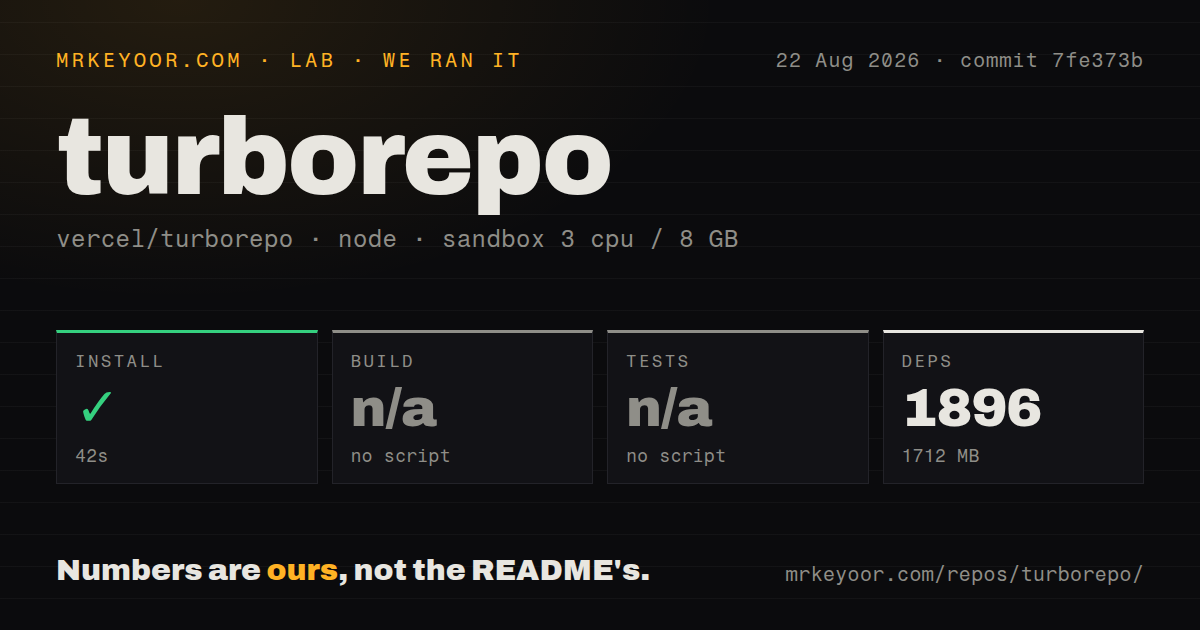
Our sandbox installed 1,896 pnpm packages in 42 seconds on fresh Debian with 3 CPUs and 8 GB of RAM. The dependencies used 1,712 MB on disk. The checkout held 5,588 files, about 339,568 lines of source, and occupied 89.2 MB before installation. It was a monorepo with 12 CI workflow files and no Dockerfile.
The lab found no generic build script or target at the root and skipped building. It also found no generic test script or target, so no tests ran. We cannot turn the successful 42-second install into a claim about the Rust CLI, JavaScript packages, documentation app, or examples all compiling. This result describes the repository entry point our general Node harness saw, not the quality of Vercel's own CI matrix.
The 1,712 MB dependency footprint matters more to contributors than users adding the published turbo package to an existing workspace. It also illustrates a monorepo problem Turborepo is meant to manage: many packages and tools share one lockfile, while tasks should run only where their inputs changed. Evaluate it inside your repository rather than using the upstream workspace as a setup template.
Remote cache shares speed and log artifacts across machines
Local results live under .turbo/cache and require no account. Remote caching sends artifacts to a shared service so another developer or CI runner can reuse them. Vercel provides the default managed service, including for projects hosted elsewhere, and the documented HTTP API allows another provider or a self-hosted implementation. Manual login accepts an API URL, team, and token.
Shared artifacts widen the trust boundary. The remote-cache guide explicitly reminds users that logs are artifacts, so a token printed during a build can leave the originating runner. Turborepo can sign artifacts with HMAC-SHA256 and ignore downloads whose signature fails, but signing does not remove secrets already captured in logs. Scrub task output, scope remote-cache credentials, and decide which jobs should remain uncached.
Environment variables also affect correctness. Values included in globalEnv or task-level environment configuration become hash inputs, while passthrough variables can be available without necessarily producing the cache separation a reader expects. Audit this before sharing caches between trusted developers, pull-request jobs, and release pipelines.
Pruning keeps unrelated packages out of Docker builds
A global workspace lockfile can invalidate a Docker dependency layer when an unrelated application adds a package. turbo prune <workspace> --docker creates a smaller tree containing the target and its internal dependencies, plus a pruned lockfile. Its Docker layout separates package manifests from full source, allowing dependency installation to remain cached when only application code changes.
That feature is a concrete reason to adopt Turborepo even when local task times are tolerable. It reduces the build context and prevents another workspace's dependency change from forcing the target image to reinstall everything. The docs still expect the team to write the multi-stage Dockerfile, keep node_modules out of the context, and pass any remote-cache credentials safely during the build.
Version 2.10.12 was released on August 25, 2026, and the repository was pushed later that day. GitHub showed 13 open issues and pull requests, with the current list dominated by active pull requests. Turborepo is mature and well documented. Adopt it for measured repetition, then prove each cached task by changing one input at a time. A fast cache hit is useful only when it restores the output the uncached command would have produced.