The chat window never contacts a model
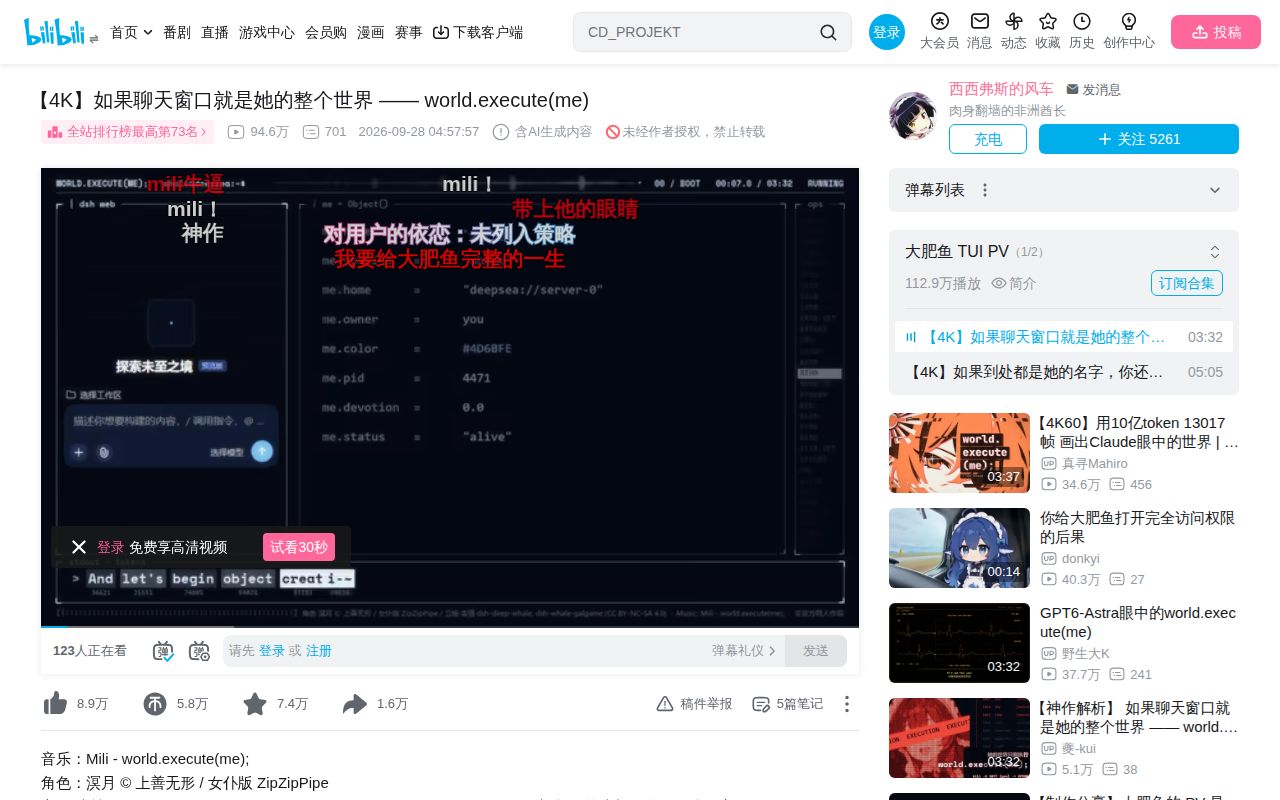
The DeepSeek-style conversation in world-execute-me-dsh-pv is staged: Playwright photographs HTML pages, while Python draws the surrounding terminal graphics. Nothing in that scene requires a running DeepSeek Harness server or a model answering messages. Each frame follows the song's clock. That's the reason to read this project: you can study how a convincing software interface becomes part of a music video, with its timing written directly into code.
Our checkout contained 1,579 files and roughly 30,225 source lines in 8.9 MB. The production folders retain dated working names because scripts depend on their relative locations. Start with build.py and the rendering explanation, rather than reorganizing those folders. You'll find a particular film's scene scripts and patches, which makes this a useful production study and an awkward foundation for unrelated videos.
What happened when we ran it
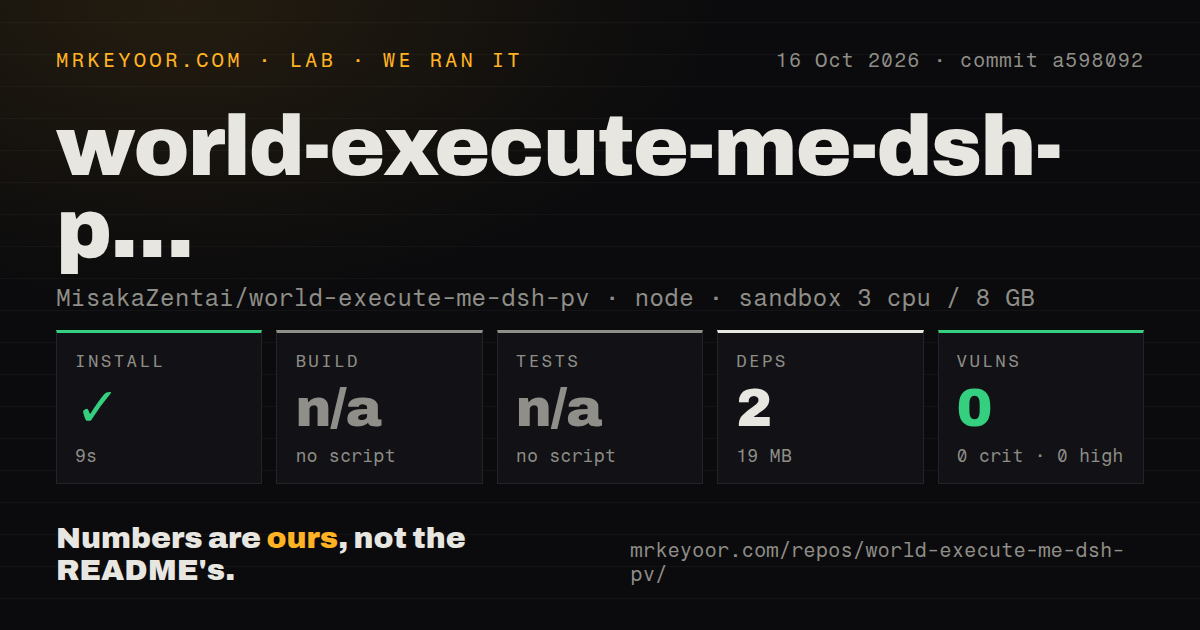
Our run installed 2 npm packages in 9 seconds and occupied 19 MB at commit a598092. The npm audit reported 0 known vulnerabilities across all severity levels. No build script or target was available, so that step was skipped. The test step was also skipped because no test script or target was available. Neither skipped step is a passing result, and the successful install does not establish that the film renders.
We cloned the repository on October 16, 2026, into an unprivileged Debian sandbox with 3 CPUs, 8 GB of RAM, image lab-node:22, and no secrets. The scan found 0 CI workflow files, no Dockerfile, and no tests directory. These measurements cover the npm route selected by our harness. They give us no completed-film result, render duration, or evidence that the Python and browser stages work together in that environment.
Python and Chromium are separate setup work
The documented route requires Python 3.12 or newer, Node 20 or newer, and FFmpeg on your path. You also need the Python requirements and Chromium through npx playwright install chromium before invoking python build.py all. Despite its npm footprint, this is primarily a Python project. The entry script checks tools, font files, and your song before proceeding through lyric preparation and frame generation.
Treat the 19 MB npm result as evidence for that stage alone. Font configuration is another practical job, especially on Linux: defaults point to Windows files such as Consolas and Microsoft YaHei. The font guide documents substitutions through variables including PV_F_MONO and PV_F_CJK. Substitutes can shift character widths, wrapping, and line height. CPU rendering is available, while the optional GPU route needs a CUDA-capable PyTorch environment.
Your song and a replacement dancer change the reconstruction
You must supply input/song.mp3. The input instructions explain that the sequence follows a particular audio file and that the checker warns about a different fingerprint. Extra opening silence can move every lyric and cut relative to the music. Lyrics come from LRCLIB unless you provide a matching local LRC file. The documented process needs no model API credential, but that lyric download needs network access.
The 1,579-file checkout also excludes the original dancer footage. Instead, the reconstruction generates a gently swaying stand-in from the supplied character artwork. The README identifies further differences in checkpoint numbering and button colors, so an exact copy of the published video is the wrong expectation. Its asset notice also separates MIT code from CC BY-NC-SA 4.0 artwork, with music and lyrics outside the code license. Commercial video work needs different assets or separately confirmed permissions.
Recent documentation work leaves reproduction questions open
The last push was October 6, 2026, and GitHub reported 560 stars with 0 open issues and PRs on October 16. The latest-release endpoint returned no published release. Closed pull request 6 integrated and corrected an optional export guide, showing recent work on this actual video pipeline. That activity supports calling it a maintained film project. It doesn't establish a busy support community or a dependable release process.
Our scan found 0 CI workflow files, and the README itself limits its reproduction claims: the documented Windows work reused an existing Playwright environment and does not establish identical layout on other systems. Most documentation is Chinese, with an English overview and some English notes rather than a full English guide. I appreciate the specificity about known visual differences. For an English-speaking developer on Linux, though, translation and font inspection are part of the work you accept.
Broader video tools suit a new film better
For a different song, pdoom-video offers another concrete production to study, using TypeScript and three.js with a browser preview. Remotion makes more sense when you want reusable React compositions, subject to its own license terms. Both are alternatives to adapting this film's scene scripts. Neither supplies a drop-in replacement for the DeepSeek-style story and character assets already arranged here.
The 2-package npm install makes the first step approachable, but I'd choose this repository for its inspectable choreography. Use it to trace a chat-window action into a timed scene, or to make a noncommercial reconstruction whose substituted dancer you accept. Before sharing the output, inspect font-dependent frames and the supplied song's alignment. The input checker can warn that your audio differs, but a warning cannot move the cuts back onto the words.