One command can format, lint, and fix a web project
Biome combines a formatter, linter, safe code fixes, and editor diagnostics. The documented languages are JavaScript, TypeScript, JSX, JSON, CSS, and GraphQL, with active parsing work for framework files. biome check --write applies formatting and safe fixes, while biome ci checks a repository without rewriting it. That smaller toolchain is attractive when Prettier and ESLint configs have become two versions of the same policy.
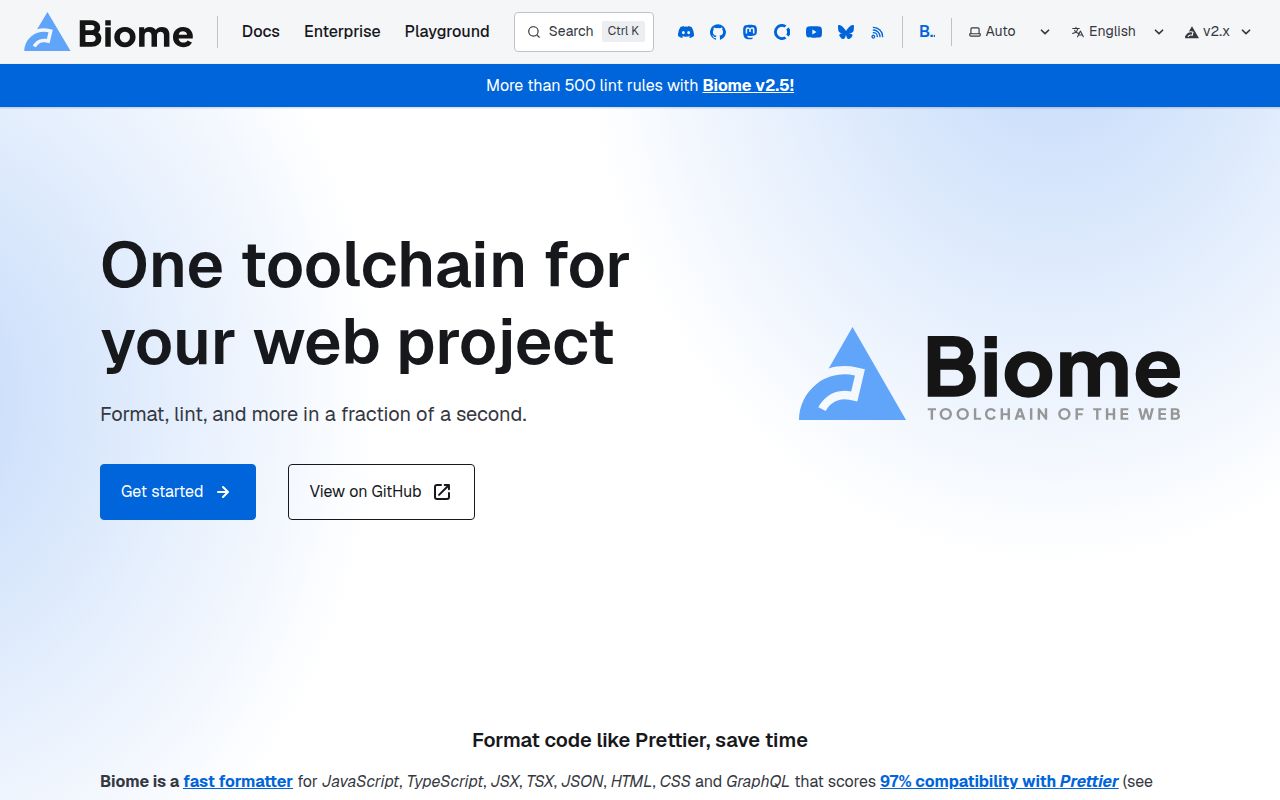
The formatter claims 97% Prettier compatibility, and the linter advertises more than 500 rules. Those are useful coverage signals, not a promise of identical behavior. A migration can alter whitespace, surface different diagnostics, or omit a plugin-backed rule. Run both systems on the whole project, inspect the diff, and map every required rule before removing the old configuration.
Editor feedback is part of the product
Biome was designed for interactive use and can format or diagnose malformed code while a developer is typing. First-party editor extensions and the language server make the same parser available before commit. The WebAssembly playground offers a zero-install way to test configuration and output on a sample before adding a package.
Language-server behavior deserves its own rollout. Release v2.5.10 fixed a memory leak during long editor sessions, while open issue 7538 reports huge logs from an older 2.1.2 setup involving Zed and a constantly updated JSON file. One report does not establish current behavior for every editor. It does justify checking cache growth, logs, CPU, and memory during a trial.
What happened when we ran it
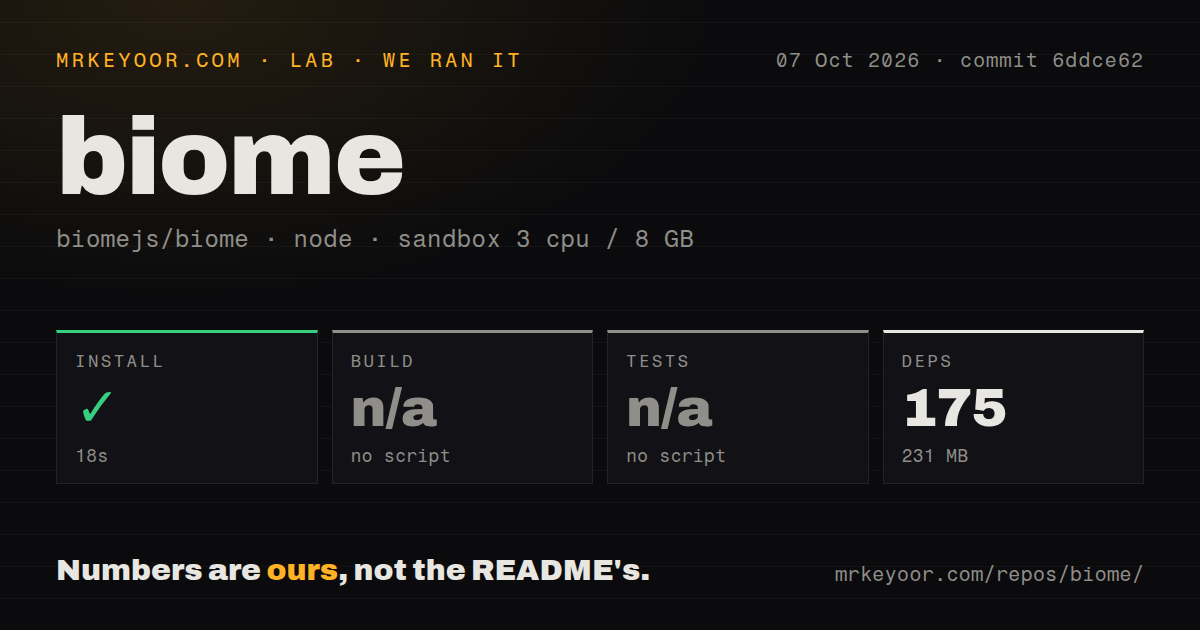
Our sandbox installed 313 pnpm packages in 28 seconds and used 305 MB on disk. We used commit fe61e21 in an unprivileged node:22-bookworm container with 3 CPUs, 8 GB of RAM, and no secrets. The checkout was 135.8 MB before dependencies and contained 27,898 files with about 1,254,677 lines of source.
The root workspace exposed no build script or target, so the lab skipped the build stage. It also exposed no test script or target, so tests were skipped. This does not mean Biome has no build or tests: the repository had 24 CI workflow files and a monorepo workspace layout. It means our standard root-package discovery did not find commands it could execute.
That distinction limits the conclusion. The 28-second install proves pnpm could resolve the measured workspace dependencies in our container. It does not prove the Rust crates compile, the CLI binary works, or the internal suites pass. A source contributor should follow the repository's dedicated development documentation and CI commands rather than treating the npm quick start as a build guide.
Framework parsers are improving through real edge cases
Version 2.5.10 shipped on August 21, 2026 with many Astro corrections: comment-only expressions, raw-text elements, frontmatter boundaries, fragment shorthand, unquoted attributes, and parser recovery are all named in the notes. The same release fixed Vue binding references, incomplete Svelte declarations, and an unnecessary type-inference path. That is meaningful progress and evidence of a wide parser surface.
It also argues for testing your own templates. An open report on 2.5.10 says a function merged with a same-name TypeScript namespace is marked unused. Current pull requests continue to adjust Astro expression parsing. Teams using plain TypeScript will face fewer framework boundaries than a mixed Astro, Vue, and Svelte monorepo. Pinning a release keeps one parser fix from changing CI unexpectedly.
One configuration is useful only if it preserves policy
Biome's appeal is consolidation. A single config can drive the CLI, editor, fixes, and CI. Diagnostics include source context, while safe fixes can handle routine issues without a second fixer. The migration path can import parts of existing ESLint policy, and the release notes continue to add rule-source mappings.
Consolidation should not erase rules silently. Inventory the existing ESLint plugins, local rules, Prettier plugins, ignore files, per-package overrides, and CI exit conditions. Mark each as supported, replaced, or intentionally dropped. Keep unsafe fixes out of automated commits until their effects are understood. The right success metric is equivalent policy with less maintenance, not the fewest configuration lines.
Published CLI setup is much smaller than contributor setup
For an application, installation is one exact dev dependency followed by npx @biomejs/biome. The published package carries the platform binary, so users do not need a Rust toolchain for ordinary checks. The commands are concise enough to add beside existing scripts during evaluation.
The source repository is different: 1.25 million measured lines, Rust crates, pnpm workspaces, generated assets, conformance fixtures, and 24 workflows. Our missing root targets are a setup warning for contributors, not a complaint about end-user installation. Anyone planning custom rules or compiler changes should budget for the repository's own toolchain and focused test commands.
August activity favors a staged migration
GitHub showed 25,653 stars, 521 combined issues and pull requests, and a last push on August 27, 2026. CLI v2.5.10 was released six days earlier. The open count includes feature work and contributions, so it is not a defect total. Frequent parser and inference fixes show active maintenance at a rapid pace.
Biome is an easy experiment and a consequential replacement. Try it on a branch, pin the version, run the formatter once as a dedicated migration commit, and compare lint policy before deleting ESLint or Prettier. The missing root build and test targets prevent our source checkout from earning a clean lab result, while the published CLI remains compelling for teams that can validate the migration themselves.