More than 70 studies turn a renderer into a trading workspace
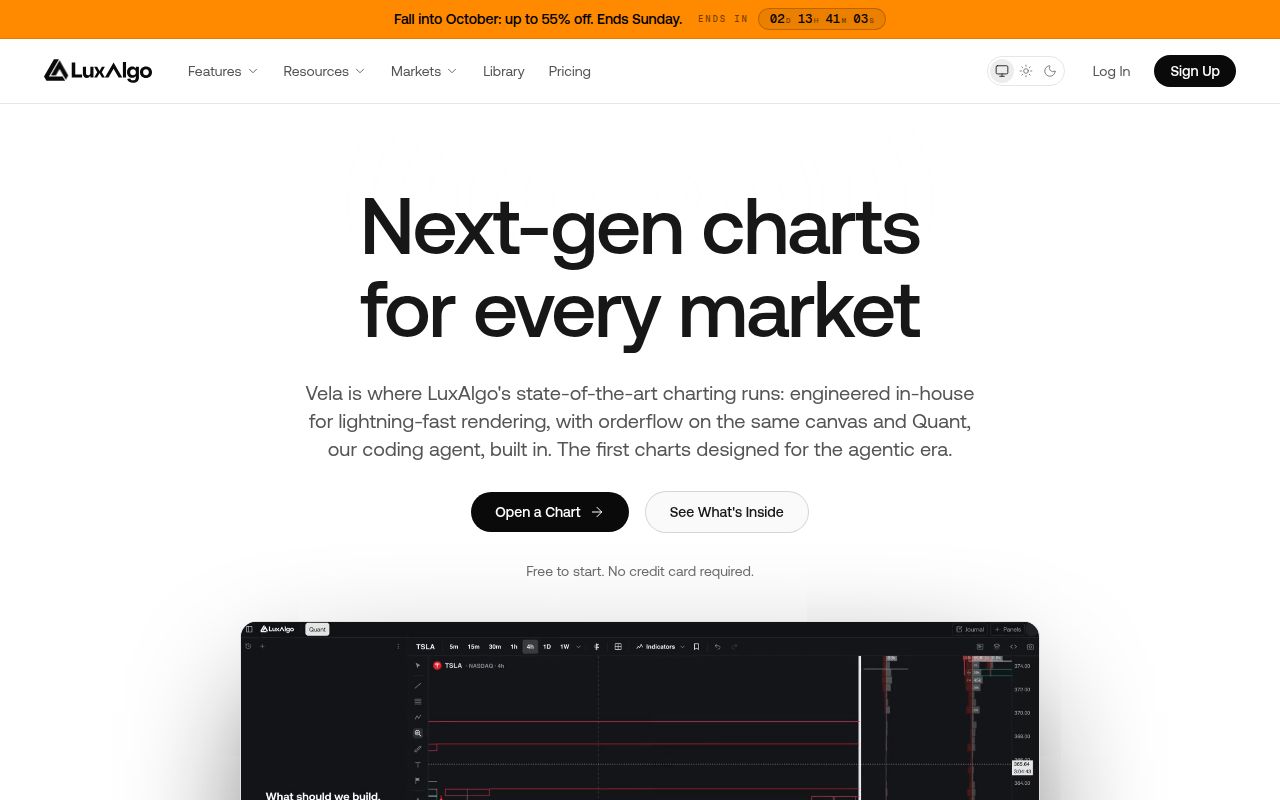
Vela can be a headless financial chart controlled entirely from code, or a complete workspace created in one call. The workspace supplies symbol and timeframe controls, multi-chart grids, drawings, keyboard shortcuts, persisted state, an object tree, and chart settings. More than 70 built-in studies run from the chart's own bars. That scope makes Vela attractive when the product brief says trading terminal rather than a candlestick panel in an otherwise finished app.
Three exchange providers are ready to register: Binance, Coinbase, and Hyperliquid. You can instead pass your own bars and keep the chart offline. WebGL2 is the primary renderer, with Canvas2D as a fallback. The public plugin API accepts custom chart types, data engines, and painted layers, which is a cleaner extension route than patching rendering internals each time the host product needs another price style.
The 177 MB install buys a tested TypeScript package
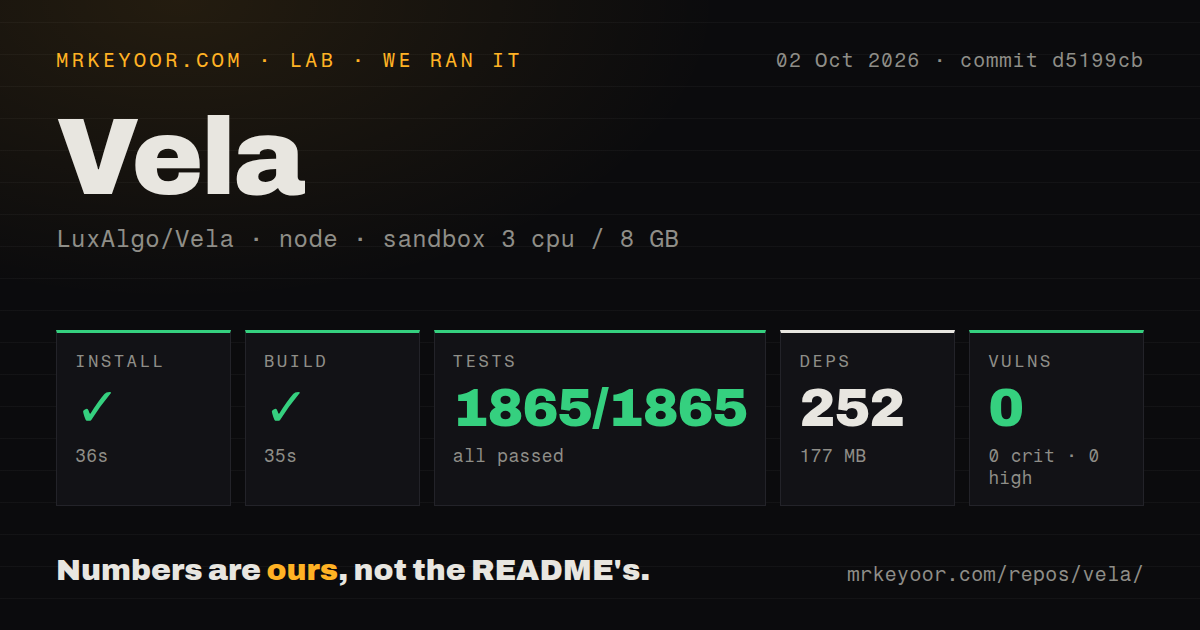
Our checkout at commit d5199cb contained 600 files, about 102,986 lines of source, and occupied 7.8 MB. Npm installed 252 packages in 36 seconds, expanding the environment by 177 MB. The package is larger than a tiny plotting primitive, but the measured footprint matches its UI kit, renderer, workspace, provider adapters, and test tooling. Installation needs no secret or external service.
The published entry points separate the headless core, workspace, UI pieces, plugins, and providers. Script-tag users also get readable and minified browser bundles that attach the public API to window.Vela. For local development, the README documents a Vite playground, Vitest, and a tsup build. The project is a browser library, so the lack of a Dockerfile is expected rather than a deployment gap.
What happened when we ran it
Our fresh Debian sandbox installed commit d5199cb in 36 seconds and built it in 35 seconds. The unprivileged container had 3 CPUs, 8 GB of RAM, Node.js 22, and no secrets. All 1,865 Vitest cases passed in 61 seconds, with 0 failures. Npm audit reported 0 known vulnerabilities across critical, high, moderate, and low severities.
Those results establish a healthy repository baseline, not rendering speed. We did not measure frame rate, input latency, memory use with long price histories, or provider reliability. The repository includes 3 CI workflow files and a tests directory. Vela earns confidence from the size and result of the suite, but a financial UI still needs browser tests against its own data shapes, screen densities, plugins, and persistence rules.
Two open bugs reach the chart users can see
Open issue 226 describes pointer dragging that repaints only every second or third frame on high-DPI displays when the WebGL2 context uses antialiasing. The report is specific to Vela 0.8.1 and includes a proposed change, but it remained open on October 2. If your product targets Retina or 4K trading desks, reproduce that case on the actual monitor and browser before committing to the renderer.
Issue 222 is more severe for custom data providers. A price pane whose values differ only by floating-point rounding can enter a tick-generation loop, throw an invalid array length error, and crash the browser tab. The report reproduces the problem on version 0.8.0 with both renderer backends. Market data is full of awkward decimals, so normalize test fixtures and include nearly flat series in acceptance tests.
Persisted state also has a named hole. Issue 138 says native indicator inputs and indicator visibility are absent from the dehydrated workspace state, so edited settings can return to defaults after a reload. Vela's README promises persisted market, style, timezone, drawings, and indicators. Check the exact fields your product treats as durable instead of reading that line as a guarantee that every indicator choice survives.
Pine support changes the license and package boundary
Vela itself is Apache-2.0, and its built-in studies need no scripting engine. Pine Script runs through the separate @luxalgo/vela-pinets adapter plus PineTS. The README identifies that add-on as AGPL-3.0 because of the runtime it executes. A team can stay within Vela's core license by using native indicators or writing another engine against the public port, but Pine compatibility is a separate adoption decision.
The README also requires visible attribution. Each chart enables a linked Vela watermark by default. You may restyle, reposition, or disable that mark only when equivalent visible linked credit appears elsewhere on the same page or screen. That condition is easy for an internal terminal and harder for a white-label product. Review it with whoever owns product branding before the interface is built around the library.
Version 0.8.1 is active without a GitHub release
The package and changelog identify version 0.8.1, while GitHub's latest-release endpoint returned no release. The repository was pushed on October 1, 2026, and GitHub showed 564 stars plus 14 combined open items on October 2: 13 issues and 1 pull request. Recent reports received maintainer replies, so issue activity and the push date point to active work even without GitHub release objects.
Vela is the best fit when its workspace is the product feature you would otherwise have to assemble. Our 1,865 passing tests make that proposition believable, and the provider and plugin boundaries leave room for proprietary data and custom rendering. The remaining work is product-specific: prove high-DPI interaction, hostile decimal data, and state restoration, then decide whether its attribution and optional Pine license are acceptable.