The catalog turns a vague prompt into design constraints
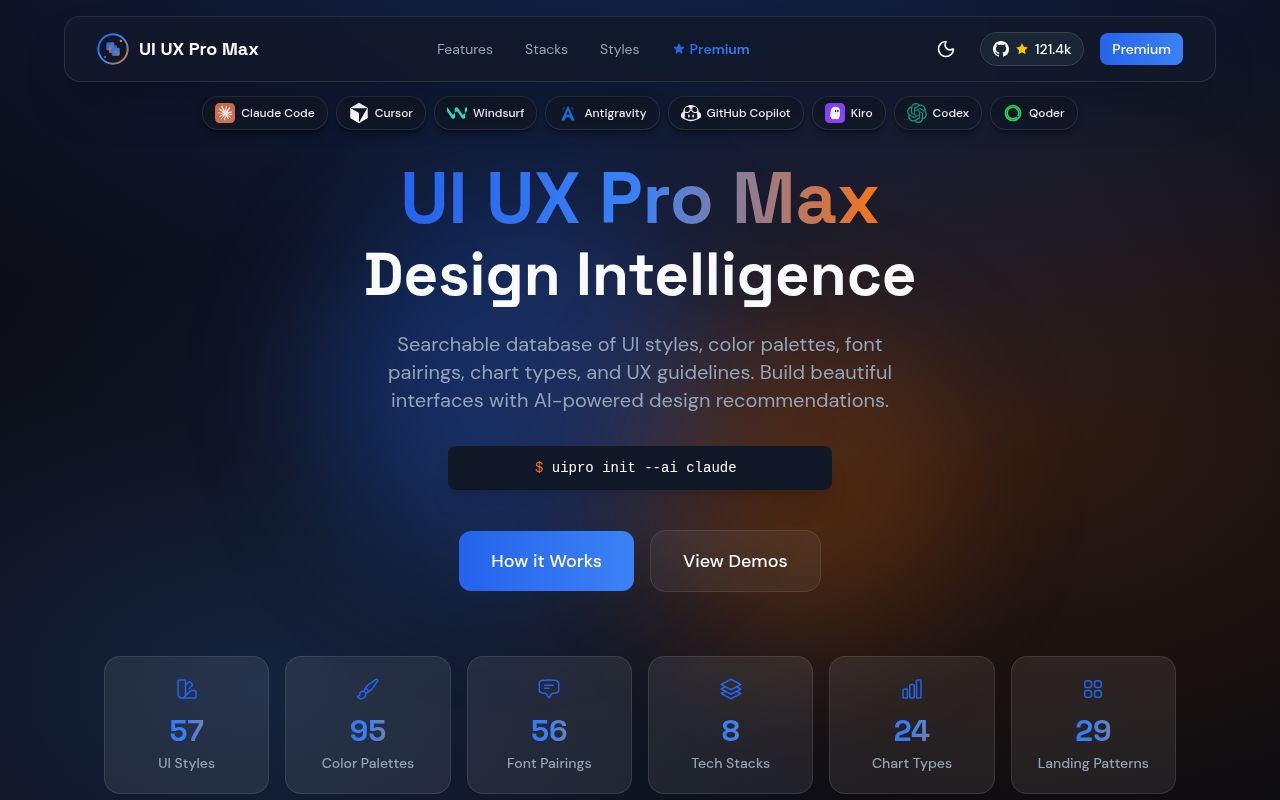
UI UX Pro Max sits between a product request and the code an agent writes. A search engine matches the request to product types, visual styles, palettes, typography, landing patterns, charts, accessibility guidance, and stack-specific rules. The output is a design-system brief with choices and anti-patterns. Giving the coding agent that brief can reduce random gradients, mismatched fonts, and components that look unrelated to the stated product.
The current catalog documents 192 product types and matching palettes, 79 searchable styles, 74 font pairings, 34 landing-page patterns, 25 chart types, and 119 UX guidelines. Those numbers describe breadth, not proof that a recommendation fits a particular audience. A spa and a banking dashboard can receive different starting points, but brand history, customer expectations, legal copy, and conversion evidence remain outside a keyword search.
Twenty-two stacks receive different implementation advice
The skill includes guidance for 22 stacks across web, mobile, and desktop development. The list covers React, Next.js, Vue, Nuxt, Svelte, Astro, Tailwind, shadcn/ui, Angular, Laravel, Three.js, SwiftUI, Jetpack Compose, React Native, Flutter, JavaFX, WPF, WinUI, UWP, Avalonia, Uno Platform, and related variants. That scope helps the agent translate a design rule into the conventions of the selected framework.
Version-aware search is a useful detail. Current queries return active guidance, while an explicit older major such as Svelte 4 or Next.js 15 can return labeled legacy rows. When the catalog has no suitable legacy entry, it abstains instead of mixing old and new framework advice. This is safer than a prompt that asks a language model to recall whichever API version it saw most often. Coverage still ends at the curated rows.
What happened when we ran it
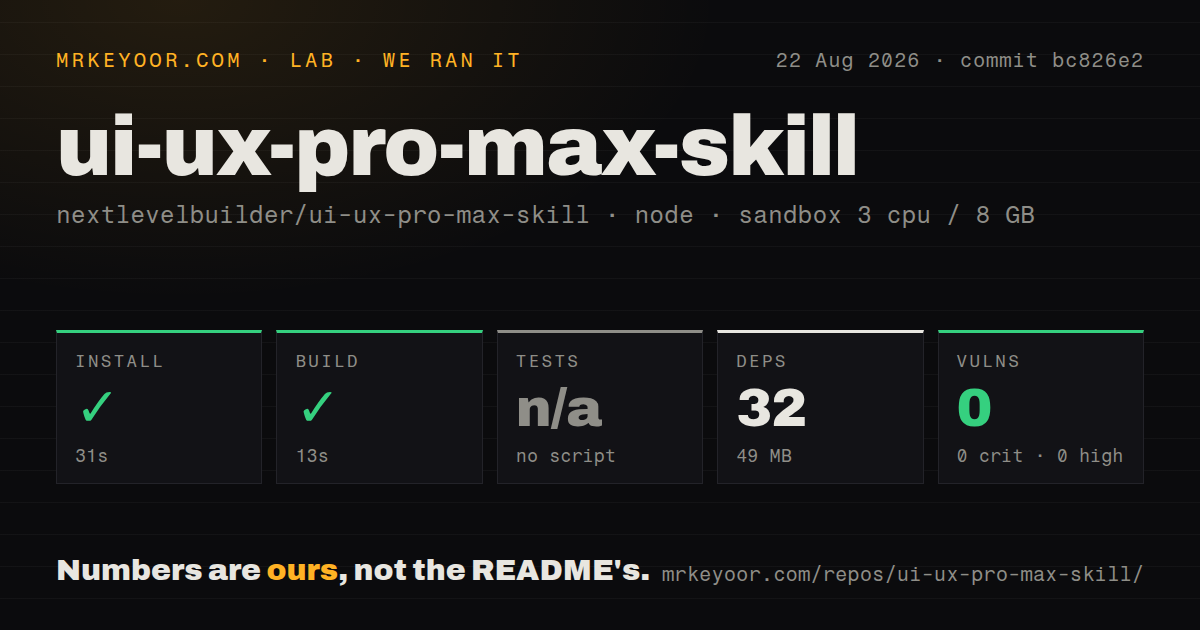
Our sandbox used the Bun project under ./cli/ at commit bc826e2. Installation succeeded in 31 seconds, added 32 packages, and occupied 49 MB. The build then completed in 13 seconds on 3 CPUs with 8 GB of RAM. The checkout itself held 661 files, roughly 41,490 lines of source, and used 21.5 MB before dependencies.
No tests script or target was available to our harness, so we skipped tests. The repository did contain a tests directory and 6 CI workflow files. Those signals cannot be converted into a passing result for our run. Npm audit found 0 known vulnerabilities across the installed dependency tree. This is a clean build outcome with a verification gap, rather than evidence that every catalog query or generated agent instruction works.
The CLI is only part of runtime setup. Python 3 is required for the search script, which the README says uses the standard library and makes no network calls. The agent host must also discover the installed skill or command. Automatic activation works in several tools; others require /ui-ux-pro-max. Trae needs SOLO mode. Testing the exact host matters because installation paths and invocation rules differ.
The open edition stops before brand asset production
The open repository provides its core catalog, BM25 search, stack guidance, and design-system generation. The README assigns brand identity, logo work, banners, presentations, custom iconography, deeper design-token architecture, image-generation integration, and priority support to a Premium product. That boundary is clear enough to affect selection if the goal is a complete brand package rather than application UI guidance.
Even within the open scope, the final code comes from the connected agent. UI UX Pro Max supplies retrieved rules and an implementation checklist; it does not render every screen, inspect screenshots, run keyboard tests, or interview users by itself. A recommendation can still produce a dull layout or fail under real copy. Teams should review browser output at narrow widths, high zoom, reduced motion, and each interactive state before accepting it.
Persistence can keep pages from drifting
The search command can save a project design system into design-system/MASTER.md and add page-specific override files. This gives later agent sessions a stable source for color, typography, spacing, components, and exceptions. That is more dependable than asking each new conversation to infer the intended style from existing code. It also creates a document that reviewers can challenge before another page copies a questionable choice.
The master file can become stale. Framework guidance, accessibility expectations, and product decisions change, while page overrides can accumulate contradictions. The CLI provides update commands for project and global installations, and v2.15.0 added stronger freshness and source tracking to the catalog. Updating skill files should not silently replace a project's approved design decisions. Keep catalog updates separate from changes to the persisted product system and review both diffs.
Accessibility rules help only when the agent applies them
The README includes concrete checks for contrast, focus states, reduced motion, long text, browser zoom, chips, badges, charts, errors, and cancellable interactions. It warns against meaning conveyed by color alone and calls for accessible full-value paths when compact labels truncate. These are useful constraints because agent-generated interfaces often look acceptable in one desktop screenshot while failing under keyboard input or longer copy.
GitHub showed 121,431 stars, 90 open issues and pull requests, and a push on 2026-08-26. Release v2.15.0 arrived on 2026-08-13 with search, provenance, stack, data, and release checks. Activity is current, but popularity cannot validate a design for your customers. Our 13-second successful build makes the tool easy to trial. Keep it when its brief produces more coherent decisions, then verify the interface with real content and interaction.