
Hypit makes the composition reusable when the script changes
Hypit ties footage, captions and effects to words, according to its README, so an agent can change a script while retaining an editable production workflow. That's a more useful reason to investigate it than the promise of cloning a popular clip. If you make recurring product videos, the expensive question is what happens when a line changes after the layout and assets are already in place.
The README describes starting from a reference, a template or a written request. It also says generation models are optional: code-rendered visuals, captions and motion graphics can form a finished video without generation-service charges. We did not render either kind of workflow. The distinction still matters when planning a trial because a production made from existing material has different service needs from one generating a new presenter and footage.
What happened when we ran it
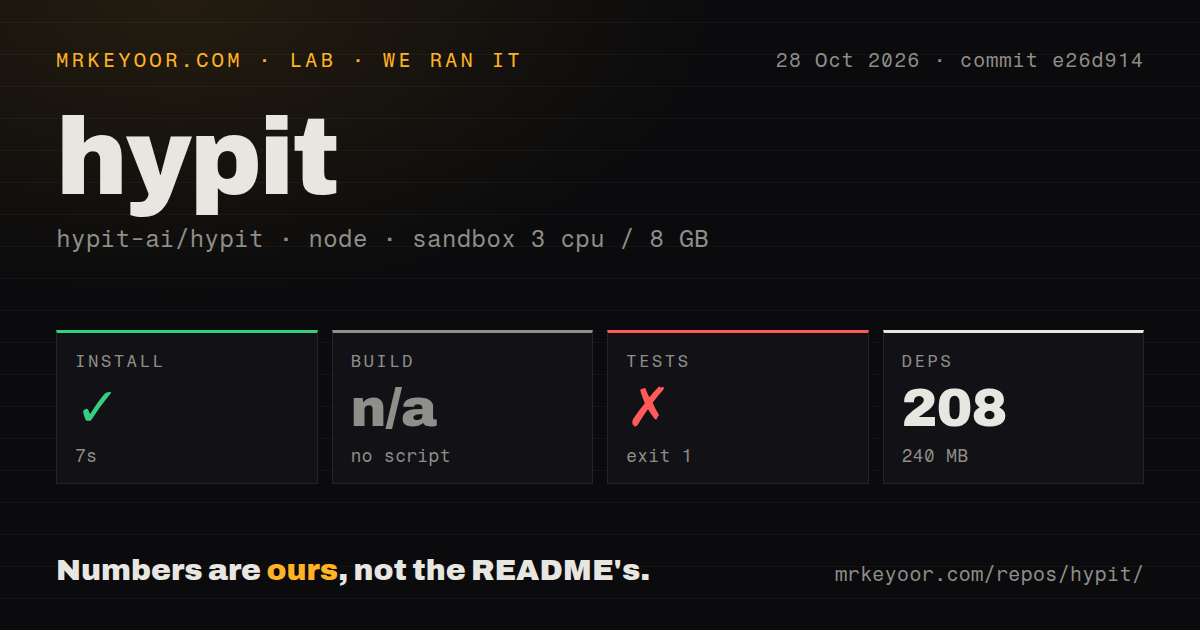
Our Hypit install took 7 seconds, and the test command failed after 109 seconds. The October 28, 2026 run used commit e26d914. It recorded 208 dependencies and 240 MB on disk. Build was skipped because no build script or target was found, so this run supplies no successful compilation result to offset the failed test command.
The visible assertion tail says actual: null, expected: 0 and operator: strictEqual. It does not name the assertion's surrounding case or explain why the value was null. Another line reports a multipart upload failure after an S3 upload part exhausted its attempts. Those fragments establish what the log printed, rather than a diagnosis of credentials, network access or the storage service.
The tail also contains passing-case lines about reporting a down program status and stopping after a failing install. Their presence doesn't make the whole command successful, and the upload message could belong to exercised failure handling. The supplied record does not settle that relationship. We have no passing-test total to report and no basis for saying video production itself is broken.
The scan recorded a pnpm workspace with 1,702 files, approximately 156,258 source lines and a 25 MB checkout. It found six CI workflow files and a tests directory, with no Dockerfile detected. The sandbox configuration specified 3 CPUs, 8 GB RAM and image label lab-node:22. Actual runtime and operating-system versions require the raw logs. No completed video, caption-alignment result or render-speed measurement accompanies this run.
The skill supplies instructions, while services supply material
The quickstart distinguishes the agent skill from the executable tools. Installing the skill does not include generation credits. The agent checks for an existing executable and helps prepare missing tools, so the advertised skill command is the entrance to setup rather than evidence that your first production is ready.
For a spoken reference, the documented workflow uses WhisperX for words and timing. HypiHub offers a hosted route, while existing or project-written providers can connect other services. The quickstart asks the user to agree to account, scope and budget before paid work. That is a useful point to stop and inspect the plan, especially if a revised script would request new assets.
An initial evaluation should change a line after producing the sample. Check whether the captions and graphics still land on the intended words, whether reusable material remains in place and which service calls the revision requests. This is a proposed acceptance check, not a result we observed. It tests the reason to adopt a reusable workflow rather than merely whether a first clip looks convincing.
Hosted use has additional license conditions
Hypit's license is a modified Apache 2.0 license. It requires a commercial license for the specified multi-tenant, hosted and commercial redistribution uses. A tenant is defined around a party's separate workspace, including projects, credentials and configuration. Do not assume that making a service free removes that condition.
The same text explicitly permits running Hypit on your own infrastructure for your organization's work, including commercial client work, and single-tenant deployments operated by and for one organization. It says the producer claims no rights in your outputs, while noting that model and service providers may impose their own terms. These distinctions make internal production and offering Hypit functionality to outside users different adoption decisions.
Remotion and FFmpeg suit different production responsibilities
Remotion documents agent, interactive and programmatic video creation. Evaluate it when owning the video's logic in code is your main requirement. It is not a license-free escape route: its README warns of a special license and company-license requirements in some cases. We have no comparative render or setup result here.
FFmpeg provides libraries and tools for processing multimedia, including video, audio and subtitles. Prefer it when you already know the media operation you need and have the source assets. Its command-line processing role is a narrower fit than asking an agent to interpret a reference and assemble production material.
GitHub records Hypit's last push as October 30, 2026, with 77 open issues and PRs. That activity and tracker count do not establish support quality or production reliability, so both remain unassessed. For adoption, require a sample revision that preserves timing and a clear account of which service calls it makes. Our successful dependency installation has not answered either question.