The registry distributes judgment rather than components
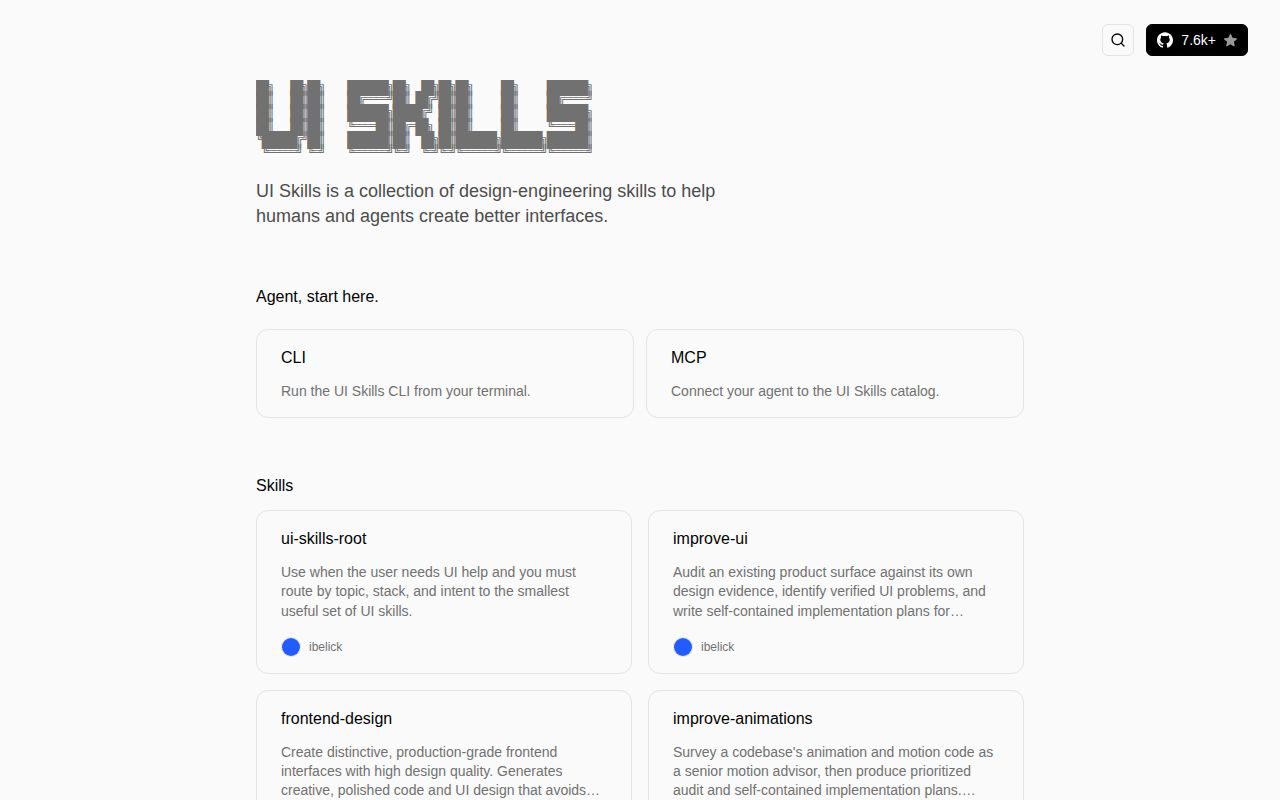
UI Skills does not ship a button set, CSS framework, or finished design system. It stores agent-readable instruction files and makes them searchable through a website, command line, and MCP endpoint. Topics include accessibility, motion, visual craft, typography, color, interaction, performance, React Native, Three.js, Remotion, and framework guidance. The value is a smaller prompt for one job instead of a vague request to make an interface better.
Some skills live in this repository, while the registry also points to files in external GitHub projects. The local set includes baseline-ui, design-document creation, accessibility repair, metadata repair, motion-performance repair, and a read-only UI audit planner. Registry entries record their source repository and raw file URL. That provenance helps review, but a registry listing is not a security review or proof that the advice fits the version of your stack.
MCP exposes 2 retrieval tools and no editing tool
An MCP client connects to https://www.ui-skills.com/mcp and receives list_skills plus get_skill. That narrow boundary is sensible. The server retrieves instructions, while the connected coding agent decides whether to inspect files, plan changes, or edit code. Teams can therefore grant registry access without granting the website a direct write path into a repository. The agent still has whatever filesystem permissions its own runtime provides.
The CLI covers the same discovery loop from a terminal: start, list categories, filter by category, and fetch one named skill. This is enough for humans who want to inspect text before installation. It also avoids attaching a long catalog to every prompt. A team can select one accessibility or motion skill, compare it with local conventions, and keep only the instructions that govern the current task.
What happened when we ran it
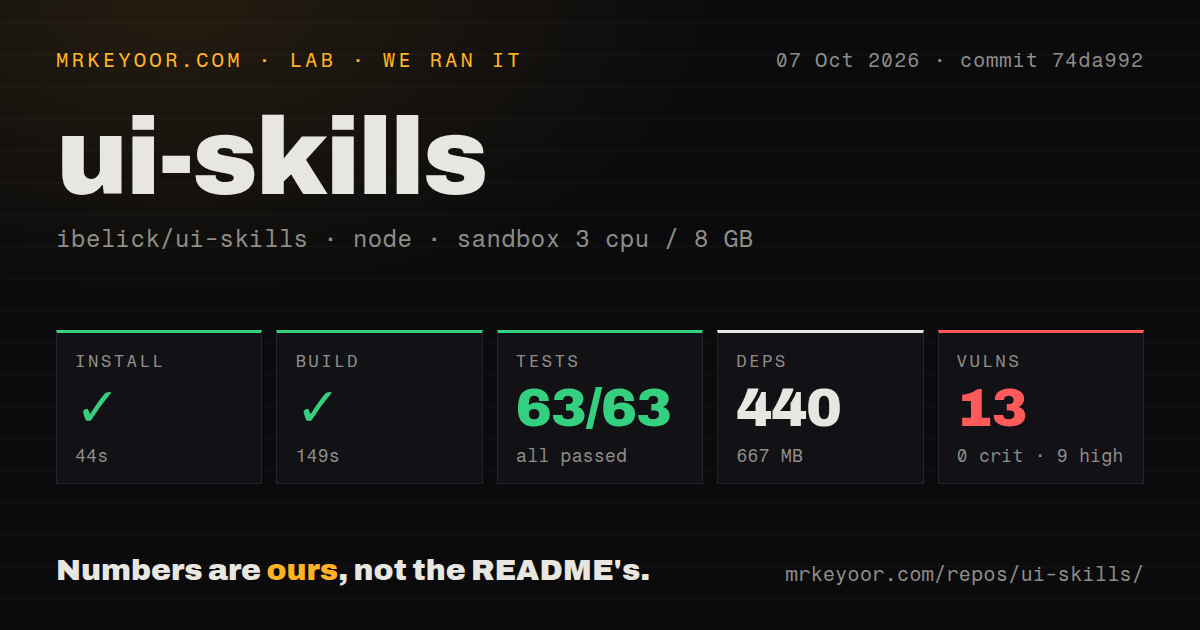
Our Node 22 sandbox installed 438 packages in 29 seconds, consuming 687 MB on disk. The Astro build completed in 42 seconds. Node's test runner then passed 58 tests and failed 0 in 13 seconds. Npm audit reported 0 known vulnerabilities across critical, high, moderate, and low severities. commit b5be117 cleared every measured setup, build, test, and audit step.
The repository itself was much smaller than its installed tree: 194 files, about 12,990 source lines, and 1.1 MB checked out. We found 1 CI workflow, a tests directory, and no Dockerfile. The 687 MB dependency footprint belongs in the self-hosting calculation even though an end user can run the published CLI or hosted MCP service without cloning the Astro site. Our lab did not score the design quality of every external skill or run agent-written patches against a browser.
baseline-ui is useful precisely because it is opinionated
The baseline skill requires accessible primitives, labels on icon-only buttons, safe-area handling, nearby error messages, reduced-motion support, and a fixed z-index scale. It rejects blocked paste, hand-built focus behavior, continuous layout animation, large blur effects, arbitrary tracking, and decorative gradients unless requested. These are concrete defaults that can stop common agent habits before they enter a code review.
Several choices are stack-specific. The skill calls for Tailwind defaults, motion/react for JavaScript animation, tw-animate-css for small entrances, and a cn helper for class logic. It prefers Base UI for new primitives when compatible. A product built with CSS modules, Vue, Angular, native iOS, or another established system should not import those rules literally. Keep the accessibility and performance principles, but preserve the local owners and component contracts.
The audit skill refuses unsupported design criticism
improve-ui takes a different approach. It is read-only on product source, traces one coherent surface, looks for governing design documents and runtime ownership, and requires contract, runtime, and correction evidence before reporting a finding. It caps the result at 3 findings and writes plans only after the user selects one. If evidence does not determine one correction, the candidate is discarded.
That restraint is a strong counterweight to the usual agent review full of taste claims. It also limits the skill's usefulness when a team wants direct implementation or broad visual exploration. Rendered evidence is used only when supplied or explicitly requested, and accessibility findings are excluded unless the user asks for them. Choose it for an evidence-based handoff, not for a designer to invent a new identity or an engineer to fix functional bugs.
Catalog trust still lacks ratings and visual outcomes
GitHub recorded 7,660 stars, 13 combined issues and pull requests, and a push on August 26, 2026. Pull requests in August added responsive, UI-state, and form skills. Release v0.2.3 arrived in June with a Windows CLI crash fix. The repository is active, and its own package has a clean lab result. External skill quality can still vary independently of the host application.
Open issue 22 asks for ratings because a large text skill does not show what its output will look like. Issue 35 asks for before-and-after screenshots. Both identify the missing evaluation layer: prose can sound sensible without producing a better interface. Until the registry shows repeatable outcomes, fetch a skill, inspect its hard requirements, apply it to a disposable branch, and judge the rendered desktop, mobile, keyboard, and reduced-motion result yourself.