mrkeyoor.com_
Fri 30 Oct 23:37 UTC
AI Toolsevaluationupdated 30 Oct 2026

Orkas review

Orkas is a desktop application whose Commander agent coordinates specialists and installed CLI agents such as Claude Code and Codex. Its README describes projects that retain goals, rules, memory and files between conversations. Our sandbox did not verify completed agent work or project continuity.

Verdict

Orkas from source merits a bounded solo trial when persistent projects and agent coordination fit the job. Our npm installation succeeded, but tests timed out after 900 seconds and desktop behavior was not verified. Shared projects, cloud sync and web publishing require evaluating the packaged edition. For local-only speech requirements, verify the specific route: the README documents both remote recognition and local transcription without establishing their interface-by-interface mapping.

We ran it

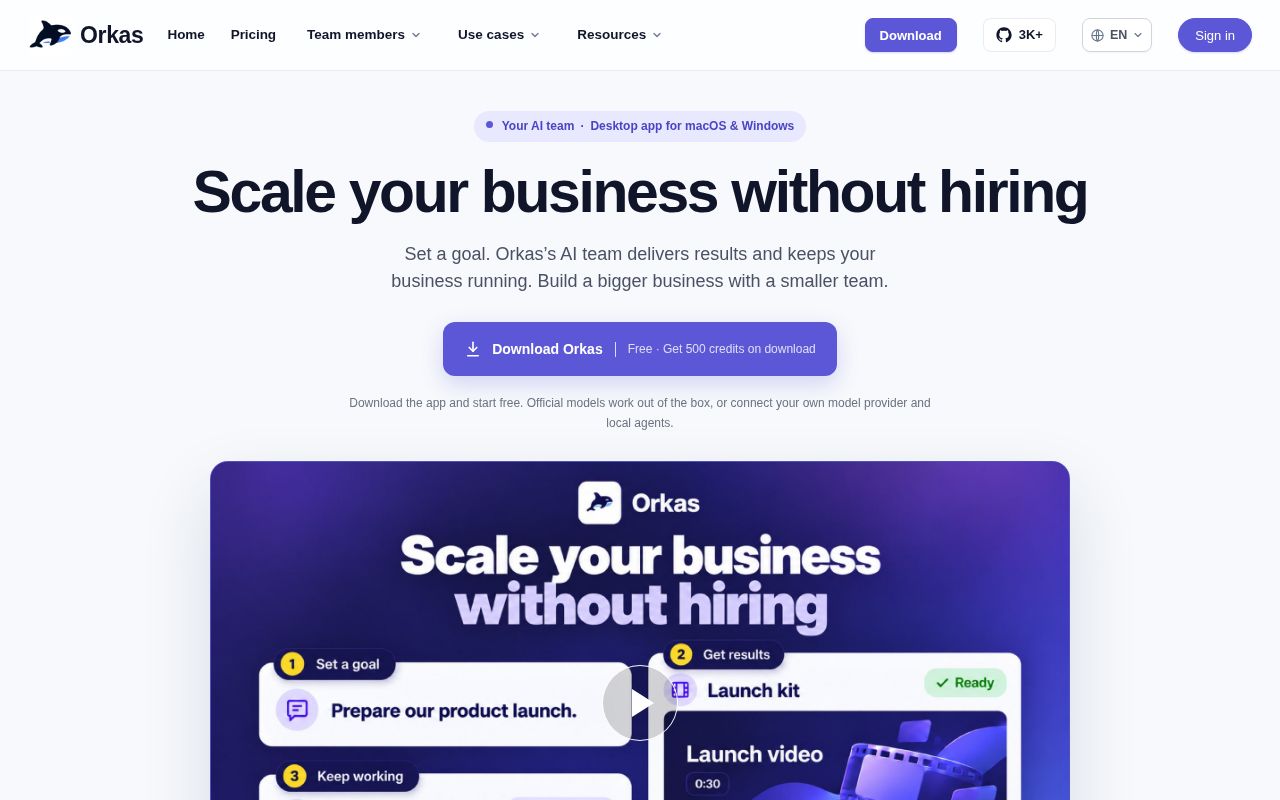
Lab card: what happened when we ran OrkasScreenshot of Orkas (orkas.ai?source=gh-orkas)
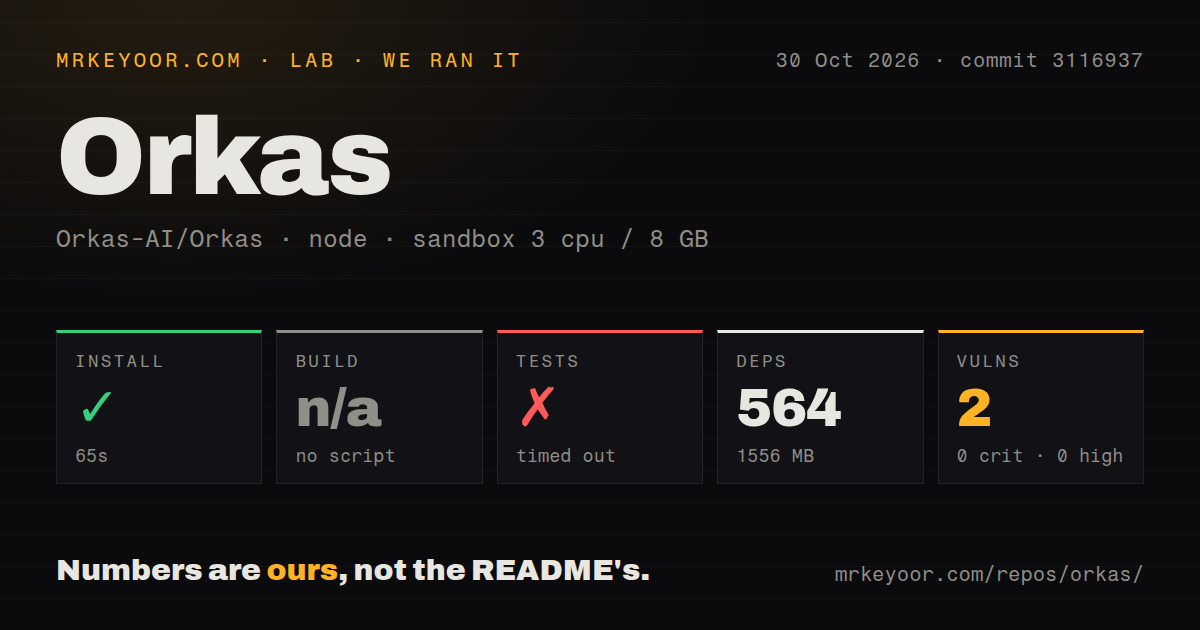
Install✓ · 65s564 packages · 1556 MB
Buildn/ano build script
Tests✗ timed out · 900sran, no count parsed
Known vulns20 critical · 0 high · 2 moderate · 0 low (npm audit)
Repo2723 files~1,031,346 lines of source · 235.4 MB · 2 CI workflows · tests dir

Answers from our run

Does Orkas build from source?

Dependencies installed in 65 seconds (564 packages), and the project has no separate build step. We cloned commit 3116937 into a clean Debian container with 3 CPUs and no project-specific setup.

Do Orkas's tests pass?

We could not finish them: the suite was still running after 15 minutes in our container.

Does Orkas have known vulnerabilities in its dependencies?

npm audit flagged 2 known advisories in the dependency tree at the time of our run.

Who should not use Orkas?

Teams requiring shared projects, cloud sync or web-app publishing from the open-source build: the README reserves those features for the packaged application.

What are the alternatives to Orkas?

Cherry Studio, CrewAI. Orkas from source merits a bounded solo trial when persistent projects and agent coordination fit the job.

SetupN/Anpm installation succeeded, but a supported desktop launch and complete first-launch resource preparation were not verified.
DocsN/AThe README describes setup and edition boundaries, but full setup usability and speech-route mapping were not verified.
CommunityN/AThe supplied activity sample does not establish support responsiveness or sustained maintainer capacity.
MaturityN/ATests timed out without a final summary; desktop reliability, agent output quality and unattended execution were not assessed.

Who it’s for

Solo developers evaluating persistent projects and several agent roles in a desktop workspace.
People already using CLI agents who want to evaluate coordination from one application.
Technical users prepared to configure model access and inspect generated files.

Who it’s NOT for

Teams requiring shared projects, cloud sync or web-app publishing from the open-source build: the README reserves those features for the packaged application.
People who need scheduled jobs to run while their workstation is off: Orkas requires the computer awake and the app running.
Alpine or other musl Linux users: the documented source route excludes those distributions.
Users who need a verified local-only speech workflow before adoption: the README documents both remote microphone recognition and local transcription, but the supplied evidence does not establish which route each interface or configuration uses.

Setup reality

Our October 30, 2026 sandbox run at commit 3116937 installed npm dependencies in 65 seconds, recording 564 dependencies and 1,556 MB on disk. The build step was skipped because the lab found no build script or target. Tests timed out after 900 seconds, despite passing files in the log tail. npm audit recorded 2 known vulnerabilities, both moderate, with none critical, high or low. The record provides no complete test summary or advisory identities.

The source route uses provider credentials or a local model endpoint; external CLI agents retain their own model settings. The documented launch scripts prepare native runtimes and model resources beyond the measured npm installation. The README's microphone workflow uses an Orkas API key and sends audio to Orkas for recognition. It separately documents local transcription through whisper.cpp and a multilingual model prepared on first source launch. The supplied evidence does not establish which speech route applies to each interface or configuration. Shared projects, sync and web publishing are packaged-app features.

The supplied README requires Node 22.12+ and excludes musl Linux. The recorded sandbox configuration was 3 CPUs, 8 GB RAM and image lab-node:22; that label does not establish actual runtime or operating-system versions. The run did not verify desktop launch, agent deliverables or the complete first-launch footprint.

Choosing Orkas from source changes which collaboration features you can evaluate. According to the README, shared projects, cloud sync and web-app publishing are only in the packaged app. That makes the source build a candidate for a solo trial; a team requiring those features needs to evaluate the packaged edition.

Orkas is a desktop workspace where a Commander agent coordinates specialists and installed CLI agents, including Claude Code and Codex. The README describes projects that retain goals, rules, memory and files between conversations. Our sandbox checked repository installation and test steps. It did not establish desktop usability, project continuity or the quality of completed agent work.

What happened when we ran it

At commit 3116937 on October 30, 2026, our Orkas npm installation took 65 seconds, recorded 564 dependencies and 1,556 MB on disk, and the test command timed out after 900 seconds. The build check was skipped because the lab found no build script or target. A skipped check does not establish a successful build or the absence of a packaging process.

The test tail includes passing files for authentication, public agent output and dispatch planning, among other areas, but no completed suite summary. Those excerpts do not establish an overall passing count, how close the suite was to completion or why the command exceeded its limit. The timeout does not diagnose an agent-runtime hang.

npm audit recorded 2 known vulnerabilities, both moderate, with none critical, high or low. The supplied measurement does not identify affected packages or exposure, so it supports neither an exploit claim nor a clean security verdict.

The sandbox configuration listed 3 CPUs, 8 GB RAM and image lab-node:22. Actual runtime and operating-system versions require the raw toolchain logs.

Source setup extends beyond npm installation

The supplied README specifies Node 22.12+ and macOS, Windows or Linux with glibc 2.34+. It excludes Alpine and other musl distributions. Python and a C/C++ toolchain are needed when a native npm package requires a source-build fallback. These are documented requirements, not verified properties of our sandbox.

The launch scripts prepare native runtimes, an embedding model and media resources. Feature-specific Python environments are prepared as needed. Our npm measurement does not establish the success or footprint of that complete process. Do not treat 1,556 MB as a ceiling for a configured workstation.

The README says the source build has no account layer and uses your provider credentials or a local model endpoint. External CLI agents keep their own model settings. Choose the provider and agent configuration before assigning real work; the packaged app's sign-in and managed-model offer are separate from this source path.

Check storage, model calls and speech separately

The README says conversations, files and knowledge bases stay on disk by default. With your own provider keys, model calls go directly to that provider; the built-in Orkas model uses Orkas's managed service. Local storage alone does not establish that processed material stays on the machine.

The documented microphone workflow sends audio to Orkas for recognition and uses an Orkas API key and credits. Separately, the README documents local speech transcription through whisper.cpp and a multilingual model prepared on first source launch. The supplied evidence does not establish which route applies to each interface or configuration. Neither the remote workflow nor the local transcription statement establishes how every speech feature behaves. Our sandbox did not verify speech processing or inspect network traffic.

If keeping speech local is a requirement, verify the route used by the exact interface and configuration before enabling it. For an initial agent evaluation, use a disposable project and material you can share with the selected provider. Request a specific deliverable, inspect the saved file against its sources, then reopen the project to check whether its retained context helps. These are proposed checks, not tasks completed in our sandbox.

Automations need an awake desktop

The README says Auto-advance and automations need the computer awake and Orkas running. It also documents catch-up behavior for missed runs. That does not provide continuous execution while the workstation is off.

Auto-advance lets agents take on subsequent to-dos. Evaluate a bounded task before relying on that behavior for ongoing work. The README says connectors ask before sending, posting or deleting by default; our run did not verify those permission boundaries.

A supplied Windows issue report describes sluggishness during concurrent tasks. It is one reporter's observation, not a performance benchmark, and our test timeout supplies no diagnosis for it.

Two alternatives to evaluate

Cherry Studio documents model conversations, agents, local knowledge bases and automation. Consider it when model interaction and document work are the main requirements. Its documented scope extends beyond chat.

CrewAI is a Python framework for multi-agent workflows, with Crews and event-driven Flows. Consider it when you want to implement orchestration in your own software. Neither alternative was measured alongside Orkas.

Trial Orkas from source for a solo workflow if persistent projects and agent coordination address a concrete need. Start with an inspectable deliverable and a project-reopening check. If collaboration is essential, evaluate the packaged edition's terms and behavior first. The source installation succeeded in our sandbox, but the test timeout and unverified desktop workflow remain limits on this recommendation.

Alternatives

ProjectWhat it isPick it when
Cherry Studio gh↗An AI workstation documenting model conversations, agents, local knowledge bases and automation.Evaluate it when model interaction and document work are your main requirements; compare its documented agent and automation features against your intended workflow.
CrewAI gh↗A Python framework with Crews and event-driven Flows for multi-agent workflows.Evaluate it when you want to implement orchestration in your own software rather than direct a desktop workspace.

What people are saying

  1. [github-trending] Orkas-AI/Orkas

Sources

  1. Orkas README
  2. Windows concurrent-task sluggishness report
  3. Cherry Studio README
  4. CrewAI README

More ai tools reviews

hypit · Paradev · see-through · Resume-Matcher · openbot · inkos · the whole board →