A pattern library, not one application
Anthropic defines a skill as a folder that teaches Claude how to perform a specialized task. The entry point is SKILL.md, with YAML fields for a name and description followed by instructions. Scripts, templates, examples, and reference files can sit beside it. Claude loads the relevant material when the skill matches a request, letting a focused procedure exist outside the main conversation prompt.
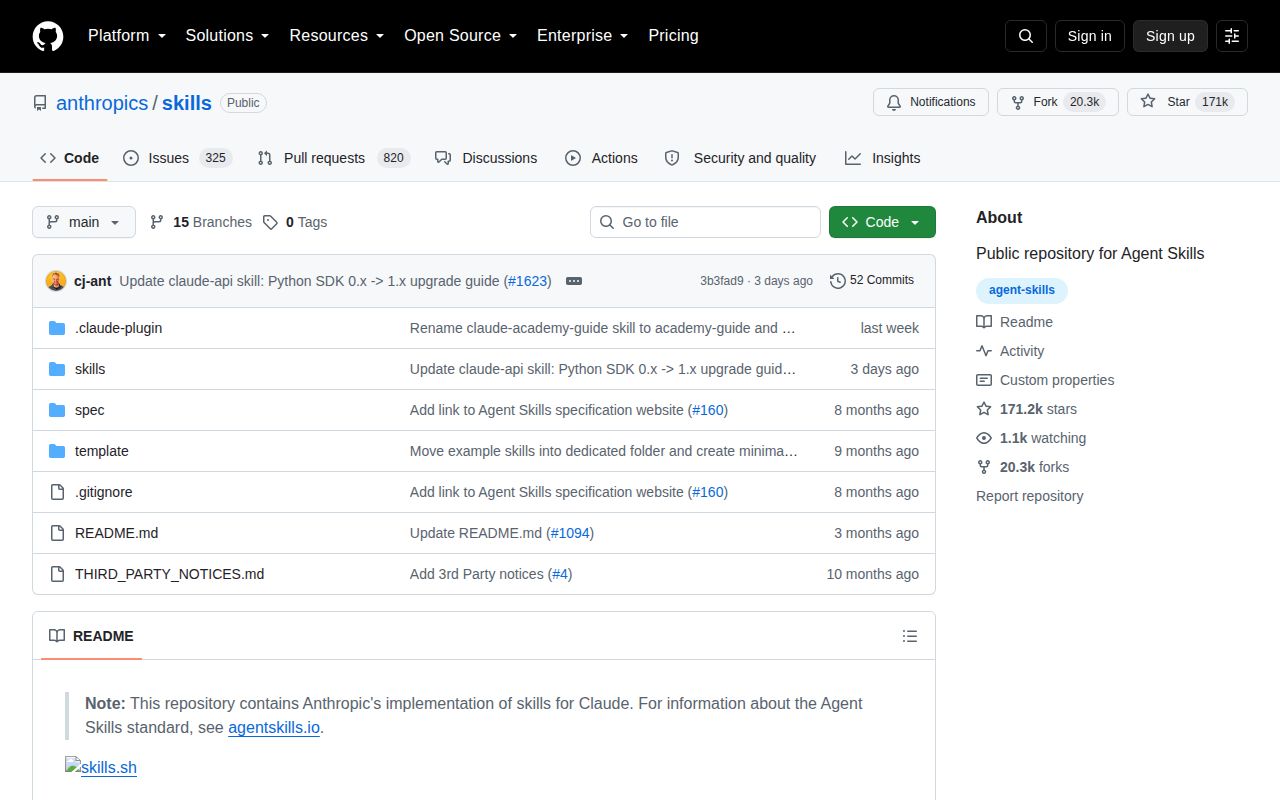
This repository shows that pattern at several levels. There is a basic template, an Agent Skills specification, creative and technical examples, enterprise workflows, and the document skills used behind Claude's file features. Claude Code can register the repository as a plugin marketplace, then install either the document set or the example set. Paid Claude.ai plans already expose the examples, while the Claude API has its own skills interface.
The collection is most useful as readable source. A team can see how Anthropic organizes instructions, routes to supporting files, and packages a plugin. It should not be treated as one library with a single runtime contract. A PDF skill and a Slack GIF skill act on different data, call different programs, and carry different risks.
What happened when we ran it
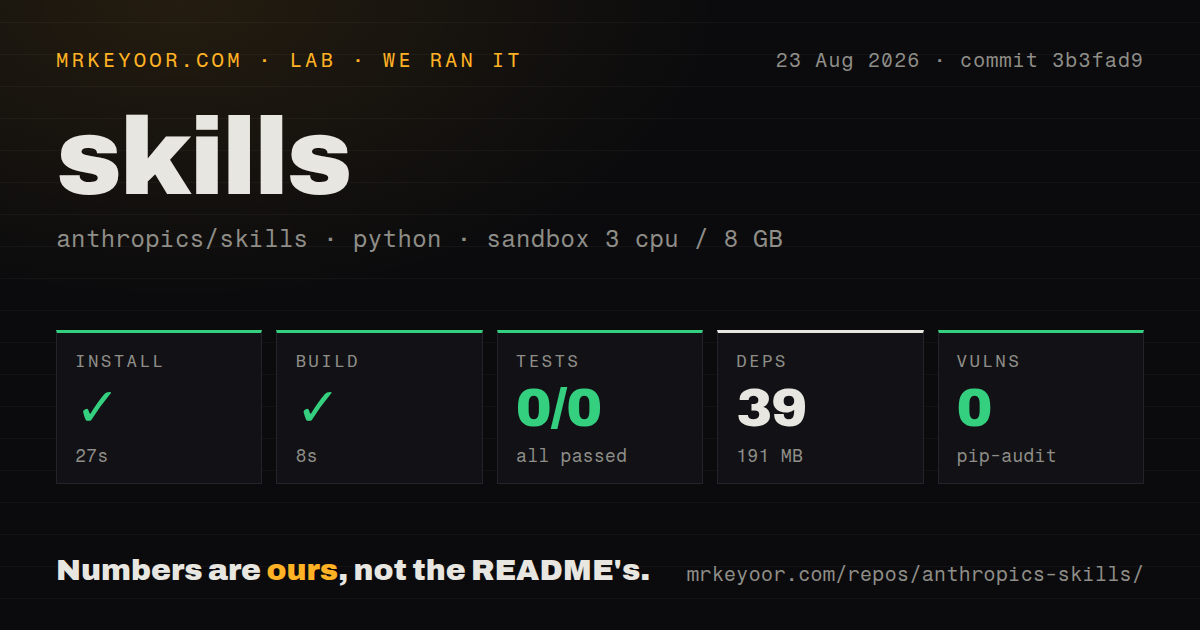
We cloned commit 3b3fad9 into an unprivileged Debian container with 3 CPUs, 8 GB of RAM, Python 3.12, and no secrets. The repository contained 417 files, about 16,032 lines of source, and occupied 10.8 MB. Our harness selected skills/slack-gif-creator as the runnable Python project. Installation succeeded in 27 seconds with 39 packages and 191 MB on disk. Its build succeeded in 8 seconds.
The test command exited 5 after 10 seconds because pytest collected no tests. The parser reported 0 passed and 0 failed out of 0, and the log ended with no tests ran in 0.00s. That is not a failing assertion, and it is not a passing suite. It means this measured subproject offered no collected pytest cases under the invoked target.
pip-audit found 0 known vulnerabilities in the installed environment. The repository had a tests directory but zero CI workflow files in our snapshot, and it had no Dockerfile. Those facts apply to the checkout as measured. They do not validate every script in every skill, nor do they say the files are unsafe. They leave more of the verification job to the adopter.
Installation is easy because execution happens later
In Claude Code, the documented route is to add anthropics/skills as a plugin marketplace, browse its plugins, and install the desired set. Once installed, mentioning a task can activate the matching skill. Creating a basic custom skill is simpler still: make a folder, write the two required frontmatter fields, and add instructions.
The important setup occurs inside the selected skill. A document workflow may invoke file converters or office tooling. A testing skill may control a browser. An MCP builder may create code and processes. A company brand skill may read private templates. The markdown file is small, but the agent can follow it into programs, files, network calls, and generated output. Read the whole folder and list those capabilities before installation.
Descriptions also deserve testing because they decide when a skill is loaded. Too broad, and unrelated prompts may activate expensive or privileged instructions. Too narrow, and the skill never appears when needed. An open issue says the skill-creator evaluation script reports a zero trigger rate for descriptions that otherwise work. We did not reproduce that report, but it is a useful reminder that an evaluation helper is evidence to inspect, not an oracle.
The examples require a security review
Several current issues report unsafe input handling in example scripts. One describes a skill name reaching a filesystem path without sanitization. Others describe shell execution in a server helper, caller-supplied MCP commands reaching a subprocess, and arbitrary connection URLs and headers being accepted by MCP connection helpers. These are public reports awaiting whatever triage or fixes follow; we did not confirm exploitability in our sandbox.
The correct response is not to label the entire repository malicious. It is to apply ordinary code-review rules before an agent runs a script. Pin the commit. Inspect subprocess creation, paths, URLs, headers, and overwrite behavior. Limit filesystem and network access. Use disposable inputs for evaluation. Never give a demonstration skill broad credentials simply because its instructions came from a recognizable publisher.
The README makes a similar scope point directly: these skills are for demonstration and education, and behavior in Claude may differ from the examples. That disclaimer should shape adoption. A production skill needs task fixtures, failure cases, permission limits, and an owner who updates it when tools or formats change.
Licensing and project health
The repository does not have one simple license answer. The README says many skills are Apache 2.0. It separately says the DOCX, PDF, PPTX, and XLSX folders are source-available rather than open source. GitHub exposes no repository-wide license identifier in its facts response. Check the license file inside the exact folder before copying or redistributing its content.
GitHub recorded a push on August 21, 2026, and the repository showed 1,145 open issues and pull requests combined. The latest-release endpoint returned Not Found, so there is no repository release tag to use as an upgrade boundary. Recent issue and pull-request activity shows ongoing work, but adopters need to pin commits and review diffs rather than wait for formal release notes.
Use Anthropic Skills to learn the format and to borrow carefully from a specific example. For production, create a smaller internal skill that contains only the instructions and scripts your task needs. Its permissions, tests, and license should be understandable without inheriting the entire collection.