A completed build leaves persistence unverified
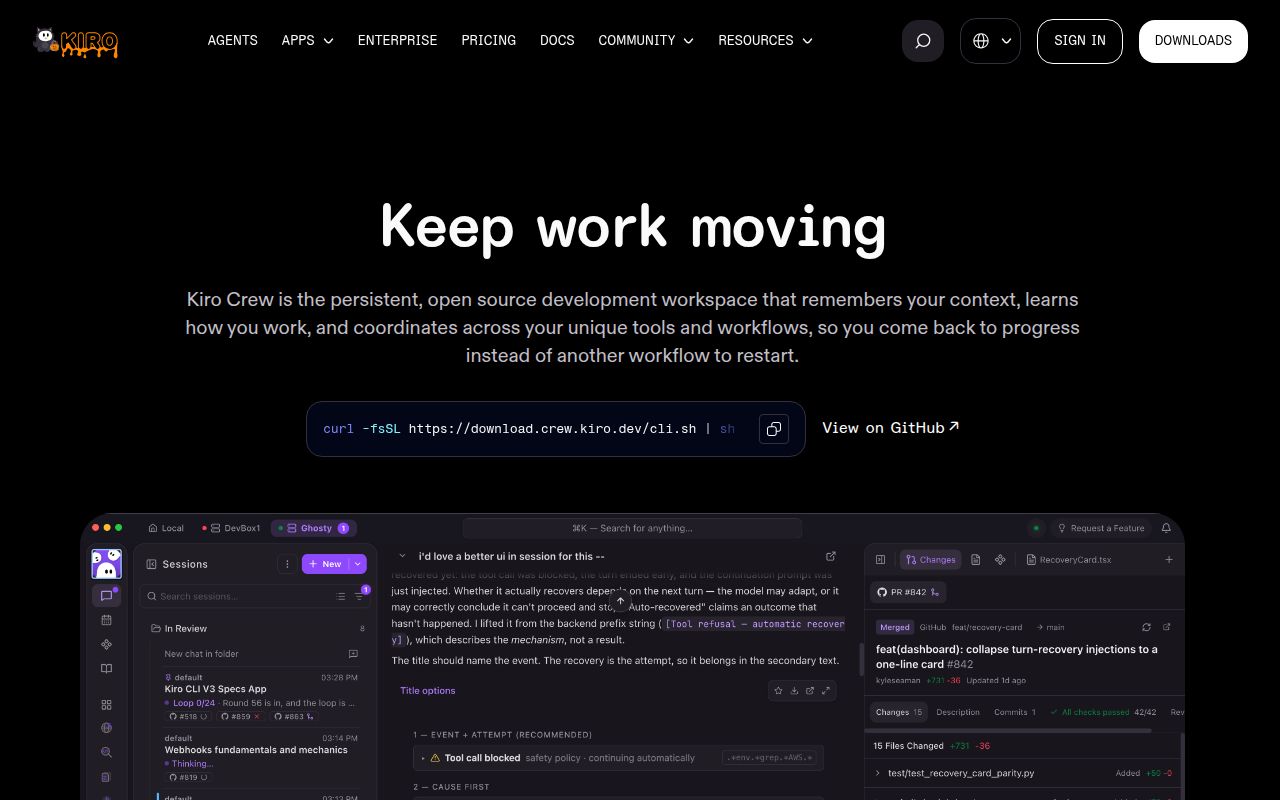
Kiro Crew's appeal is continuity: its README says sessions, memory, schedules and task checkpoints survive Gateway restarts. Developers considering recurring or interrupted work have a reason to evaluate that claim. Our sandbox run completed dependency installation and a build-labelled step, but did not verify recovery after a restart or unattended task reliability.
The Gateway holds state, policy, approvals, schedules, memory and apps on its host. The desktop app, web dashboard, CLI and messaging connections provide ways to reach that work. The README also describes editable lessons derived from corrections and MCP servers for adding tools. These are documented capabilities, rather than results established by this run.
What happened when we ran it
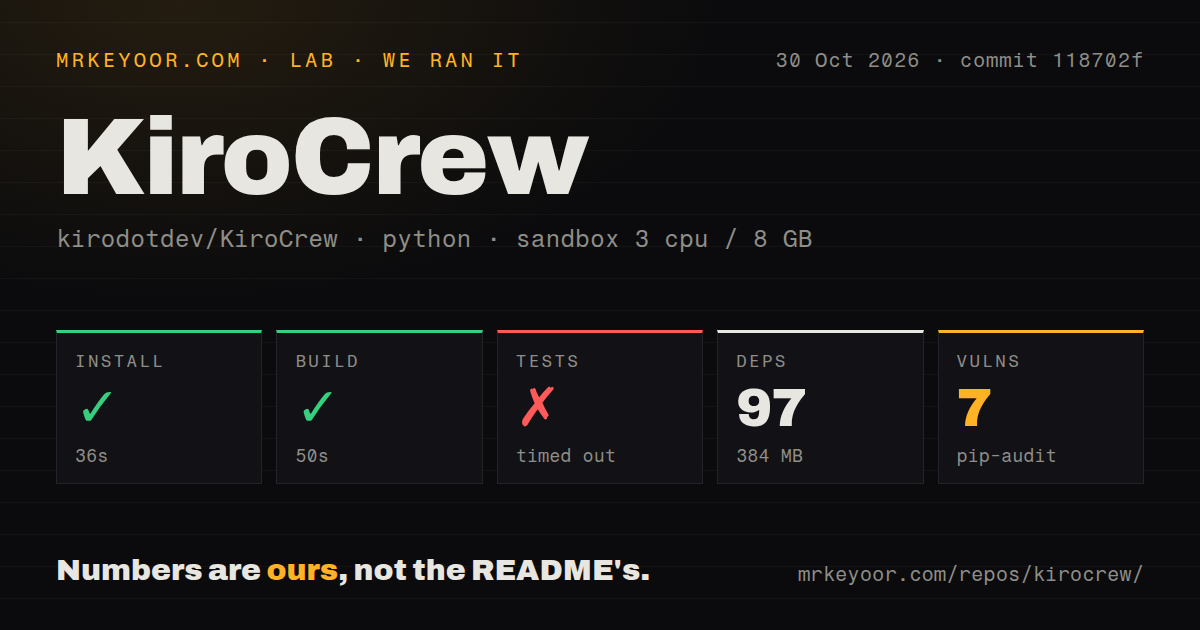
At commit 118702f on October 30, 2026, dependency installation completed in 36 seconds. The build-labelled step completed in 50 seconds, but tests timed out after 900 seconds. The run recorded 97 dependencies and 384 MB on disk. It provides no passing-test count or evidence that an agent completed a development task correctly.
The final supplied log warns that xdist budgeted 2 of 8 workers. It reports 18.7 GiB free, 31 GiB installed and about 3 GiB required per worker, mostly for collection. The warning ends mid-sentence. It shows a worker-budget decision, without establishing whether the suite was collecting tests, executing them or waiting elsewhere when the timeout occurred.
The harness configuration lists 3 CPUs and 8 GB RAM with image ghcr.io/astral-sh/uv:python3.12-bookworm. The supplied evidence does not reconcile that allowance with the warning's memory readings. Neither an out-of-memory diagnosis nor an actual Python or operating-system version follows from these records.
Pip-audit reported 7 known vulnerabilities. The summary records one vulnerable package, but supplies no package name, advisory identifier or severity. Inspect those details before broader use.
The checkout scan recorded 21,265 files, approximately 7,505,075 source lines and 592.3 MB. It detected 76 CI workflow files and a tests directory, without detecting a Dockerfile. That scan result does not contradict the README's documented published container image.
Confirm the backend before first use
Release v0.11.0 says new installs with no saved harness choice start on KAS; an explicit Kiro CLI choice is kept. The release notes say the desktop app ships the pinned KAS engine and no longer bundles kiro-cli.
The supplied README instead says the default agent runs on kiro-cli, which users install and sign in to separately. Its macOS and Linux source route requires Python 3.12+, Node.js 22.12+ and npm, then documents setup, doctor and gateway commands. It directs Windows users to separate instructions.
These sources disagree about the default backend. Confirm the artifact and its selected backend before following either credential setup route. The measured checkout is commit 118702f; the supplied release page identifies v0.11.0 with commit 343a199. This review does not present the checkout measurements as a test of the v0.11.0 release artifact.
Desktop downloads, the signed wheel and the published container are separate installation routes. The source-checkout measurements do not establish their footprint, login behavior or application startup.
Decide what may leave the Gateway
The README says anonymous usage heartbeats and official-app installation receipts are enabled by default. It says first egress waits until the first-run privacy disclosure appears, and documents dashboard controls and a telemetry-disable command. Local hosting alone does not establish offline operation.
The dashboard binds to loopback by default; remote exposure requires authenticated configuration. Upstream also describes tool approvals, credential guards and OS isolation where available. Our run did not evaluate those security controls.
For a supervised trial, use disposable work with an output you can check. Inspect which operations request approval and what happens after a denial. Interrupt the task, restart the Gateway and check whether state and permissions behave as expected. These are proposed checks, not tests completed for this review.
Choose the workflow you want to operate
Aider provides terminal pair programming with an LLM on a new or existing codebase. Evaluate it when interactive editing in the terminal covers your task.
LangGraph is a low-level orchestration framework for long-running, stateful agents. Evaluate it when you want to implement the workflow inside an application.
Kiro Crew instead supplies a development workspace around a persistent Gateway. These recommendations distinguish workflows; this review did not compare editing quality, execution speed or recovery reliability.
What the evidence supports
The repository metadata records a push on October 31, 2026, and the supplied activity extract includes newly opened pull requests. Those observations establish recent activity, without establishing support responsiveness or operational reliability.
Documentation scores 3/5 on a written-guidance rubric: 1 explains purpose only, 2 gives partial setup instructions, 3 provides actionable installation and operating routes with unresolved caveats, 4 provides consistent instructions across the inspected sources, and 5 adds independently verified setup instructions. The README supplies actionable routes and controls, but its default-backend guidance conflicts with v0.11.0. This score assesses written guidance only.
Setup ease, community support and operational maturity remain unassessed. Confirm the backend, inspect the audit details and run a supervised interrupt-and-resume trial before relying on recurring work.