One skill gives coding agents 23 named design operations
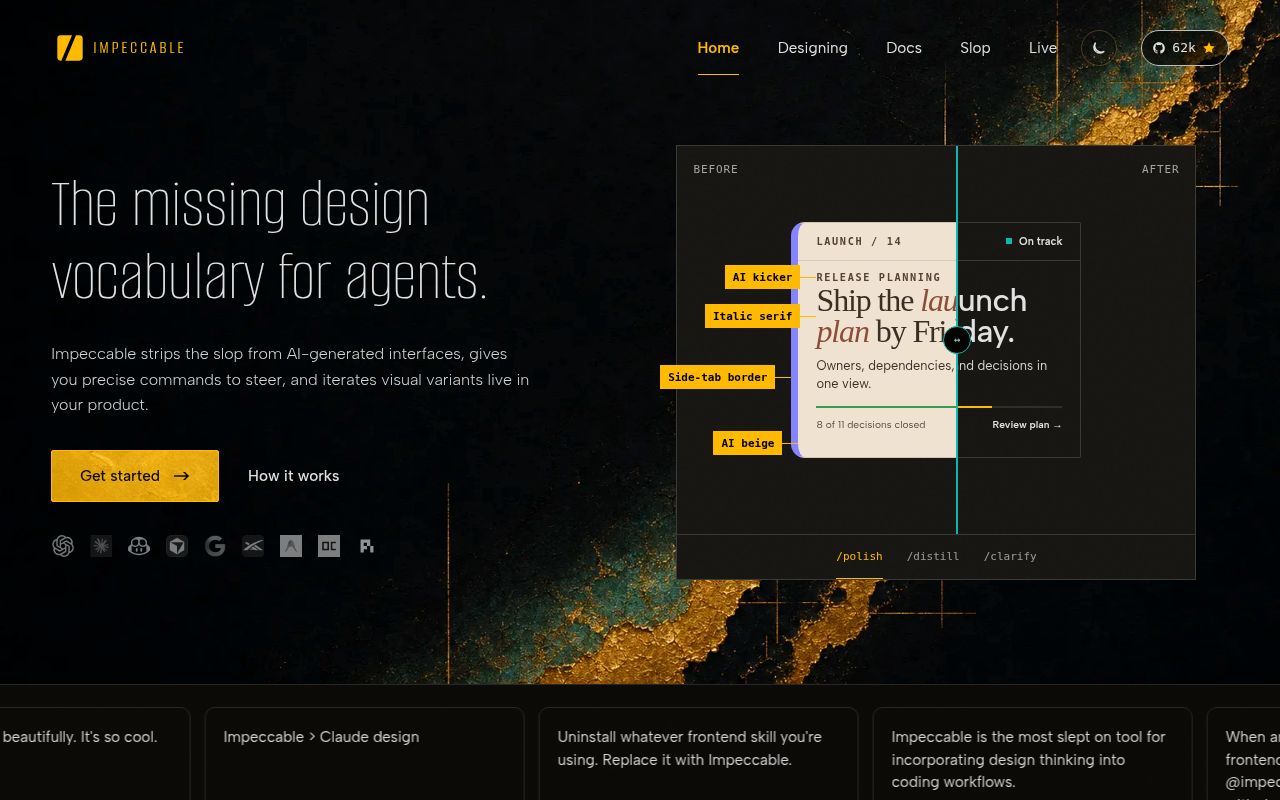
Impeccable turns vague requests such as "make this better" into a shared set of actions. Its 23 commands cover initial direction, interface shaping, critique, technical audit, refinement, typography, layout, motion, responsive work, onboarding, error states, and browser-based variants. /impeccable init records product and design context so later sessions can read the audience, visual lane, voice, colors, type, components, and examples the team wants to avoid.
That persistence is more useful than another prompt pasted into chat. PRODUCT.md and DESIGN.md give the agent project-specific constraints, while command names make requests easier to review in a pull request or task. The repository is substantial: 3,265 files, about 1,281,695 source lines, and a 62.6 MB checkout before installation. This is an evolving toolchain with provider builds, hooks, a browser extension, live mode, and test machinery, not one Markdown instruction.
The 59-rule detector catches patterns without an LLM
The standalone CLI scans files, directories, or a URL and can return JSON for CI. Its 59 deterministic rules cover recurring AI design habits and ordinary interface defects, including font choices, contrast patterns, excessive cards, bounce easing, line length, padding, touch targets, and heading order. Configuration can ignore rules, paths, or values, and inline comments can waive one finding close to the code. No model or API key is needed for this detector path.
A deterministic result is still a heuristic. Issue 656 shows a CSS custom-property fallback such as var(--radius-md, 8px) being parsed as 128px and reported outside the declared radius scale. Issue 662 says the CLI can accept ignore values for rules that will never consult those values. Both reports are specific and recent. They argue for checking the snippet and rule logic before turning every finding into an automatic edit or CI failure.
What happened when we ran it
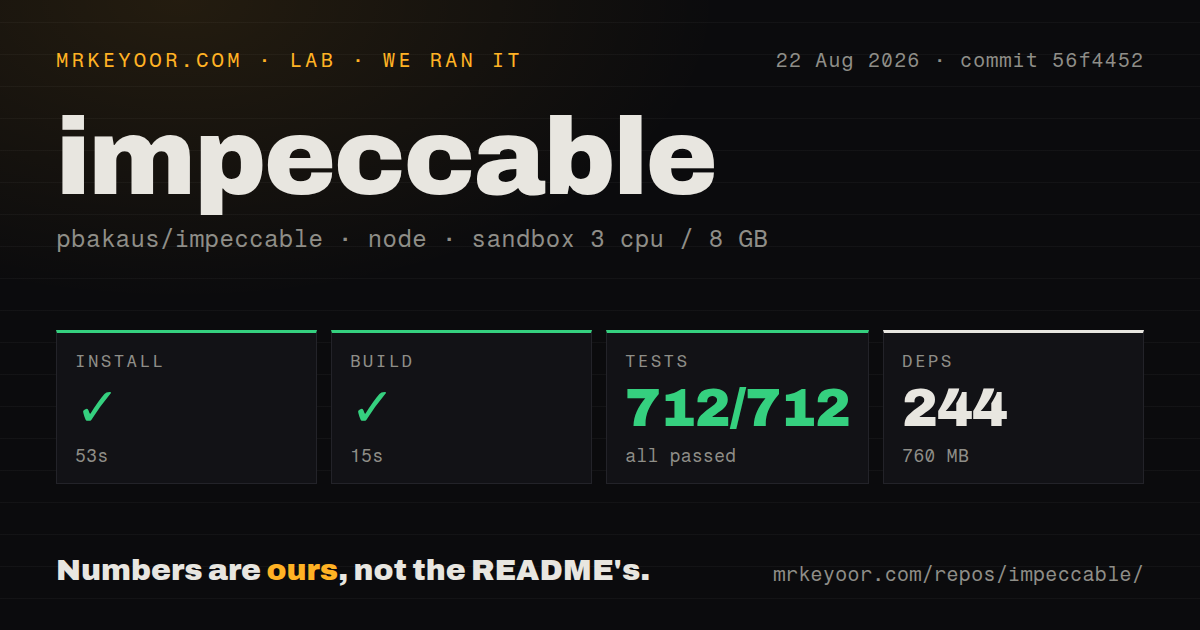
Our sandbox installed 244 packages in 53 seconds, leaving 760 MB on disk. The build completed successfully in 15 seconds at commit 56f4452. We ran the project in an unprivileged Node 22 Debian container with 3 CPUs and 8 GB of RAM. The checkout had no Dockerfile, contained a tests directory, and exposed 3 CI workflow files.
The test script exited with code 1 after 81 seconds. Our harness aggregate recorded 712 Node tests passed and 0 failed out of 712, while the final log tail gave a different script summary: 141 tests, 35 suites, 109 passes, and 32 failures. The process then printed script "test" exited with code 1. We cannot reconcile those 2 summaries from the supplied excerpt, so the decision-relevant result is a failed overall step.
Hooks put findings inside the edit loop
The installer can add provider-native hooks for Claude Code, Copilot, Codex, Cursor, and Grok Build. Depending on the harness, findings appear before a write, after an edit, or when the agent stops. That timing is valuable because the warning arrives while the changed file and intent remain in context. The installer preserves unrelated hook entries and refuses malformed manifests unless the user chooses a forced replacement with backup.
Trust is part of installation. Codex users must open /hooks and approve the project hook after install or an update that changes its definition. Grok Build also requires folder trust. Hook code runs in the developer's project context and reads edited UI files, so teams should inspect the manifest, pin updates, and keep audit logging off unless they have a reason to retain invocation details. A design helper does not deserve invisible execution.
Runtime state needs a deliberate Git policy
Impeccable writes screenshots, session files, preview state, manual-edit evidence, caches, and developer overrides under .impeccable. The README supplies a detailed ignore block, while shared files such as config, design state, and critique reports may remain tracked. A monorepo needs unanchored ignore patterns because the active workspace can sit below the repository root. Existing tracked screenshots also require a separate untrack operation; adding .gitignore does not remove them.
Issue 660 exposes a related lifecycle problem. A critique snapshot can remain on disk after its findings are fixed, then a later polish session treats that stale file as a current backlog. The issue reports a later agent spending about 200,000 tokens proving old findings were already resolved. Until snapshots have a close or freshness path, remove or archive them deliberately when the work is done and inspect inherited critique state before acting on it.
August 2026 activity is high, while stability still needs proof
GitHub showed 62,993 stars, 58 combined issues and pull requests, and a last push on August 26, 2026. The latest GitHub release, Extension 1.3.3, shipped that day with detector accuracy fixes while keeping 59 rules. Active pull requests cover live variant generation, CI routing, and credential redaction. This is a fast-moving project, and provider-specific installation details can change with the harnesses it supports.
Impeccable is worth testing if AI already writes meaningful amounts of your frontend. The 15-second build and no-key detector lower the barrier, but the 760 MB install, trusted hooks, false-positive reports, stale state, and failed test step keep it out of blind-default territory. Start with detect --json on a representative directory, review each rule's usefulness, then enable the skill and hooks for one project. The human accepting the UI should remain the final quality gate.