Agent Sprite Forge built successfully in our sandbox, but its test command timed out after 900 seconds. For a game developer, that leaves two separate checks unfinished: repository verification and whether the exported character looks right in the game editor. The supplied measurements cannot answer the second question.
The README describes skills for Claude Code, Codex and Grok. You approve a master character image, then the agent requests an image-to-video clip for each action. Python tools remove backgrounds, register frames, select loops, retime one-shot motions and package the results. Evaluate it if you can supervise that process and inspect the exports before using them.
What happened when we ran it
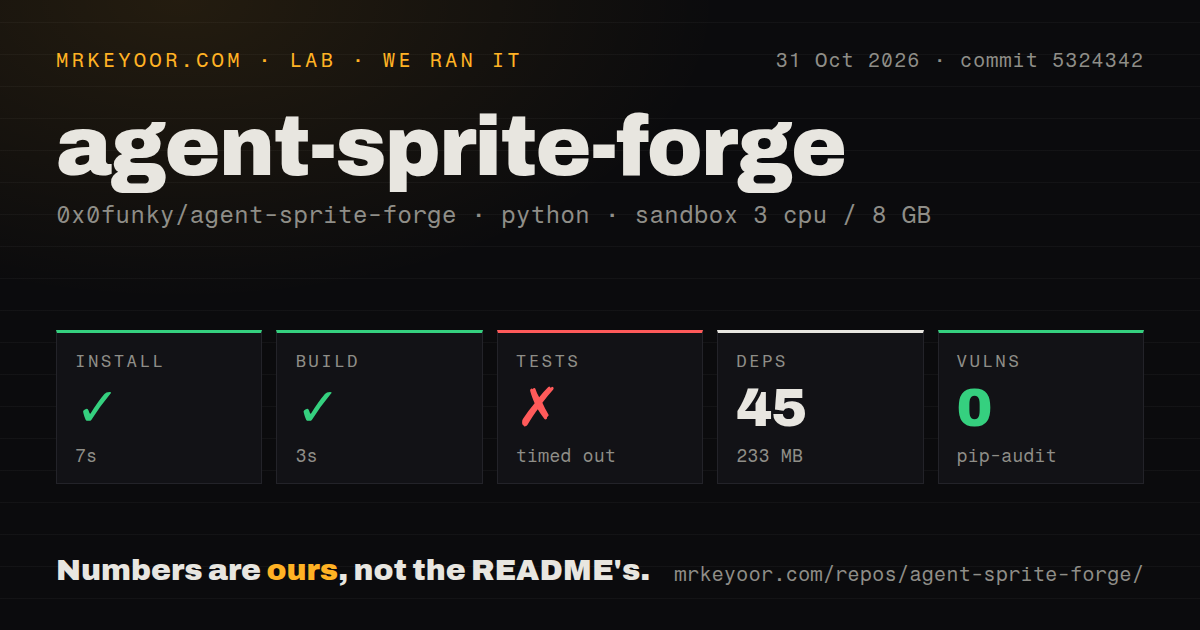
Our October 31, 2026 sandbox run at commit 5324342 installed successfully in 7 seconds and built successfully in 3 seconds. The record lists 45 dependencies and 233 MB on disk. These are repository setup results, not timings for character generation or animation production.
Tests timed out after 900 seconds. The supplied log tail shows progress dots and skip markers, with 83% as the last visible percentage. It ends without a final summary or an exposed exception. The tail does not establish a passing-test count, identify a slow test or explain the timeout. Verification remains incomplete; the timeout alone does not establish that sprite generation is broken.
Pip-audit reported 0 known vulnerabilities. This is the recorded advisory result, not a finding about generated media or editor compatibility. The scan found a tests directory, no CI workflow files and no Dockerfile.
The recorded sandbox configuration was 3 CPUs, 8 GB RAM and image ghcr.io/astral-sh/uv:python3.12-bookworm. The image label does not establish the actual runtime or operating-system versions. The supplied measurements contain no generated-asset quality assessment or game-editor import result.
One approved image still needs review for every action
The documented pipeline uses one master still to guide the character's actions, with an HD finish by default and a pixel finish on request. Its numeric checks do not approve anatomy, identity, motion quality or appeal, according to the known limitations.
The README says the agent looks at every review sheet before accepting an action because numbers cannot see a changed weapon or a covered face. A package that passes structural checks therefore still needs visual inspection. For a trial, choose a character with a distinctive feature and check whether it survives each movement you need.
The pipeline documents retakes, but the supplied sandbox measurements establish neither a retake rate nor a generation cost. Budget for evaluation without assuming that every first take will be usable.
Configure the generation route and spending controls
The README requires Python 3.10+ and ffmpeg 5.1+ with libvpx-vp9 and libx264 for video, sprite sets and packaging. Skills load in a new agent session after installation.
Generation uses configured API providers first, then supported signed-in local CLIs. Code-drawn art is a disclosed fallback when no route exists or when requested. Local CLI generation uses subscription quota. Installing Python dependencies does not establish that your intended generation route works.
The limitations page says automated tests made no live provider call or live CLI run, and a route becomes usable only after verification on the installed version. Treat route readiness as a separate setup task.
There is no spending cap unless you set one. The documented controls include budget and call limits, with cumulative limits recorded over the project ledger. OpenAI image models have no verified price row, so the documented --budget-usd option refuses them. Check the controls for your chosen route before permitting generation.
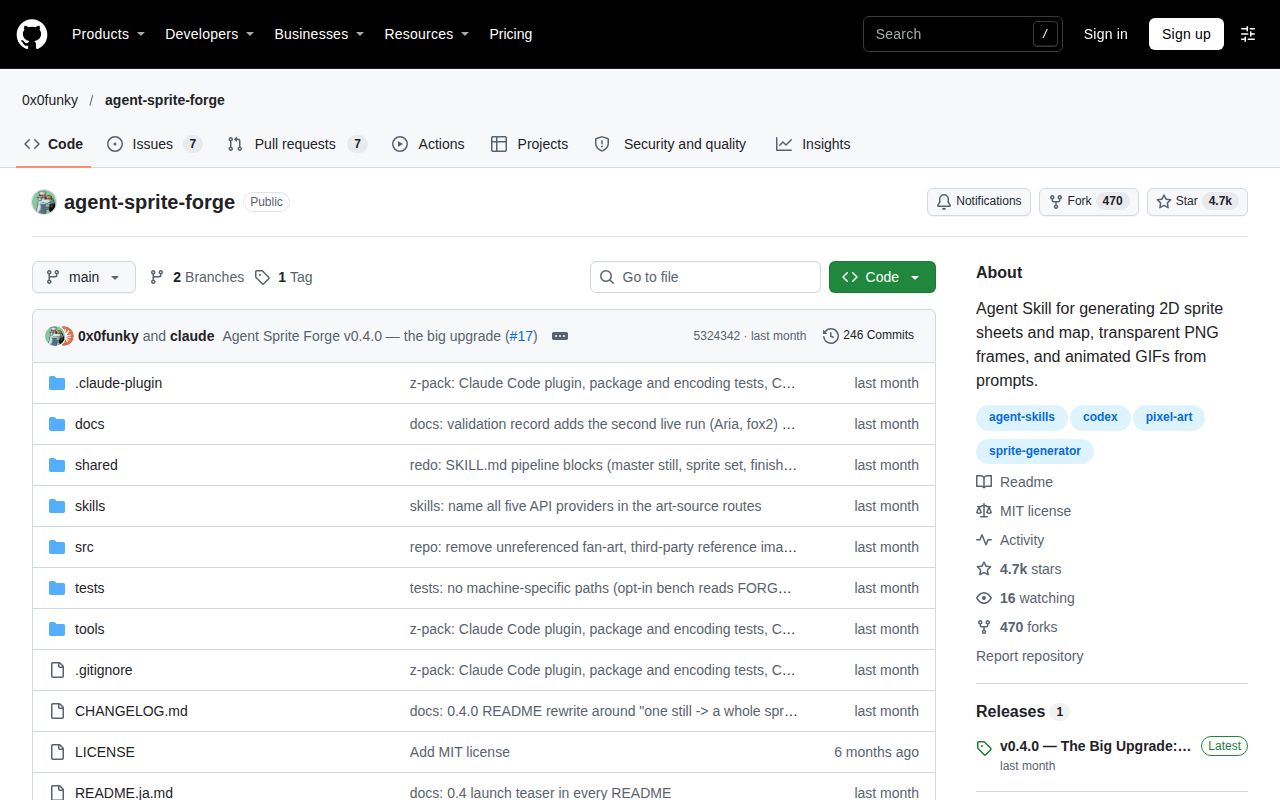
Repository metadata lists MIT. We did not verify licensing terms for generated assets; check the applicable repository and provider terms before commercial use.
Export checks stop short of editor imports
The limitations page says editor imports are not verified. Godot, LDtk and Aseprite outputs have parse-level checks. Tiled output is verified by re-rendering files rather than opening them in the Tiled GUI. Verify the export path you intend to use before generating a larger asset library.
Playback has a separate limit. The documented WebGL compositor check ran in headless Edge or Chrome with SwiftShader, without a hardware GPU, Safari or iPhone run. If those targets matter to your game, check playback there before accepting the delivery format.
When direct frame editing fits better
Pixelorama documents animation layers, frames and onion skinning. Its README also describes drawing while animation plays. Evaluate it when you want to author poses and adjust frames directly.
LibreSprite documents animation previews, onion skinning and sprites composed of layers and frames. Its README describes a program for creating and animating sprites. It is another candidate when direct editing is the task. Neither alternative was measured against Agent Sprite Forge for speed or output quality.
Documentation earns 4/5 on a guidance-only rubric: 1 means missing prerequisites, 2 means substantial missing steps, 3 means a usable documented route with gaps, 4 means explicit configuration and limitations, and 5 requires verified instructions across the assessed scope. The supplied README explains installation, route order and spending controls; the limitations page identifies unverified imports and provider behavior. Those passages support 4 for written guidance, while complete setup remains unassessed.
Start with your own character, one loop and one one-shot action. Inspect the distinguishing details, then import both actions into the editor you will ship from. Complete that round trip before commissioning the rest of the character's moves.