Server rendering and translated expressions share one syntax
Topcoat components are async Rust functions that return HTML through the view! macro. They can query a database or read request context during server rendering without a separate API layer. For immediate browser interactions, the $(...) syntax describes ordinary-looking, type-checked Rust expressions that Topcoat evaluates on the server for the initial page and translates into JavaScript for later updates. The project therefore avoids a WebAssembly bundle and a separate client build step for this supported expression vocabulary.
That qualification matters. Topcoat is not promising that arbitrary Rust becomes JavaScript. Developers work within the runtime's signals, events, bindings, and expression rules. When data must return to the server, a #[shard] component re-renders and swaps its HTML, while procedures expose async server functions to browser code. This model is appealing for applications dominated by forms and server data. It needs a prototype around the most interactive screen before a team assumes every client behavior will fit.
Module files can define routes without code generation
Topcoat can infer URLs and layouts from the Rust module tree. A module at app/about.rs maps to /about, nested files produce nested paths, modules beginning with _ become layouts without URL segments, and API modules can declare method-specific routes. Manual routing remains available. The auto-discovery route does not require a separate build step, according to the README, which keeps routing close to normal Rust structure rather than introducing another generated manifest.
The framework also supplies request context, type-indexed application context, per-request memoization, cookies, sessions with bring-your-own storage, assets, fonts, icons, mail, and integrations for htmx, Alpine AJAX, and Datastar. Topcoat UI copies editable Tailwind-based components into the application through its CLI. Version 0.6.2 added the ability to mount a Topcoat router as an Axum service, a useful escape hatch for teams that already have Axum infrastructure or need routes outside the higher-level framework.
What happened when we ran it
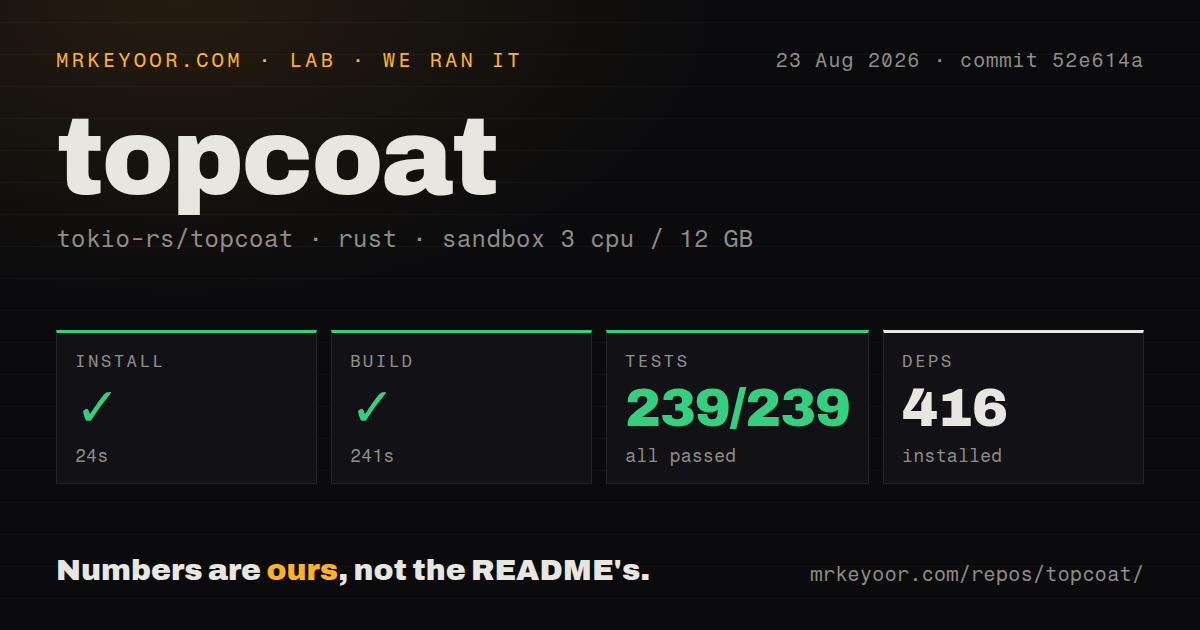
Our commit 52e614a checkout installed 416 Cargo packages in 24 seconds in a Rust 1 Bookworm container with 3 CPUs and 12 GB of RAM. The build succeeded in 241 seconds. Tests then succeeded in 151 seconds: Cargo reported 239 passed and 0 failed out of 239. This is the cleanest possible result from the provided lab block, though it measures source health in one environment rather than browser behavior or production throughput.
The checkout contained 995 files, about 93,671 lines of source, and 6 MB of repository data. It had 3 CI workflow files, no Dockerfile, and no tests directory. Cargo projects commonly place unit tests beside implementation code, so the absent directory does not contradict the 239 executed tests. The total 392 seconds spent building and testing is worth planning around for contributor feedback. We measured correctness outcomes here, not a performance benchmark for applications built with Topcoat.
The 239 passing tests do not make the API stable
The README puts a blunt warning near the top: Topcoat is early-stage and experimental, and users should expect breaking changes. That statement should carry more weight than the star count or clean suite for a long-lived product. A framework reaches into routing, rendering, state, assets, cookies, sessions, and component syntax. Breaking changes across those seams can make upgrades expensive even when the release notes are careful and test coverage is good.
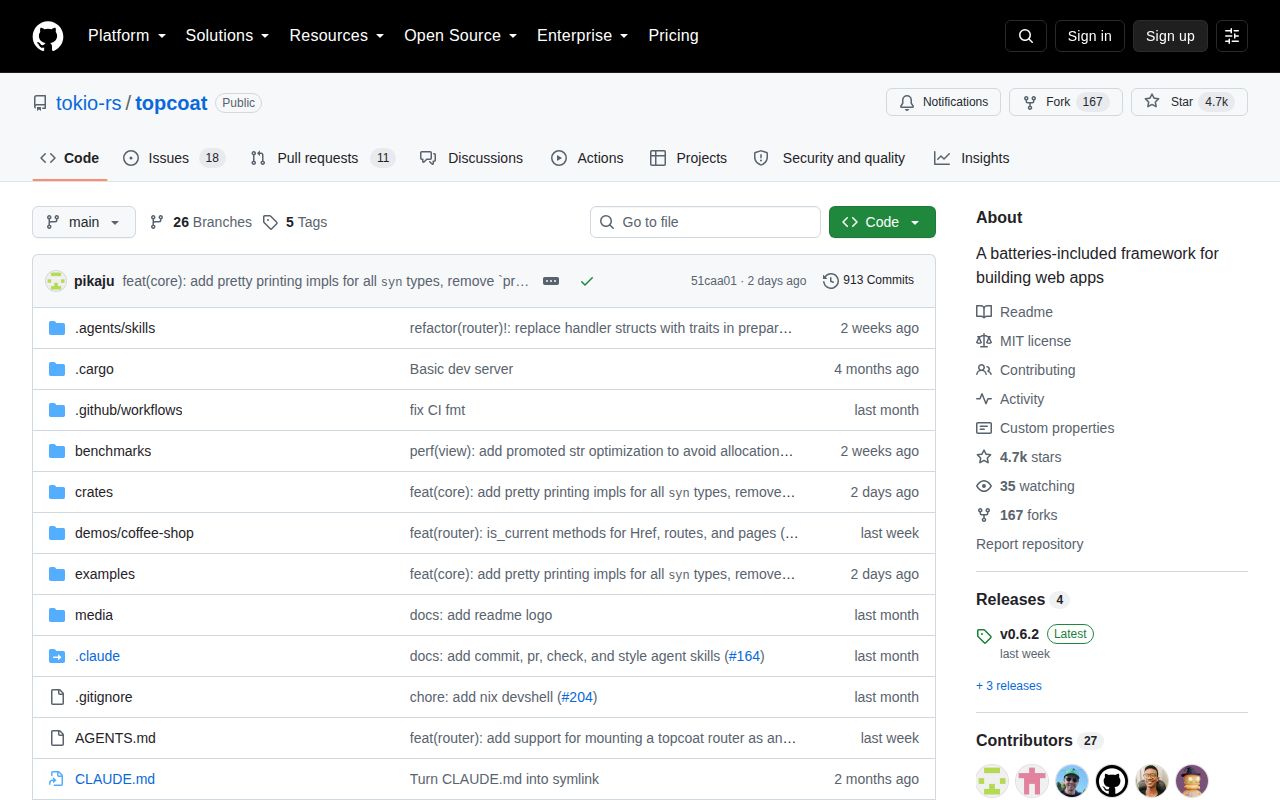
Activity is current. GitHub showed 4,704 stars, 29 open issues and pull requests, and an August 25, 2026 push. Version 0.6.2 had been released one week earlier. The Tokio organization is a meaningful home for Rust users, but organizational reputation is not a compatibility guarantee for a new framework. Evaluate Topcoat on its own stated stability and the application code you would have to migrate if macros or runtime conventions change.
Authentication and deployment remain roadmap wishes
The roadmap lists static export, more reactivity, validation, localization, OpenAPI endpoints, deployment documentation, pre-rendering, streaming SSR, client navigation and prefetching, image processing, authentication, background jobs, and islands as unchecked items. The wording is a list of features the project would like to add, not a delivery promise. Several are ordinary requirements for production applications. Their absence narrows the safe adoption zone to projects that can supply those pieces or live without them.
Sessions already exist, including login and logout lifecycle support, sliding expiration, and token rotation with adopter-provided storage. That is useful plumbing, but it is different from a complete authentication system with identity providers, account recovery, authorization policy, and operational guidance. Similarly, asset bundling and a start function do not answer container hardening, health checks, reverse proxies, migrations, or rollbacks. The roadmap's missing deployment guide leaves those decisions with the operator.
Topcoat is best tested on a disposable product slice
Leptos is the comparison for teams wanting a fuller reactive Rust web ecosystem, including WebAssembly-oriented paths. Dioxus is stronger when one UI model must span web, desktop, and mobile. Loco provides a more conventional server-application structure, while Axum is the smaller HTTP base for teams happy to assemble their own stack. Topcoat's distinctive bet is server-first components plus translated client expressions, surrounded by enough application pieces to feel like one framework.
That bet is interesting and unusually concrete for an experimental project. Our run resolved 416 packages, built successfully, and passed all 239 tests. The cost was 392 seconds of build and test time, and the README still warns about breakage while listing basic production features as wishes. Use Topcoat where replacing it would be tolerable and where its interaction model removes real code. A prototype that survives one upgrade and one deployment exercise will tell you more than the small hello-world example.