Typed extractors make handlers read like request contracts
Axum routes methods and paths to ordinary async functions. Handler arguments declare what should be taken from the request: a path segment, query values, headers, shared state, or a JSON body. Return types implement response conversion, so a tuple can carry a status code and JSON value without a separate response builder. The API avoids route macros and lets Rust's type system catch incompatible handler shapes during compilation.
This style is especially pleasant for JSON services. Parsing and rejection behavior sit at the function boundary, while business logic can receive already validated Rust values. Custom extractors let an application centralize authentication or tenant lookup. The cost appears in compiler errors when trait bounds become complicated. Teams new to Rust web types may spend time learning why a handler does not satisfy Handler, even when the final code is concise.
Tower is the middleware system, not an optional adapter
Axum does not maintain a parallel middleware abstraction. Routers and handlers fit Tower's Service model, so applications can use layers for timeouts, tracing, compression, authorization, request IDs, and other cross-cutting behavior. The same service concepts appear around Hyper and tonic, which helps a platform team share policies between HTTP and gRPC components.
Tower compatibility is the main reason to choose Axum over another ergonomic Rust router. It is also a learning requirement. Layer order changes behavior, error types must line up, and a timeout only helps when cancellation and downstream work behave as intended. Axum gives the pieces a consistent interface; it does not design the middleware stack or prove that the ordering is safe for your service.
What happened when we ran it
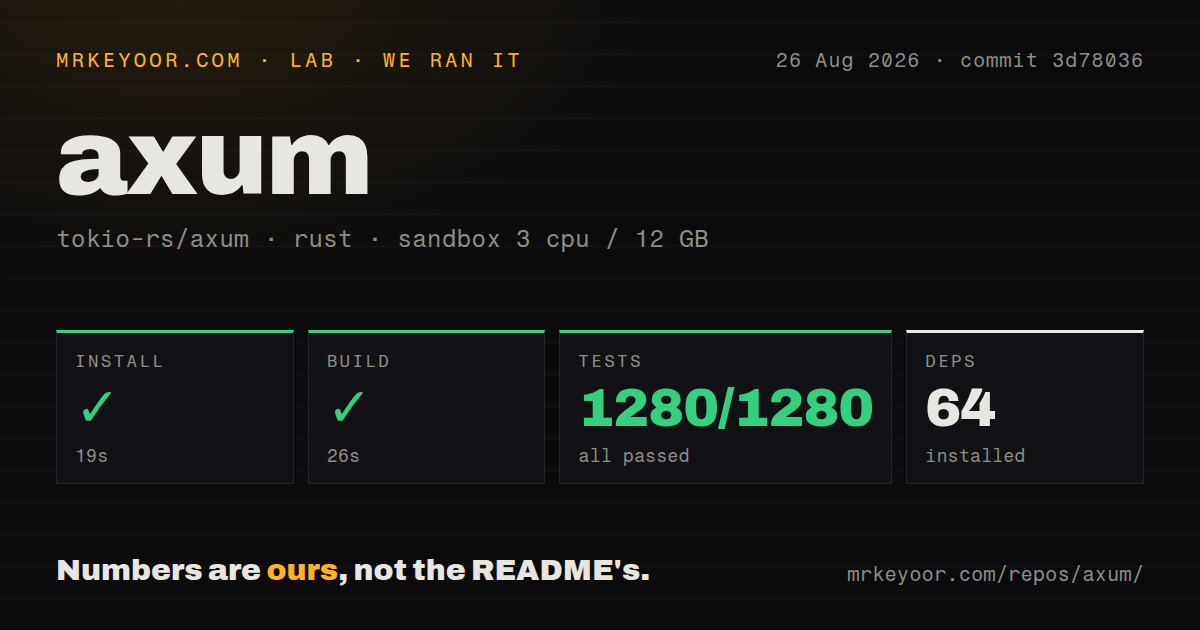
Our run cloned commit 3d78036 into a fresh unprivileged Rust container with 3 CPUs, 12 GB of RAM, and no secrets. Cargo installed 64 packages in 19 seconds. The repository built successfully in 26 seconds, then all 1,280 tests passed in 111 seconds. No failed case or timeout appeared in the supplied result.
The checkout was compact: 498 files, roughly 45,947 lines of source, 1.9 MB on disk before dependencies, and 2 CI workflow files. Our scan found no Dockerfile and no tests directory. Rust projects commonly keep unit tests beside modules and integration coverage in examples or workspace crates, so directory shape is a weak signal here. The 1,280 executed cases are the stronger evidence.
These measurements cover the repository, not request throughput. We did not run an HTTP load test, compare Axum with Hyper, or measure memory use. The README calls Axum a thin Hyper layer and links external benchmarks, but those are not our results. Performance claims for a production decision need the application's handlers, middleware, allocator, TLS path, runtime settings, and target hardware.
Axum supplies HTTP composition rather than a whole application stack
A minimal server needs a Tokio runtime, a router, and a TCP listener. From there, the application chooses serialization, database access, migrations, authentication, sessions, templates, background jobs, configuration, and error reporting. This freedom keeps Axum usable for small APIs and unusual service architectures. It can also produce inconsistent house patterns if every team assembles a different crate set.
Examples and crate documentation show WebSockets, server-sent events, multipart forms, state, error handling, middleware, TLS approaches, and testing. They are building blocks rather than a generated project layout. An organization adopting Axum should provide its own service template with tracing, request limits, shutdown, health endpoints, and dependency policy already decided. That local template supplies the conventions Axum intentionally omits.
The library forbids unsafe code in its own crate. That is a useful boundary, though dependencies and application code can still contain unsafe Rust. Axum's MIT license is simple for commercial use, and contributions default to the same license unless stated otherwise. Neither fact removes the need to audit the crates selected around it.
The released 0.8 line and default branch serve different users
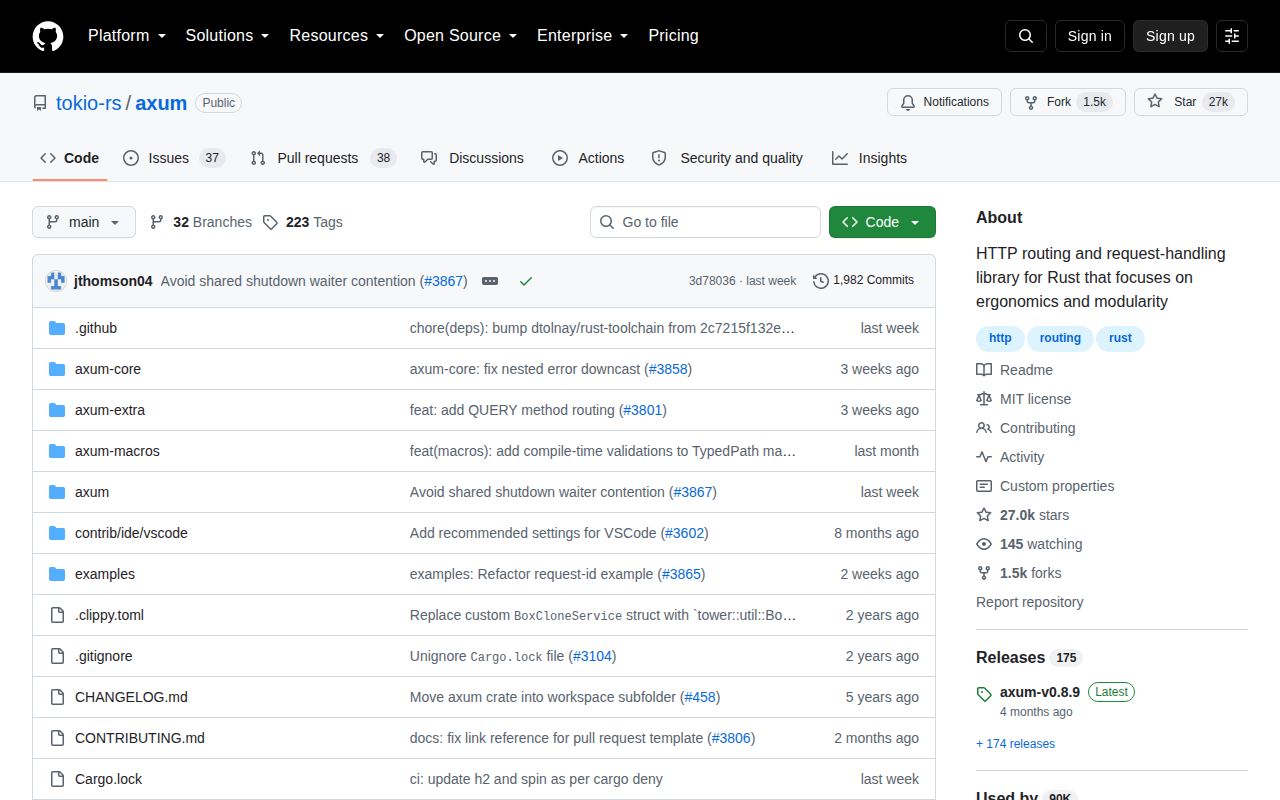
The README puts a prominent warning above its example: maintainers are working toward axum 0.9, and main contains breaking changes. Released users should read the 0.8.x branch and the documentation for the exact crate version in Cargo.lock. Copying an example from main into a 0.8 application can create needless compiler errors or lead a team to APIs it cannot yet ship.
Release axum-v0.8.9 arrived on 2026-04-14. It added more flexible WebSocket subprotocol selection, corrected a CONNECT routing field, improved the multipart limit error, and raised the minimum Rust version to 1.80. That MSRV change is concrete upgrade work for projects on older toolchains, especially distributions that move Rust slowly. Pinning dependencies will keep an unplanned compiler bump out of a routine build.
August work shows active maintenance across core behavior
GitHub recorded the last push on 2026-08-20 and 75 open issues and pull requests combined. Activity continued through 2026-08-23, including work on an inner-path extractor. August changes also touched shutdown contention, CI, request IDs, Tokio feature selection, server-sent events, and connection lifetime limits. The queue is active in the areas an HTTP library must keep correct.
Axum has reached the point where the difficult decision is architectural, not whether the repository works. Our 19-second install, 26-second build, and 1,280 passing tests support confidence in the measured commit. Choose it when Tower is already part of the platform or when a small typed layer is preferable to framework convention. Choose a fuller framework when the team wants more of those conventions maintained upstream.