One Rust codebase can render on the server and in the browser
Our 1,524-file checkout at commit ac0408a supported three web paths: client-side rendering, server-side rendering, or server rendering followed by hydration in the browser. Server functions let client code call logic that runs only on the server without maintaining a separate REST layer for every operation. The router uses ordinary links and forms, while streaming support can send data and HTML as they become ready.
That combination is the reason to consider Leptos. A team already comfortable with Rust can share types and keep server-only work near the components that consume it. The cost is a larger mental model than a browser UI library. You still need to understand which code runs in a native server binary, which code becomes WebAssembly, and what crosses between them. The 1,524-file repository reflects that scope.
The quick start adds cargo-leptos to the Rust toolchain
Our 45-second install covered the repository dependencies. The README's recommended full-stack route then installed cargo-leptos, created an Axum or Actix starter, and ran cargo leptos watch. Browser-only projects may use Trunk or a wasm-bindgen setup. None of those paths requires a Leptos account or framework API token. Your application can still need database credentials and service configuration, but those belong to the app rather than this framework.
There is a specific WebAssembly trap. Code that directly uses rand or getrandom must enable a JavaScript-backed source of randomness for wasm32-unknown-unknown. Leptos configures its own dependency, not yours. The README warns that missing this setting can break a build or leave randomness unavailable in the browser. That is the sort of target-specific detail a Rust team should put in its starter template once, then test in CI.
What happened when we ran it
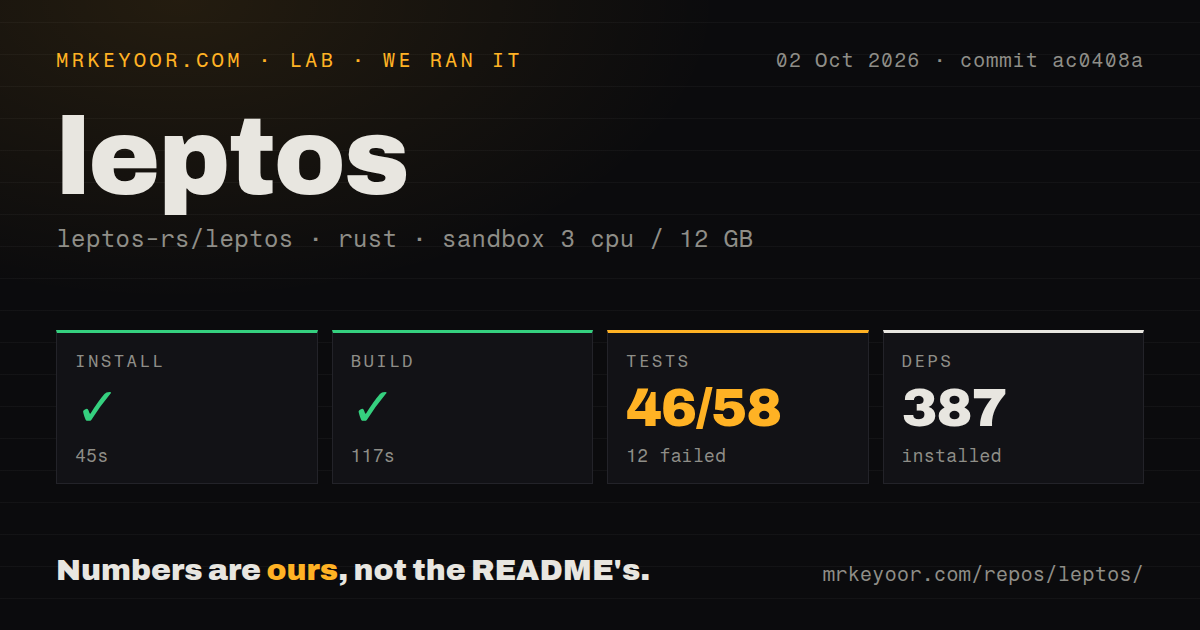
Our fresh Debian sandbox was the measurement setup: 3 CPUs, 12 GB of RAM, no secrets, and no elevated privileges. It installed commit ac0408a in 45 seconds and brought in 387 packages. The checkout held 1,524 files, roughly 132,265 lines of source, and occupied 7.9 MB before installation. The build completed successfully in 117 seconds.
We ran the full cargo test command, and it failed after another 117 seconds. Across the supplied run, 46 tests passed and 12 failed out of 58. The log tail shows several smaller targets finishing cleanly, followed by an SSR result with 6 passed and 6 failed. Cargo ended with exit 101 and named -p leptos --test ssr as the command to rerun.
The tail does not include the failed assertion names or error messages, so it cannot support a claim about the cause. We cannot call this a missing Debian package, a framework regression, or a flaky test from that evidence. The useful finding is narrower: installation and compilation worked on commit ac0408a, while the repository's full test command did not pass in the same clean container.
Our scan also found 8 CI workflow files, no Dockerfile, and no tests directory. The absence of a tests directory does not mean there are no tests, as the 58-test cargo result plainly shows. It means tests are organized within the Rust workspace rather than in that conventional top-level folder. Teams expecting an official container recipe will have to define their own image and decide which workspace checks become release gates.
Signals update DOM nodes without rerunning components
The 132,265-line checkout uses Leptos components that run once to create DOM nodes and connect reactive signals. When a signal changes, the framework can update the affected text node, class, or element instead of rerunning the component and comparing virtual trees. This is a different programming model from Yew and React. It can make update paths direct, but it also means familiar component-lifecycle instincts do not transfer unchanged.
The framework covers more than that reactive core. Its router works on both server and client, server functions keep sensitive logic off the browser, and Suspense can stream HTML. The README says the APIs are basically settled, yet its production answer asks users to distinguish between consuming a finished product and contributing missing pieces. That candor matters more than a broad production-ready label.
Production users may need to fix framework-level gaps
Leptos says several community members run it for work, often while becoming contributors themselves. It also acknowledges that a needed feature may be absent and that a framework fix may not arrive immediately. A team with Rust expertise and room to read internals can accept that bargain. A product group buying a frontend abstraction precisely to avoid framework work should take the warning literally.
The September 26, 2026 release, v0.8.21, included fixes for Suspense concurrency, hydration order, forms, islands routing, and WebAssembly prefetch behavior. GitHub showed 70 open issues and 41 open pull requests on October 3, while the last push landed October 2. The current issue queue and same-week push show that maintainers are still working through edge cases.
Dioxus is the stronger pick when the web is not the main target
Leptos is most convincing when the browser and an HTTP server are the destination. Its own comparison says Dioxus provides a better desktop experience, while Yew keeps a component rerender and virtual DOM model. Sycamore shares the SolidJS influence and fine-grained approach but has a narrower scope. These are design choices, so star counts should not decide between them.
We measured a 117-second successful build, proving that the large Rust workspace can compile in a plain container. The 12 failing tests are the sharper purchasing fact. Pick Leptos if one Rust language across server and browser is worth owning its build path and helping at the edges. If your team wants the framework to disappear behind a familiar frontend routine, this is likely more commitment than you want.