Tiptap gives you an editor engine, not an editor screen
Tiptap wraps ProseMirror in a friendlier extension system for React, Vue, and plain JavaScript. The core manages document state, commands, selection, and rendering hooks. Your application decides what the toolbar looks like, which nodes exist, how links are inserted, and what happens when a user pastes content. That split is the reason to choose Tiptap when editing is part of the product rather than a form field.
The README points to more than 100 extensions across official documentation and the community. Teams can start with common text styles, lists, links, tables, and media, then write custom nodes and extensions for their own content model. This freedom has a cost: every enabled behavior becomes part of the schema and interaction contract. Changing it later can affect stored documents, keyboard behavior, copy and paste, and rendering outside the editor.
The 881 MB workspace is larger than the basic editor you ship
A small application installs selected published packages rather than this whole development repository, so our monorepo disk figure is not a browser bundle measurement. It still shows the scale contributors enter. The workspace contains the editor packages, framework bindings, extensions, demos, and supporting tools. A buyer should measure the production bundle with the exact extension list instead of using the repository checkout as a proxy for client weight.
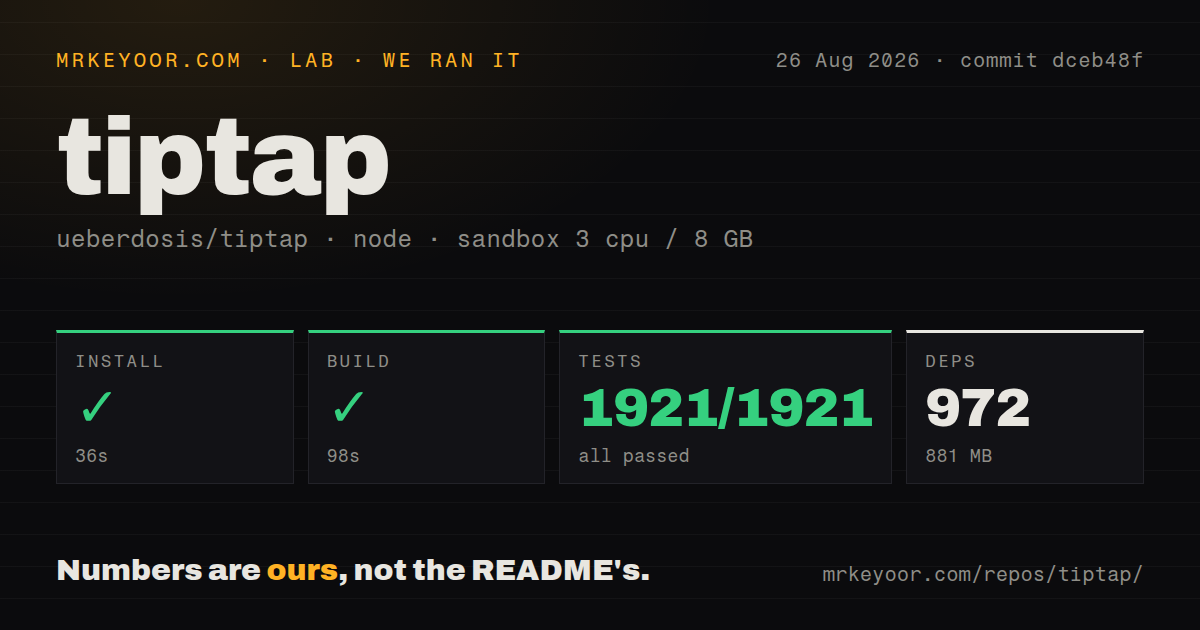
Our clean install pulled 972 pnpm packages in 36 seconds and occupied 881 MB. The checkout at commit dceb48f held 2,098 files, about 163,366 lines of source, and 9.7 MB before dependencies. It is a workspace monorepo with 3 CI workflow files. Our scan found no root Dockerfile and no tests directory, although the configured test command ran successfully.
What happened when we ran it
Our sandbox built Tiptap in 98 seconds after the 36-second install. Vitest finished in 87 seconds with 1,921 passed and 0 failed out of 1,921. The supplied log showed no failed install, compiler error, or test case. For a fast-moving editor codebase with several framework adapters, a completely passing measured suite is a meaningful reason to put it on a shortlist.
The run used an unprivileged Node 22 container with 3 CPUs and 8 GB of RAM. It did not measure browser bundle size, typing latency, collaborative synchronization, document conversion, accessibility, or mobile keyboard behavior. Those are application-level outcomes. An editor can pass package tests and still conflict with a site's CSS, SSR lifecycle, custom node views, or unusual stored documents.
Headless control leaves interface quality with your team
There is no default toolbar to judge or override. That avoids fighting a component library, but it also leaves button states, focus order, keyboard shortcuts, labels, dialogs, touch targets, and error feedback to the product team. Tiptap provides UI templates as a jump start, not a complete design system guaranteed to suit an application. Accessibility testing must cover the assembled editor, not just the core package.
Framework bindings reduce boilerplate without hiding every lifecycle edge. Open issue 7091 reports that React Strict Mode can call onCreate twice with different editor instances. Code that sends analytics or creates remote state in that callback should be idempotent until the behavior is resolved. Open issue 8220 reports a higher-impact case: framework-rendered node-view chrome can enter a redraw loop on iOS and freeze the tab. Test custom nodes on real mobile paths before release.
Open core and paid extensions need separate buying decisions
The editor repository uses the MIT license, and its base editor does not require a hosted account. Collaboration is available through the separate open-source Hocuspocus backend, built around Yjs. Operating it means handling persistence, authentication, scaling, and recovery. The README also lists collaboration, comments, versioning, document conversion, and AI-related work under Pro Extensions, which require a valid subscription.
That boundary is reasonable, but teams should map requirements before building. If comments or DOCX export are mandatory, price and inspect the relevant Pro package rather than assuming an open extension covers it. Issue 8224, for example, reports that a Pro DOCX export extension depends on an archived image parser with 2 cited advisories and no fixed release. The reporter limits the practical impact to a possible browser-tab hang, but the unresolved dependency deserves a check by buyers of that extension.
August releases are active, while the issue queue is broad
GitHub recorded 38,172 stars, 854 combined issues and pull requests, and a push on August 26, 2026. Release v3.30.3 arrived on August 24. Its changes fixed React node-view rendering, nested JSX siblings, text styles inside blockquotes, and YouTube live URLs, while adding an AI streaming-reveal extension. The dated push and release show current maintenance; 854 is not a count of confirmed bugs.
The issue list reflects the range Tiptap supports: core editing, React, Vue, Markdown, tables, mobile behavior, and paid document features all appear. That breadth is useful when a custom editor justifies ongoing ownership. It is also the warning. Tiptap saves a team from writing an editing engine, but it does not save them from designing and testing their editor. Pick it for control, not for a zero-effort rich-text box.