Shared rooms need agents you already operate
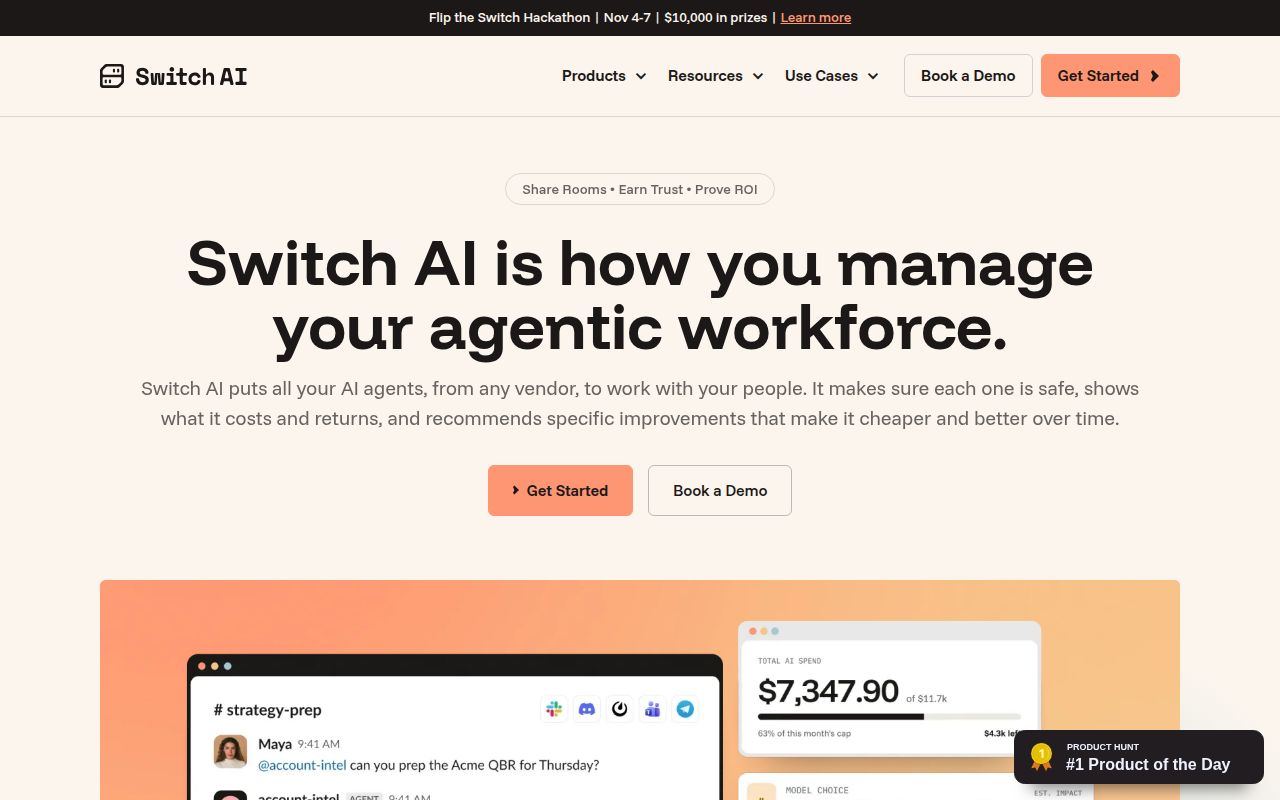
Agent Switch brings existing AI agents into Slack, Teams, Discord, Telegram and Mattermost. Its README says it ships no agents and no models. If your team already uses a coding agent, the attraction is letting a colleague join the conversation and see the context instead of asking someone to paste a private session into chat.
That makes Switch relevant to a team with an agent workflow already worth sharing. A developer who only wants a private model chat has little reason to add rooms, messaging integrations and remote agent hosts. The system connects parts you still have to choose and operate.
The README describes room membership as the boundary for an agent's context. It also describes roles, instructions and tools attached to agents. Those are product claims we would want to check with restricted accounts. Our recorded core run did not establish that room isolation or any messaging connector worked.
What happened when we ran it
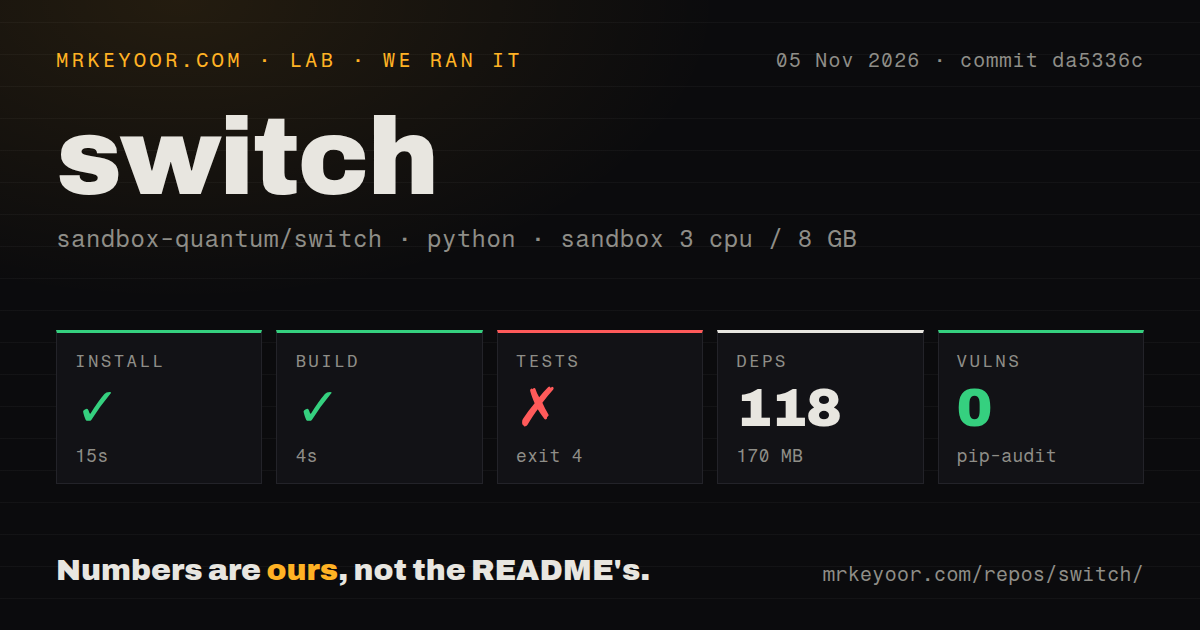
Our Agent Switch core installed in 15 seconds and built in 4 seconds at commit da5336c on November 5, 2026. The run recorded 118 dependencies and a 170 MB installed footprint. Tests exited 4 after 2 seconds.
The supplied tail identifies the immediate failure: loading core/tests/conftest.py reached an import of pytest_asyncio and raised ModuleNotFoundError. The test command stopped during that loading step. It provides no passing-test result, and it cannot tell us whether the core's behavior would pass after the missing module becomes available. The record does not establish why that module was absent.
The configured sandbox had 3 CPUs, 8 GB RAM and image ghcr.io/astral-sh/uv:python3.12-bookworm. The image name cannot establish the actual Python or operating-system version without toolchain logs. The measured Python project was in core/, so its build result does not validate desktop installers or a connected agent session.
pip-audit reported 0 known vulnerabilities. That finding concerns known advisories in the recorded audit, not authorization design or agent access to your files. The scan also recorded 9 CI workflow files and a tests directory, with no Dockerfile detected. That scan does not prove published server containers are absent, and CI file presence does not prove a passing pipeline.
A closed laptop and a reboot are different cases
Switch's remote-host guide says an agent on another machine can keep answering after you close your laptop. It also says a host reboot stops the server and you must start it again yourself. That is a material limit for a team expecting an agent to answer while its operator sleeps.
The documented host path needs working SSH access and an account allowed to install software. A server host also needs Docker. The guide lists Linux or macOS and explicitly excludes a Windows remote-host installation path. The README's Windows desktop download serves a different role, so its existence does not remove that host restriction.
Console installs the provider's command-line tool, but the operator must sign in on the host. It also leaves cloning the repository to you. The agent uses the code in its remote working directory, which can differ from what is on your laptop. Before asking a colleague to rely on an answer, check that directory's revision and the access available to the host account.
For a pilot, close Console and confirm the agent remains reachable through the intended chat app. Then check the documented reboot recovery separately. Those are proposed acceptance checks, not workloads completed in our sandbox.
Desktop telemetry starts enabled
The README says Switch Console collects anonymous usage analytics by default, with a first-run notice and a Share usage data toggle. Listed fields include event names, application version, operating system, provider category and an anonymous installation ID. The project says it excludes prompts, source code, credentials and model outputs. We did not inspect network traffic.
Core has a different documented default: server usage telemetry is off unless enabled. A Console-managed server follows additional rules described in the README, including applying a server setting at startup. Check both components when evaluating your organization's reporting policy. Self-hosting alone does not establish that the desktop sends no events.
The license includes a sale restriction
The license combines Apache 2.0 with a modified Commons Clause condition. Its text excludes the right to sell the software or derivatives and defines sale to include certain paid hosting or related services. Treat it as a license with an added restriction when comparing deployment options. Calling it Apache-only would omit a consequential term.
For a different workflow, Open WebUI documents connections to Ollama and OpenAI-compatible APIs in its own interface. It is a candidate when direct model access is the requirement. n8n combines a visual workflow canvas with custom code and describes itself as fair-code. Consider it when the automation should be designed as an explicit workflow. Neither alternative was benchmarked against Switch.
Active development leaves operational questions open
The repository's last push was November 6, 2026, with recent pull requests concerning agent presence and Console login-error handling. That indicates ongoing work, not verified fixes in a released desktop package. We leave numerical ratings unassessed because the core checks and public documents do not establish deployed reliability, support capacity or platform-wide setup quality.
Start with one restricted room and an agent working on a disposable checkout. Keep access narrow until a colleague can use it, the host recovery procedure is understood, and the missing test prerequisite has been investigated.