AI Goofish Monitor asks you to import a Xianyu login session before you can evaluate the workflow that matters: finding a relevant listing and receiving a useful alert. Our sandbox completed installation and its recorded build step, but it did not establish a working marketplace session or alert delivery.
The repository's primary README is Chinese, and an English README exists. Its documented filters and account handling target Xianyu, also called Goofish. Readers looking for a general monitor across shopping sites should start with a different scope.
Xianyu task management is the reason to consider it
The English documentation describes independent tasks with keywords, prices and AI prompts. You can schedule tasks with cron expressions and narrow results by province, city and district.
AI mode generates analysis criteria asynchronously. Keyword mode creates a task directly from your rules. For an initial evaluation, start with keyword mode and check whether a task finds the listings you expected. Add model judgment after inspecting the underlying search results. This is a proposed evaluation sequence, not a workflow completed in our lab.
The documented notification destinations include Telegram, ntfy.sh and webhooks. Check a complete alert at the destination you use; the documented integrations do not establish that messages arrived in our sandbox.
What happened when we ran it
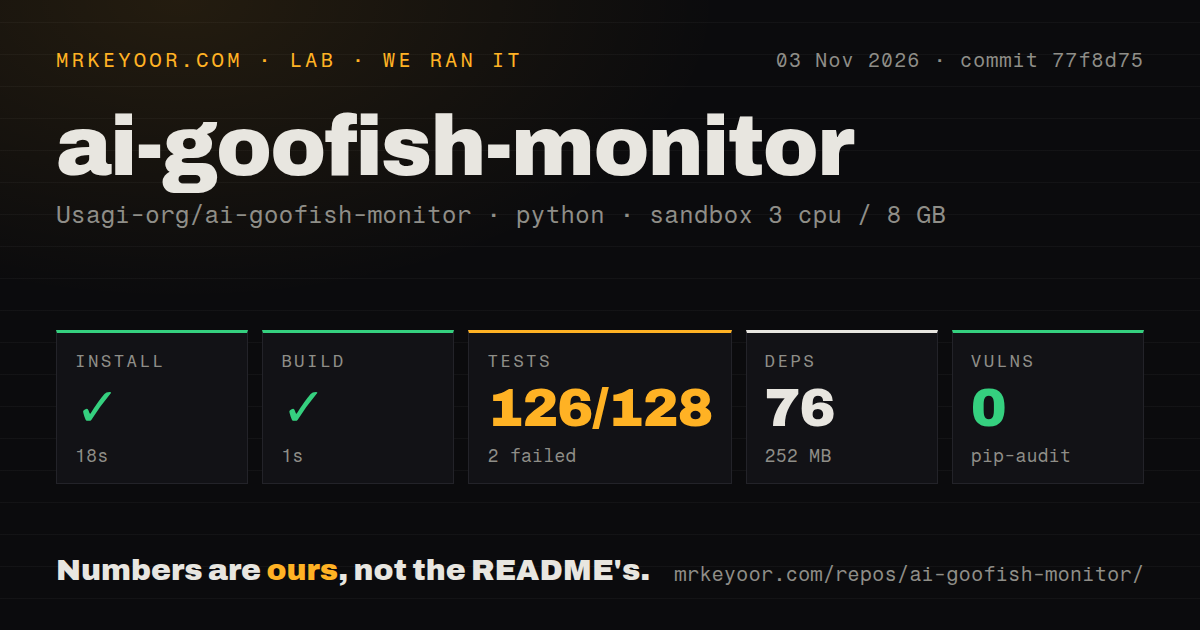
Our November 3, 2026 run at commit 77f8d75 completed installation in 18 seconds and the recorded build step in 1 second. The record lists 76 dependencies and 252 MB on disk. It does not identify enough of that build command to establish that a deployable browser interface was exercised.
The test step exited 1 after 12 seconds. The pytest tail reports 126 passed, 2 failed and 3 skipped, with its own elapsed time of 7.88 seconds. The supplied record also lists a total of 128. These figures are unreconciled, so we do not describe them as a passing fraction. The two durations cover different scopes.
The failures name frontend output-path consistency and JSONL saving. The first assertion complains that web-ui/dist appears in a configuration list. The second compares saved records with expected records; the displayed diff includes additional status and visibility fields, such as _status and _effective_hidden. The tail does not establish which side should change, whether a deployed page is missing or whether listings were lost.
The pip-audit result was zero known vulnerabilities. The audit record lists 76 scanned packages, 76 reported packages and zero skipped packages. This dependency audit does not assess application authorization, login-state handling or marketplace access. The scan also found two CI workflow files, a Dockerfile and a tests directory.
The checkout contained 301 files, approximately 26,331 source lines and 4 MB. Its configured sandbox had 3 CPUs, 8 GB RAM and image ghcr.io/astral-sh/uv:python3.12-bookworm. That label does not establish the actual Python or operating-system version. No measured scraping throughput, recommendation quality or alert latency accompanies this run.
Login state and image-capable AI need configuration
The README lists an AI key, an OpenAI-compatible base URL and a model supporting image input as minimum configuration. The account workflow imports Xianyu login-state JSON. First-time setup uses a Chrome extension to export that JSON, which you paste into the application. Login-state files live under state/.
The documented local route checks for Playwright and a browser before continuing. The recommended Docker image includes Chromium. Neither statement establishes which browser ran in our sandbox. Pick the deployment route you intend to maintain, then confirm that it can use your account and reach the selected model endpoint.
The documentation gives default web credentials and explicitly tells production users to change them. It also warns that frequent marketplace requests can lead to account restrictions. Account and proxy rotation are documented features, but they do not guarantee uninterrupted access. Follow Xianyu's user agreement and robots.txt rules.
SQLite does not contain every file you need to preserve
The English README identifies SQLite as the primary store for tasks, results and price history. Login state and prompts remain filesystem data. Keeping only the database would therefore omit material the documented workflow uses. Decide which directories you need to preserve before relying on scheduled tasks.
The frontend-path failure also merits a deployment check. The successful recorded build does not resolve it. Confirm that the chosen revision serves its interface and assets through the intended startup route; no browser-session result in our record settles that question.
A closed proposal does not resolve the recorded failures
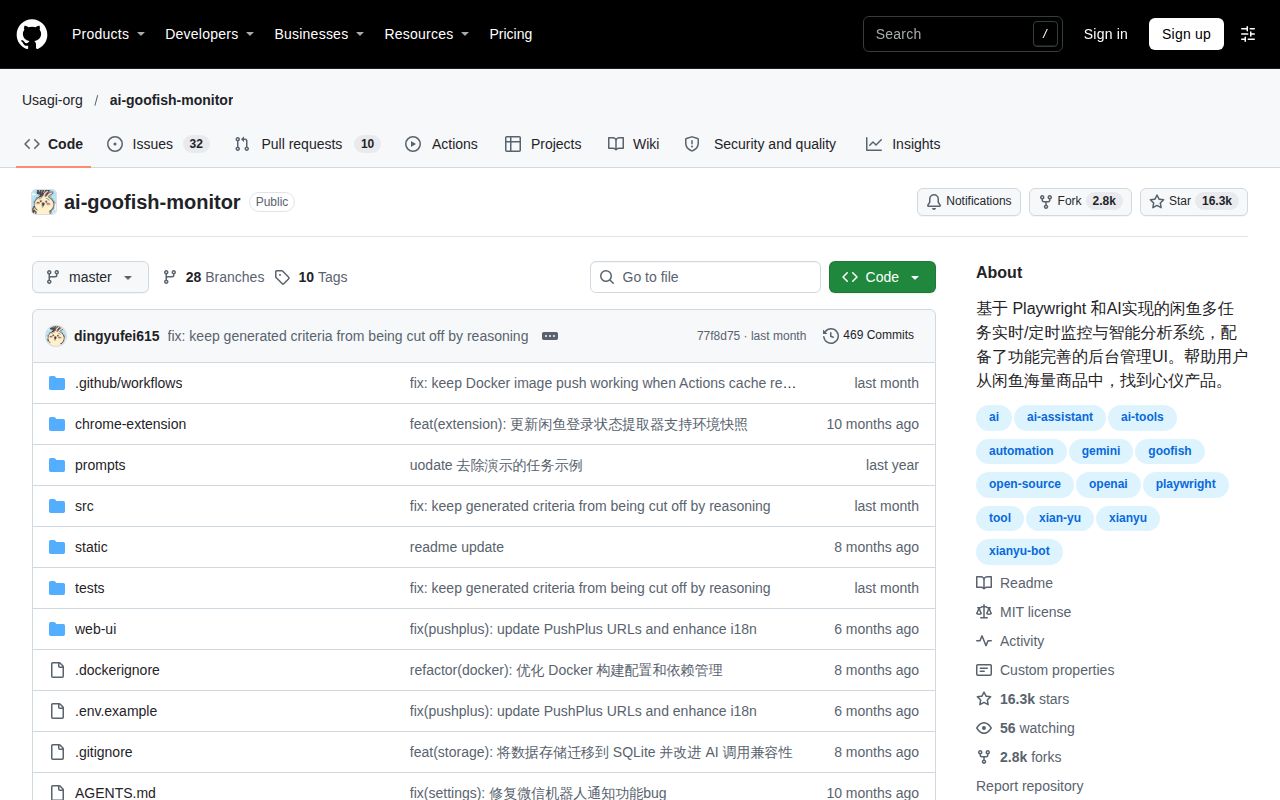
GitHub records the last push on October 10, 2026, while the supplied issues-and-PRs feed includes activity on November 3. PR 522 proposed changes to Windows behavior, output-path configuration and result assertions. It was closed on November 3 without merging. Its author's reported validation does not establish results for our measured checkout. We have not rerun a revised checkout.
Documentation receives 3/5 on this review's scale: 1 means no usable workflow is documented, 3 means a concrete path exists, and 5 requires independent verification throughout. The English account, task and storage instructions support the middle judgment. Setup ease, support capacity and production maturity remain unassessed beyond our repository checks.
Choose between marketplace searches and page changes
xianyu_spider is a FastAPI-based Xianyu product-search interface with Chinese documentation. Evaluate it when you want to integrate Xianyu search results into your own application.
changedetection.io is a website-change monitor with notifications. Evaluate it when changes on selected pages are the question you need answered. We have not verified it against Xianyu or compared either alternative's speed or accuracy.
For AI Goofish Monitor, start with a permitted account, a narrowly defined search and one notification destination. Resolve the recorded assertion mismatches for your chosen revision, then check whether its actual listings and alerts justify keeping an authenticated monitor running.