Check platform fit before setting up automation
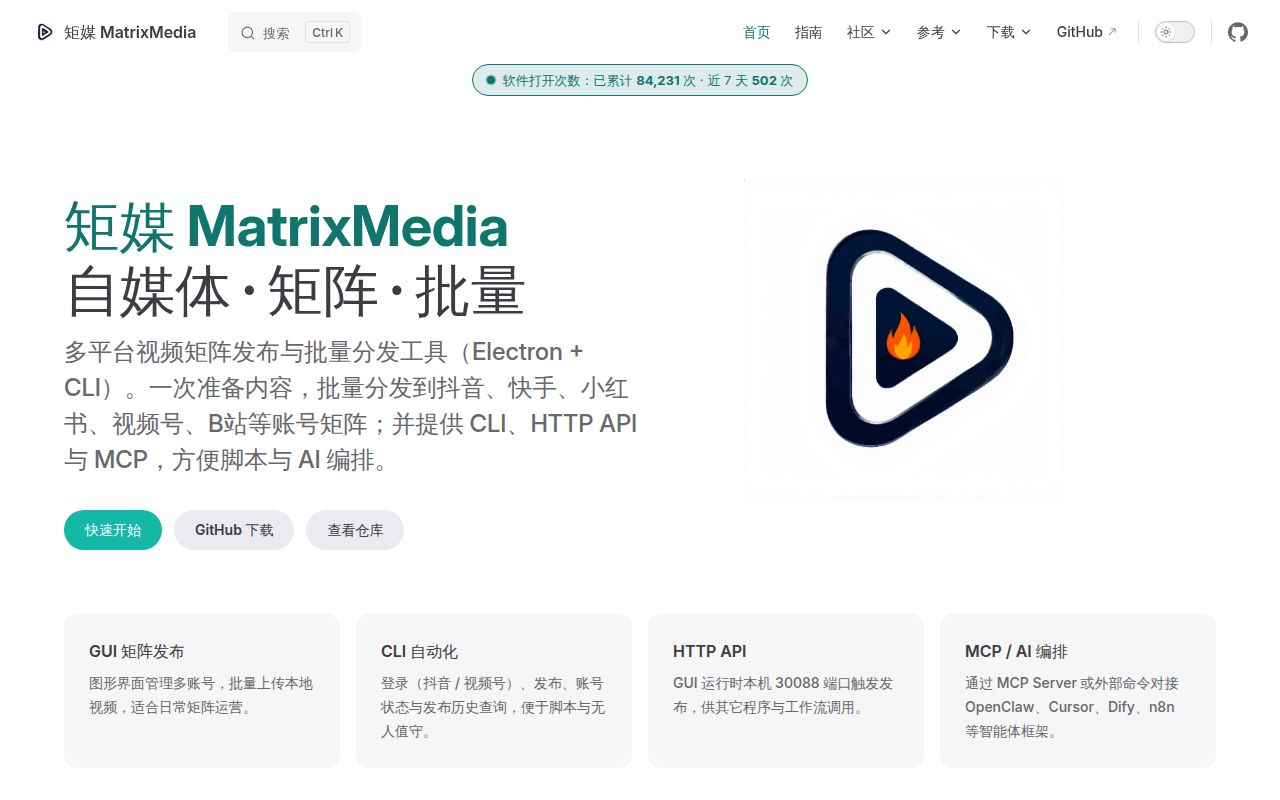
MatrixMedia documents video publishing to eight Chinese platforms: Douyin, Kuaishou, Baijiahao, Bilibili, Toutiao, WeChat Channels, Xiaohongshu, and Fanqie Video. Its Electron interface and CLI combine account checks, publishing, and local history. These capabilities are upstream documentation claims; the recorded lab run did not publish a video.
The supplied README and MCP guide are in Chinese. Operators who cannot read them will need help with setup instructions and account requirements. Check the exact destination before investing in integration: the documented Douyin support does not establish TikTok support.
What happened when we ran it
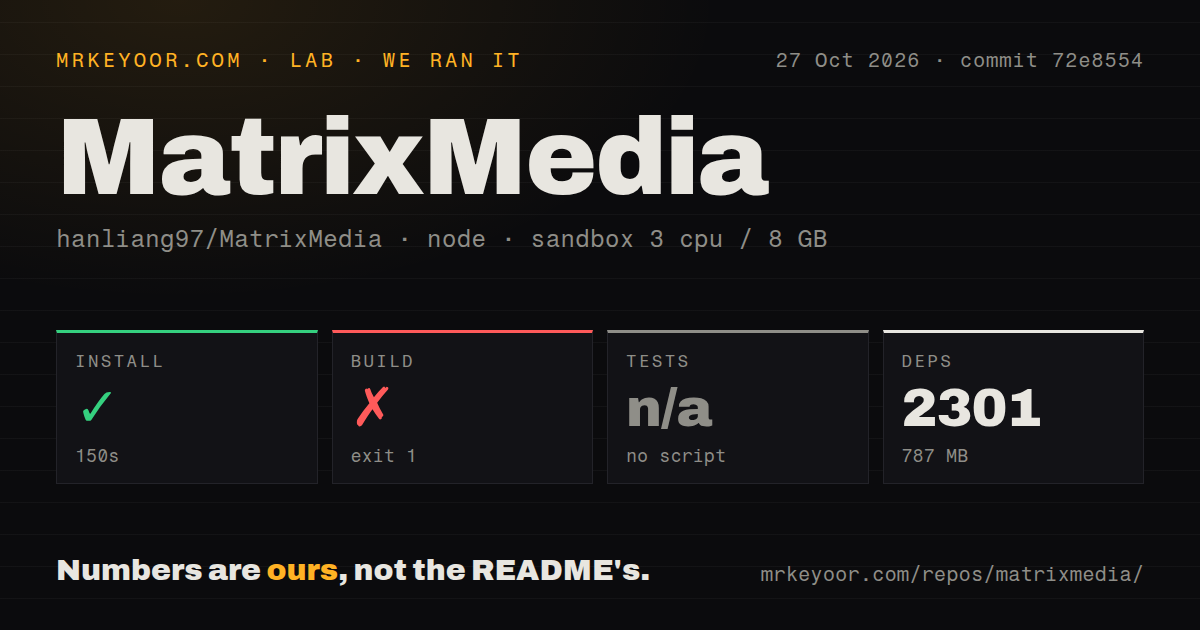
The recorded run used commit 72e8554 on 2026-10-27. Installation succeeded in 150 seconds, with 2,301 dependencies recorded and 787 MB on disk. The source build failed after 65 seconds with exit code 1. That installed footprint does not establish the size of a distributed desktop application.
The supplied build tail includes WinPackager.signApp and doSignAfterPack before Yarn reports failure. It does not show the underlying exception, so it cannot establish a certificate problem, a missing platform tool, or operating-system incompatibility. The finding is an unsuccessful source packaging step in this sandbox. Desktop downloads and upload adapters were not tested.
Tests were skipped because no test script or target was found. The scan recorded 3 CI workflow files, no Dockerfile, and no tests directory. No vulnerability audit result was supplied. These observations describe the recorded checkout and run; they do not establish that the project has no tests elsewhere.
The sandbox configuration recorded 3 CPUs, 8 GB RAM, and image lab-node:22. The image label does not establish the actual runtime or operating-system version. The README names Node 20 for development and says build configuration needs adjustment for the operating system. Setup ease in a supported environment remains unassessed.
MCP reuses sessions but cannot perform interactive login
The MCP guide describes a stdio server that launches CLI subprocesses rather than directly calling the built-in HTTP API. MCP cannot perform interactive login itself. GUI login is the general documented route; Douyin and WeChat Channels also support CLI QR login, and MCP can reuse those sessions.
The README says CLI and GUI share local session partitions. Its HTTP interface requires the GUI process running, while CLI commands can start independently. A publishing machine therefore needs valid platform sessions, whichever command interface invokes the work.
The MCP server also needs building and configuring in the client. The guide describes discovery through an explicit executable path, PATH, default installation locations, or a source checkout. It says an installed desktop application needs no environment variables. None of these integration or account paths was exercised by the recorded run.
Draft success still needs a destination check
Issue 42 reports successful draft responses with empty creator dashboards in MatrixMedia v0.12.9. The reporter used the macOS arm64 package and described the same outcome for Douyin, Bilibili, WeChat Channels, and Xiaohongshu. This is a reported draft-path failure, not a lab result or proof that ordinary publishing always fails.
The maintainer said on October 23 that commit 228d267 added diagnostic reporting for whether the page address changed after saving a draft; independent draft-success checks remained outstanding. The response explains that an unchanged address can be normal for drafts, so this diagnostic alone does not establish failure. The maintainer also said platform-specific checks needed validation with real accounts and kept the issue open pending those checks. The supplied evidence does not establish that v0.13.2 resolves the reported behavior.
During evaluation, compare the command result and local history with the actual draft or published item in the destination dashboard. Decide how to reconcile ambiguous results before enabling automatic retries, which could duplicate a submission that succeeded without a reliable acknowledgment.
Alternatives depend on the workflow
Social Auto Upload documents a unified CLI and agent skills for multiple publishing platforms. Its README places platform commands in sau_commands/ and publishing flows in uploader/. Consider it when that command-oriented structure fits your workflow better than MatrixMedia's desktop application. No comparative publishing or setup measurements were supplied.
Postiz documents team collaboration, commenting, and post scheduling. Its README also describes analytics and distinguishes the hosted service from the self-hosted edition. Self-hosters must create their own platform developer apps and obtain the required approvals. Consider it for a shared scheduling workspace after checking your exact channels and account requirements; equivalent coverage of MatrixMedia's destinations has not been established.
Release availability does not resolve the failed build
The supplied release record identifies v0.13.2, published on October 24, 2026, at commit 72e8554. The readable extract shows an asset count but no filenames, so it does not establish which operating systems those assets target. No downloaded package was tested in the recorded run.
Documentation earns 3 out of 5 on this editorial rubric: 1 means little usable guidance; 2 means partial instructions with major omissions; 3 means concrete setup and integration paths with material gaps in validation; 4 means detailed guidance with most relevant paths corroborated through use; 5 means detailed guidance corroborated across the reviewed workflow. The supplied README and MCP guide support 3 because they explain interfaces, session reuse, discovery, and login limits, but those workflows were not validated in the lab.
Support capacity and production maturity remain unassessed. A useful next step is a supervised trial with an authorized account, ending with the intended item visible in the destination dashboard.