One interface can sit in front of several model services
Open WebUI gives Ollama and OpenAI-compatible endpoints a browser interface with accounts, conversations, files, knowledge retrieval, tools, channels, notes, and administration. The practical appeal is consolidation. A team can expose local models and paid APIs through one place, then decide which users and groups may see each model. It can also connect MCP, OpenAPI, and project-specific tools, so the UI can grow beyond ordinary question-and-answer chat.
That breadth comes from a large application. The commit we measured contained 5,031 files, roughly 258,753 lines of source, and occupied 103.7 MB before installation. Open WebUI includes a Svelte front end and a Python back end, while its deployment options stretch from a local pip command to multi-node Kubernetes. Buyers should treat it as an internal service with data and policy, not as a disposable skin over an API.
The 1,570 MB install is only the application layer
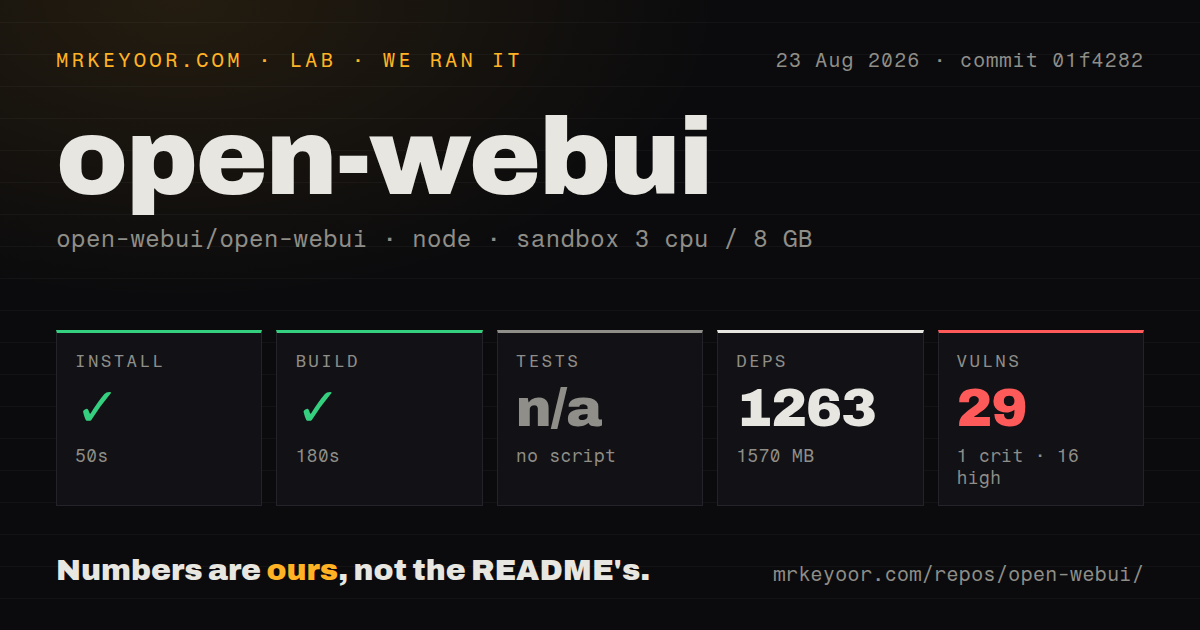
Our sandbox installed 1,263 npm packages in 50 seconds and ended at 1,570 MB on disk. That result does not include an Ollama model, a remote inference server, or user documents. The simplest useful setup points Open WebUI at an existing model endpoint. Running local inference adds model downloads and compute planning, while hosted providers add keys, billing, and their own retention terms.
The README gives workable Docker examples for the common cases. It tells operators to mount /app/backend/data, because omitting that volume risks losing the database with the container. Ollama on the host can also be awkward: a container cannot reach the host service through its own 127.0.0.1, so the documented commands use a host gateway or host networking. That is a normal container boundary, but it often explains a first launch that shows no models.
What happened when we ran it
Our run at commit 01f4282 installed successfully in 50 seconds and built successfully in 180 seconds on 3 CPUs with 8 GB of RAM. The fresh Debian container had no secrets and ran without elevated privileges. A successful source build is useful evidence that the checked-out web application compiled in that environment; it is not an inference benchmark or proof that every optional provider works.
No tests script or target was available, so we skipped tests. The repository did contain a tests directory and 6 CI workflow files, but neither fact gives us a test result for this run. Npm audit found 29 known vulnerabilities in the installed tree: 1 critical, 16 high, 11 moderate, and 1 low. Those findings warrant triage against the deployed paths and current lockfile before exposing an instance to users.
Nine vector stores mean more choices to operate
Knowledge retrieval supports local files, web pages, several extraction engines, hybrid search, reranking, and 9 named vector databases. That range helps a team fit Open WebUI around existing PostgreSQL, Qdrant, Milvus, Elasticsearch, OpenSearch, Pinecone, Oracle, or other storage. It also means the product cannot pick the right retention, backup, embedding, and access policy for you. A serious document deployment needs test queries and permission checks using the same content users will upload.
The default local route can stay compact with SQLite and local files, while larger installations can use PostgreSQL, object storage, Redis-backed sessions, and multiple workers. Each move outward adds credentials and failure modes. Open WebUI documents enterprise authentication, LDAP, OAuth, SCIM, telemetry, and cloud storage integrations, but the presence of a setting does not establish that it matches your identity or compliance requirements. Plan a narrow configuration first and add services for a measured reason.
The license can block a rebranded product
GitHub's repository response did not identify a standard SPDX license. The README is more specific: current code includes Open WebUI-licensed components with a requirement to preserve the Open WebUI branding, alongside older contributions under their applicable licenses. That is materially different from adopting an MIT or Apache-2.0 component and freely replacing its identity. Legal review belongs near the start if the interface will ship inside a product or under another brand.
The hosted enterprise offer includes custom branding, support, and long-term-support releases, which may resolve some commercial requirements through a separate agreement. It also changes the buying decision. A hobby deployment can accept fast community releases, while an organization may care more about update windows and contractual support. Release v0.11.1 appeared on 2026-08-25, and the repository was pushed again on 2026-08-26, so maintenance is plainly active rather than inferred from an old tag.
Active development increases the upgrade burden
GitHub listed 150,045 stars and 206 open issues and pull requests when we fetched the project. The combined count is not a bug total. It does show a large audience and a busy development surface. The latest release spans tool approval, model questions, streaming changes, file handling, performance work, and fixes across many subsystems. Administrators should read release notes and test their own provider, storage, authentication, and retrieval paths before replacing a working instance.
Open WebUI earns its place when one maintained service can replace several disconnected chat front ends. Our 180-second build passed, and the documented deployment range is unusually wide. The cost is visible in the same evidence: 1,263 packages, 1,570 MB, 29 audit findings, a mixed license, and no runnable test target in our checkout. Choose it for the workspace and controls. If those features are incidental, the smaller alternatives demand less care.