The visual editor earns its keep when workflows cross systems
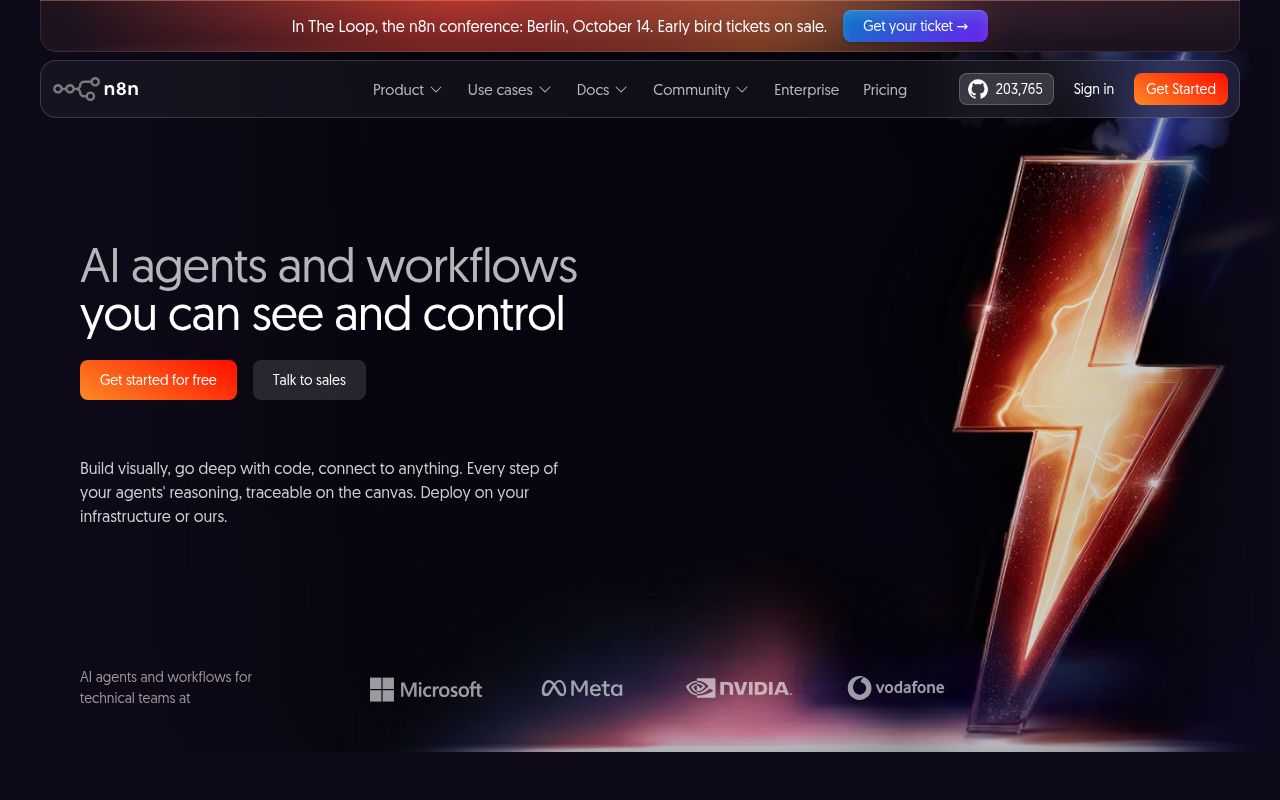
n8n gives technical teams a canvas for triggers, branching, data transformation, approvals, API calls, and AI steps. The useful distinction is that the canvas does not fence developers out. A workflow can include JavaScript, Python, npm packages, HTTP requests, or a custom node when a packaged connector falls short. That makes it suitable for operational work that begins as a simple integration and later needs error handling, review steps, or application logic.
Breadth is the attraction. The README claims more than 1,500 integrations and 9,000 workflow templates, with model connections for OpenAI, Anthropic, Google, and open models. Those figures describe available starting points, not instant compatibility with every account. Each serious workflow still needs credential setup, field mapping, retries, and a decision about what happens when an upstream API changes. The editor makes that work visible; it does not make external systems reliable.
A 27,101-file monorepo is a product platform, not a script runner
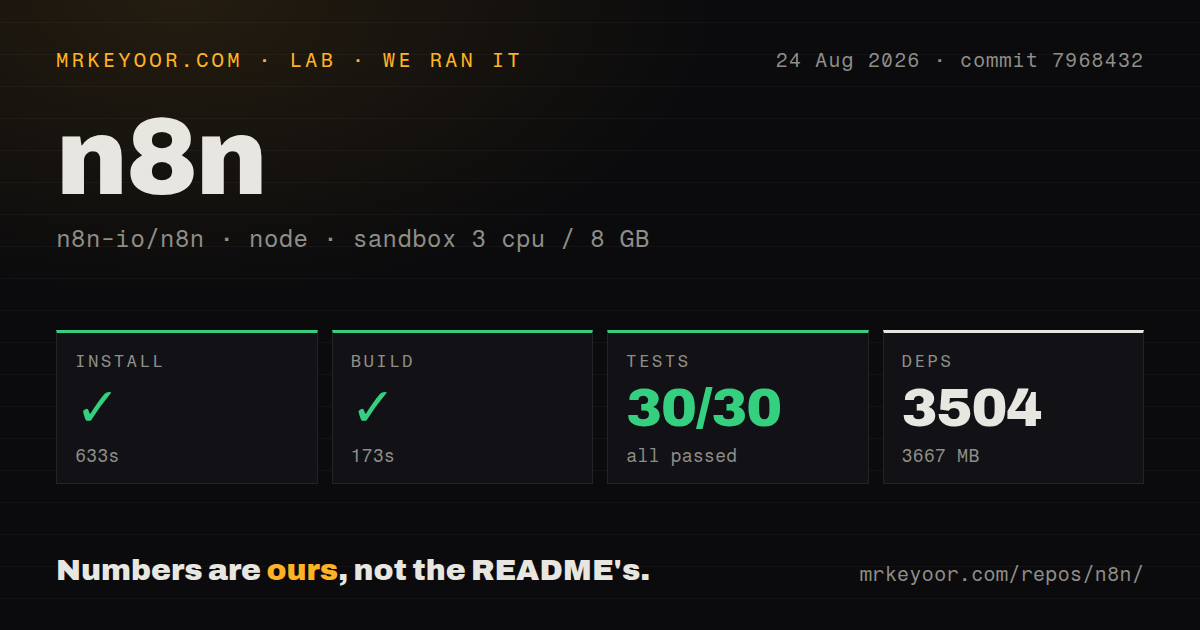
The source tree makes n8n's cost easier to understand. We checked out commit 7968432 and found 27,101 files, roughly 4,072,125 lines of source, and 194.7 MB before installing dependencies. It is a pnpm workspace with 96 CI workflow files. This is closer to adopting an application platform than adding a utility to an existing Node service. Teams should budget time for release notes, database migrations, backups, and workflow regression checks.
That cost can be sensible. A visual record of which webhook called which service is easier for an operations team to inspect than scripts scattered across servers and personal accounts. Human approval steps and execution history also matter once an automation can send messages, change customer data, or call an agent. For two nightly API requests, ordinary code and a scheduler remain easier to audit and cheaper to maintain.
What happened when we ran it
Our sandbox installed 3,504 packages in 633 seconds and consumed 3,667 MB on disk. The build succeeded in 173 seconds. Those numbers put a real price on source contribution and private builds: a fresh environment needs several minutes and gigabytes before any workflow runs. The checkout used Node 22, 3 CPUs, and 8 GB of RAM in an unprivileged Debian container with no secrets.
The test step exited 1 after 54 seconds. Vitest reported 30 passed and 0 failed, yet the wider Turbo run stopped at @n8n/computer-use#test. Its summary showed 63 successful tasks out of 74, with 40 cached. The tail also warned that five packages had no declared test output files. The log does not identify the underlying computer-use error, so blaming a missing package or service would be guesswork. The repository-level test command did not complete successfully in our stated environment.
Self-hosting moves credentials and callbacks onto your plate
The README's Docker route is short: create a volume, expose port 5678, and run the published image. That is enough to see the editor. Production is where the real setup begins. OAuth callbacks need a stable public URL, webhook triggers need inbound routing, and every integration brings a token or account grant. Backups must cover the database and encryption material, because stored credentials and workflow definitions are the service's core state.
Execution capacity also changes with the work. A webhook that edits JSON is unlike browser or AI work that waits on remote services and may consume more memory. Release n8n 2.38.4, published September 7, 2026, fixed shutdown ordering, task timeouts, failed external-secret replacement, and Anthropic agent-thread errors. Networking, persistence, and worker behavior belong in every upgrade checklist.
Fair-code terms rule out some commercial uses
n8n calls itself source available and self-hostable, but its README links the Sustainable Use License rather than an OSI-approved license. Files with .ee. in the name or .ee in their directory need a separate enterprise license. The Sustainable Use License limits use and modification to internal business, non-commercial, or personal purposes, and distribution must be free and non-commercial. Legal review is warranted when n8n becomes part of something sold to customers.
This distinction is easy to miss because the repository looks and works like a familiar public project. It should affect the buying decision before a team builds dozens of workflows around it. Activepieces, Windmill, and Huginn approach automation with different product boundaries and licenses. Compare the exact use case, especially if customers will access the automation layer or if the product itself competes with hosted workflow software.
September 2026 activity is high, and so is change risk
GitHub showed 203,788 stars, a last push on September 9, 2026, and 1,181 combined issues and pull requests. The combined count is not a bug count. Open issue 36863 reports a specific MCP composition failure: upstream tools appear in tools/list, then fail on tools/call when an MCP Client Tool sits behind an MCP Server Trigger. The issue was still being updated on September 9, which is evidence of current user and maintainer attention as well as an unfinished edge.
For a team already maintaining a stack of brittle Zapier-style flows and private scripts, n8n can put ownership, history, and code escape hatches in one place. Our 633-second install and failed top-level test make source work heavier than the friendly Docker command suggests. Start with one consequential workflow, rehearse backup and restore, pin the deployed release, and confirm its licensing fits the service you intend to offer.