Substrate runs agents; it does not build them
Agent Substrate manages the processes underneath an agent framework. Its premise is that long-lived agents often wait for a person, a model response, or an external tool. Keeping one Kubernetes pod active for every idle process wastes capacity. Substrate maps many logical actors onto a smaller worker pool, then moves them as demand changes.
When an actor goes idle, the system can suspend it and preserve volatile memory plus filesystem state. Incoming traffic causes the router to find capacity, restore that actor inside a sandbox, and send the request to its new worker. The README's demo shows roughly 250 stateful actors across 8 physical pods and reports sub-second activation. Those are project claims from its demo, not figures from our sandbox run.
Eight physical pods illustrate the density argument
Kubernetes still provisions infrastructure and worker pods. Substrate adds an API server, controllers, a node supervisor, networking components, a command-line plugin, snapshot flows, and sandbox helpers. atelet handles node work and coordinates snapshots. atenet combines DNS, Envoy routing, and proxies so an actor can keep a stable address while moving.
The counter demo advertises more than 30-fold oversubscription for its 250 actors. A benchmarking directory provides Locust-based load tooling, which is a better starting point than treating the video as a service-level promise. A serious evaluation should measure resume failures and tail latency under its own actor size, idle pattern, storage backend, and node pressure.
Ordinary Kubernetes pods are the correct baseline. If you operate dozens of agents, or can reconstruct them from durable application state, Deployments and Jobs are much simpler. Substrate makes sense only when memory-preserving resume and worker sharing save more money or capacity than this additional control plane consumes.
What happened when we ran it
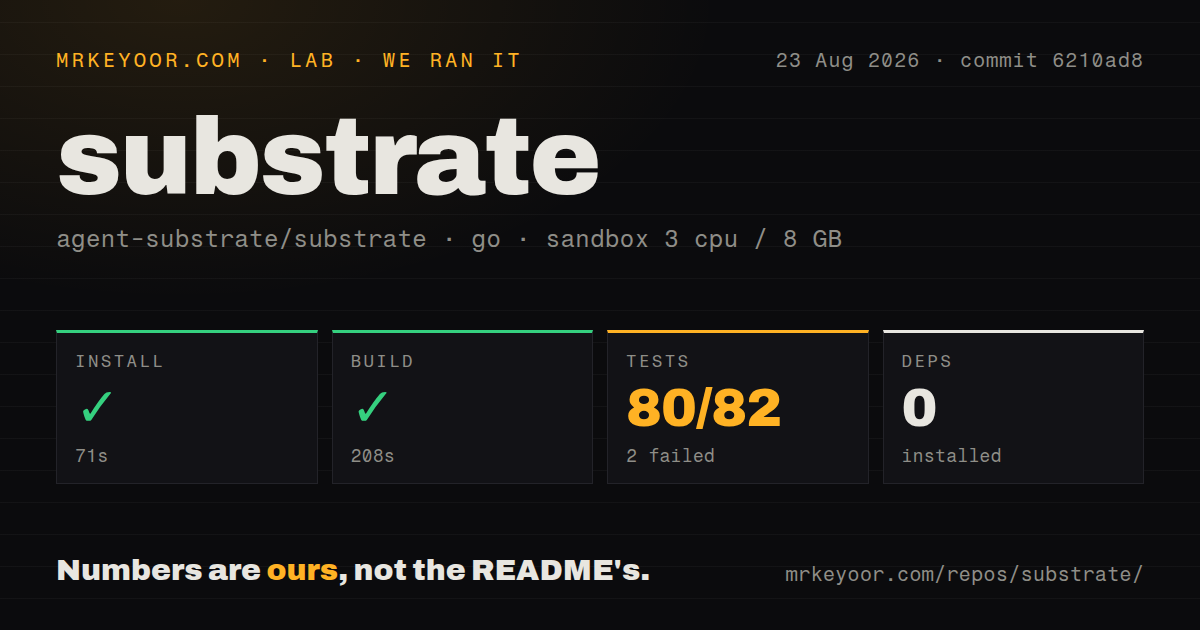
We cloned commit 6210ad8 into an unprivileged Debian container with 3 CPUs and 8 GB of RAM. The Go install step succeeded in 71 seconds and added no packages. Building took 208 seconds and passed. Tests ran for another 108 seconds, with 80 passing and 2 failing out of 82, so the overall command exited 1.
The supplied log tail does not name either failed test. It lists multiple packages with no test files, then shows passing results for tools/setup-gcp/cmd and tools/validate-image-cache, followed by FAIL. We will not guess whether the failures were environmental or defects. A buyer should reproduce the same commit in a Kubernetes-capable environment and capture the complete failure output before evaluating a fix.
Our checkout contained 1,110 files, roughly 168,337 source lines, and 9.4 MB of checked-out data. It had 2 CI workflow files, no Dockerfile, and no tests directory. Go tests can live beside source, so the missing directory is only a repository-layout signal. The two failures are the finding that matters.
The local quickstart builds a complete development cluster
A local trial starts with Go, Docker, kubectl, and kind. Scripts create a cluster and registry, then install the control plane, PostgreSQL, RustFS, and a counter demo. You install kubectl-ate, create an Atespace and actor, forward the router service to port 8000, and send a request with a specific Host header. That is a small platform deployment, even though scripts handle much of the typing.
The Google Cloud route asks for application-default credentials and an environment file before provisioning GKE, GCS, and IAM resources. Deployment and teardown scripts cover partial or full environments. Operators still own image distribution, cluster upgrades, certificate rotation, storage durability, backup policy, monitoring, and failed restores.
Supported Kubernetes policy follows the latest stable release and the previous minor release. That is a narrow moving window for an infrastructure dependency. Teams with slower cluster upgrade schedules must either test outside the stated target or update Kubernetes more often than their usual cadence.
The README says production use is premature
The maintainers call Agent Substrate early development, say it is not ready for production, and warn that APIs are almost guaranteed to change. That is unusually direct and should control the buying decision. The project is also not an officially supported Google product, despite Google copyright headers and contributors, and it is outside Google's open-source vulnerability rewards program.
Worker reuse raises hard security questions even with gVisor or microVM isolation. Processes, files, environment data, credentials, network rules, and snapshots all need correct actor boundaries across suspension and restore. The repository links dedicated authentication and threat-model documents, which is good engineering practice. Documentation describes the work; it does not convert an early system into a proven multi-tenant boundary.
Use trusted, disposable workloads and an isolated development cluster for evaluation. Do not place customer repositories, lasting credentials, or mutually hostile tenants on it merely because the interior sandbox sounds strong. Routing, storage, identity, and management components around that sandbox also participate in the boundary.
August 26 activity is high, while the release line is empty
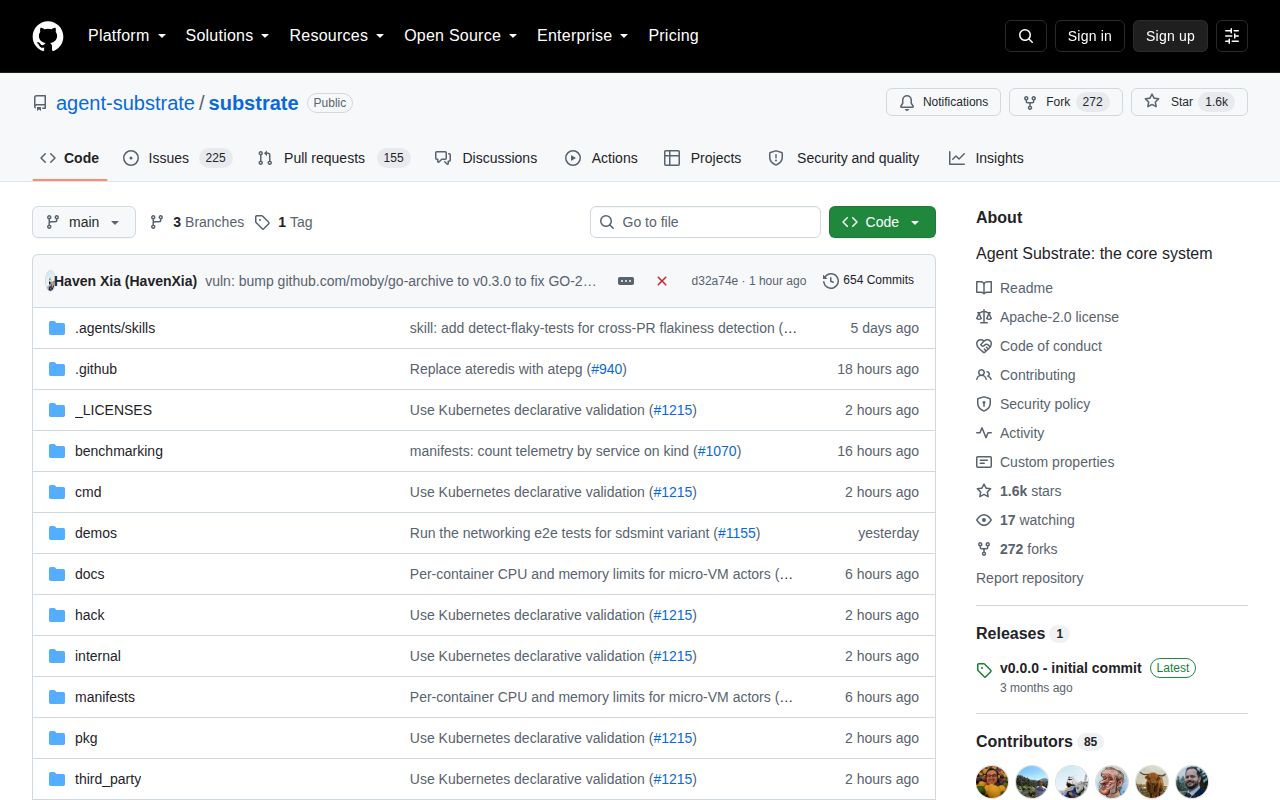
The repository was pushed on August 26, 2026, and GitHub reported 380 combined issues and pull requests. Current work covers actor identity, Envoy concurrency, checkpoint retries, WebSockets, certificates, and policy. The volume shows active engineering and a large unfinished surface at the same time. Weekly meetings, a Google Group, and CNCF Slack channels give adopters public places to follow decisions.
The latest release remains v0.0.0, published May 19, 2026 with only "initial commit" in its notes. A stale tag alone would not prove neglect, and the August push activity clearly contradicts that reading. It does mean there is no useful stable release series to pin. Evaluators are selecting a commit from a fast-moving main branch.
Substrate is worth running when your platform problem truly resembles its 250-actor demo and your team can help debug Kubernetes internals. The 2 failed tests in our run reinforce the project's own warning. Study it, measure it, and contribute if the actor model fits. Keep production on a system with a stability promise until Substrate makes one.