Firecracker is a microVM engine, not a container platform
The 819-file checkout implements a VMM in which one Firecracker process runs one Linux microVM and accepts configuration through a host-facing API. The caller supplies the guest kernel, root filesystem, disks, network interfaces, CPU and memory settings, then issues the start command. That small boundary is the appeal. A serverless platform or sandbox service gets hardware virtualization without exposing the guest to the device catalog of a desktop-oriented hypervisor. Firecracker itself does not schedule workloads or manage a fleet.
The checkout we measured at commit 40f2ed2 contained 819 files and about 155,448 lines of source in 35.7 MB. That is a focused codebase, yet it is only one component of a deployable service. AWS uses Firecracker for Lambda and Fargate, and the README points to Kata Containers and Flintlock integrations. Teams adopting the VMM directly still need to build or choose image preparation, placement, network allocation, process supervision, cleanup, and an interface for users.
Linux and KVM decide whether it fits
Firecracker requires an x86_64 or aarch64 Linux host with read-write access to /dev/kvm; our sandbox had 3 CPUs. The guest is Linux too. The getting-started guide recommends a bare-metal EC2 instance because ordinary EC2 virtual machines do not expose KVM there. This immediately rules out a casual laptop trial on macOS or Windows, and many hosted environments will need nested virtualization support that their provider may not offer. The project includes tools/devtool checkenv so operators can test the host before going further.
Our sandbox had 3 CPUs and 12 GB of RAM, but it was an unprivileged Debian container, which is a meaningful distinction for a KVM-based VMM. We did not reach a running microVM because compilation stopped first. The demo path also needs a guest kernel, an ext4 root filesystem, a Unix socket, and elevated host networking work. It creates a TAP device, enables IP forwarding, and adds firewall rules before the guest can reach the network.
What happened when we ran it
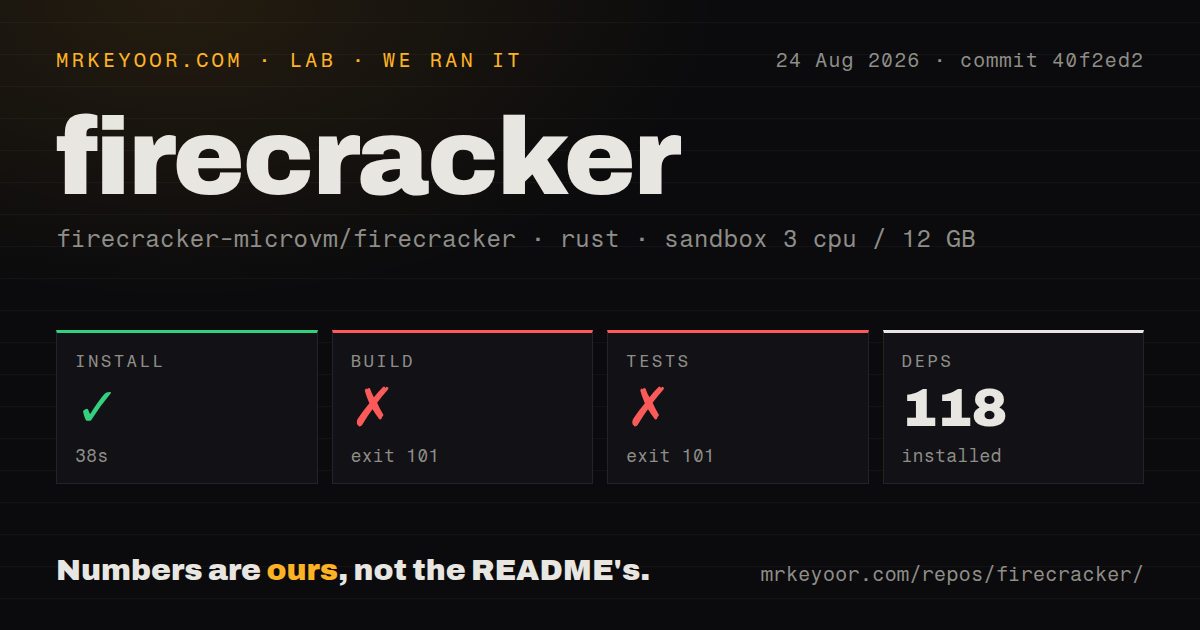
Our install stage succeeded in 38 seconds and installed 118 packages in the lab-rust:1 image. The repository had 7 CI workflow files and a tests directory, but no Dockerfile. Firecracker's README recommends building through its tools/devtool command with Docker and Bash. Our measurement used a fresh Debian container at commit 40f2ed2, so the result describes that sandbox rather than the project's own development container or supported bare-metal hosts.
The build failed after 87 seconds with exit code 101. The linker was compiling the Firecracker 1.17.0-dev source when rust-lld reported that it could not find the seccomp library requested as -lseccomp. The test step failed after 43 seconds with the same exit code and the same linker message during compilation. That means we learned nothing about test assertions or runtime behavior. The logs show a missing link target, but they do not establish whether a package was absent or a library path was wrong.
Production isolation still depends on the host
Firecracker v1.16 ships per-thread seccomp filters and a jailer that applies cgroups, namespace isolation, a chroot boundary, and privilege dropping. The production guide is direct about the operator's share of the security model. Host and guest kernels plus CPU microcode need patching. Jailer input paths must be protected from unprivileged modification. Separate workloads should receive dedicated identities and resource limits, while guest-controlled serial output and logs need bounded storage.
Seven CI workflow files are one useful maintenance signal, and current activity is stronger. GitHub showed a push on 2026-08-25, 113 open issues and pull requests, and 51 open issues when pull requests were excluded. Issue updates continued through 2026-08-22. The latest release, v1.16.1, arrived on 2026-07-02 with fixes for snapshot-restored vsock traffic and jailer path handling. The release policy defines support windows and currently lists both v1.15 and v1.16 as supported.
Network security deserves special attention because the VMM does not filter guest egress. Packets move from the guest interface to a host TAP device, and the host must block restricted destinations. The production guide also calls for supervision of unresponsive processes and careful resource controls. Those requirements are not optional polish around a hostile multi-tenant service. They are part of the isolation design, which makes Firecracker a poor fit for a team hoping that the binary alone will provide a safe public sandbox.
The best buyer already has a control-plane plan
Firecracker's 35.7 MB checkout is the right candidate when a platform team wants a deliberately limited Linux machine model and accepts responsibility for everything around it. Cloud Hypervisor suits operators who want a broader cloud-VM feature set. Kata Containers is the easier route when the actual requirement is VM-isolated containers under Kubernetes. gVisor takes a different approach by interposing a userspace kernel, which can fit teams that value familiar container operations over a VM boundary. These choices solve adjacent problems, so the surrounding platform matters more than a feature checklist.
Our 35.7 MB checkout installed 118 packages successfully, but the 87-second build and 43-second test attempt both ended at -lseccomp. That result keeps the setup score at 2 out of 5 despite excellent documentation. Firecracker remains easy to recommend as a VMM for specialists and hard to recommend as a shortcut. Use the release binary or the documented development environment for evaluation, qualify the exact Linux and hardware combination, and budget for a control plane before calling it a platform.