A Glimpse of the Future, Frozen in Time
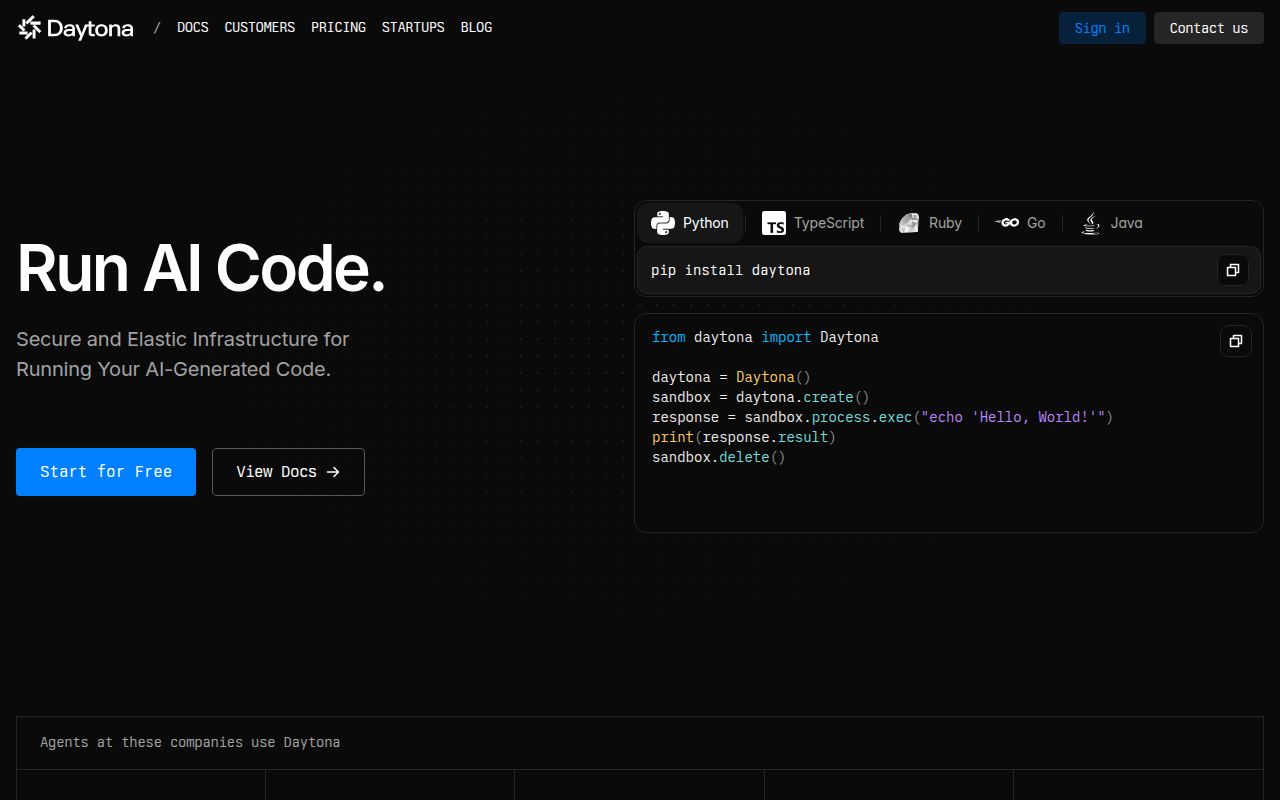
Daytona emerged with a compelling proposition: to become the foundational layer for the burgeoning world of AI agents. It's not just a library or a tool, but a complete infrastructure platform designed to solve a critical problem: how do you safely and efficiently run the code that AI agents generate? The project's core concept, the "sandbox," is a powerful abstraction. It promises fully isolated, composable computers, complete with their own kernel, filesystem, and network stack, that can be spun up in under 90 milliseconds. For developers building the next generation of AI-powered tools, this was a dream come true. It offered a way to move from theoretical agent workflows to scalable, secure, and stateful applications.
The architecture described is robust and clearly designed for scale, broken down into an interface plane, a control plane, and a compute plane. This isn't a toy project; it's a serious piece of engineering aimed at enterprise-grade problems. The feature list is a testament to this ambition, covering everything from programmatic agent tools to human-in-the-loop interfaces and organizational governance controls.
A Feature-Rich Foundation
Digging into Daytona's capabilities reveals a platform that thought of almost everything. For the AI agents themselves, the tooling is extensive. Programmatic control over process and code execution, filesystem operations, and even Git commands provides the primitives needed for complex tasks. Features like stateful snapshots are crucial, allowing an agent to pause its work and resume later, or to recover from an error without losing context. The inclusion of a Language Server Protocol (LSP) interface and a Model Context Protocol (MCP) server shows a deep understanding of the AI developer ecosystem.
For the humans managing these agent fleets, Daytona provided a rich set of interfaces. A web dashboard, terminal access via web or SSH, and even VNC for graphical applications meant that developers could easily inspect, debug, and interact with the sandboxed environments. This is a critical feedback loop that many similar platforms overlook. Furthermore, the "Platform" tier of features, with organizations, API keys, billing, audit logs, and security controls, clearly positioned Daytona as a commercial-grade product, ready for team and enterprise adoption. It was designed to be the standardized, governable runtime for an organization's entire AI development lifecycle.
The Unavoidable Dealbreaker
Unfortunately, all of this potential comes with a massive, unavoidable caveat that fundamentally changes the recommendation for this project. As of June 2026, the public daytonaio/daytona repository is no longer maintained. A prominent notice at the top of the README states that core development has moved to a private codebase and that this repository will receive no further updates, fixes, or releases.
This single fact transforms Daytona from a cutting-edge tool into a historical artifact. The project is frozen in time at version v0.190.0, released over a month ago. The 441 open issues will remain open forever. Any security vulnerabilities discovered from this point forward will not be patched in the public version. The promise of a vibrant community, suggested by links to Slack and X, applies to the commercial entity, not the open-source code. For anyone considering building a product on this foundation, this is a non-starter. The risks associated with using an abandoned, complex infrastructure project in production are simply too high.
Where Does That Leave Us?
So, who is this project for today, in August 2026? It's certainly not for teams looking to build and ship a product. The lack of maintenance, support, and future updates makes it a liability. Instead, the Daytona repository serves two main purposes now. First, it's an exceptional learning resource and reference architecture. Anyone tasked with building a similar AI sandboxing platform can study Daytona's code to understand the complexities involved. Its multi-plane architecture and comprehensive feature set provide a detailed blueprint for what a mature system looks like.
Second, it could be a launchpad for a well-resourced team willing to fork the project and take on the considerable burden of maintaining it themselves. This would involve not just fixing existing bugs and addressing the 441 open issues, but also keeping dependencies up to date, patching security holes, and continuing development to keep pace with the rapidly evolving AI landscape. This is a significant undertaking, likely requiring a dedicated team of infrastructure engineers. For the vast majority of developers and companies, this is not a practical or desirable path. While the code is available, the vibrant, living project is gone.