A native engine replaces the usual Python serving layer
stable-diffusion.cpp brings the llama.cpp idea to diffusion models: keep inference in C and C++, use GGML for hardware backends, and expose a binary plus an embeddable library. The project can generate and edit images, create video with supported models, apply LoRAs and ControlNet, upscale with ESRGAN, and convert weights. That breadth is useful for native applications and local services where a Python process and its framework stack would be awkward. It is still an engine, not a complete creative workstation.
The repository at commit 88411ef had 3,933 files, roughly 771,770 source lines, and a 296.8 MB checkout. Its model list spans Stable Diffusion 1.x through 3.5, SDXL, FLUX, Qwen Image, Z-Image, Wan, LTX, and several newer families. Formats include PyTorch checkpoints, Safetensors, and GGUF. You must still obtain weights separately and read the model-specific guide, because text encoders, VAEs, quantization choices, and command flags differ.
CPU is the simple build; every GPU adds a toolchain
A CPU build uses a recursive clone and ordinary CMake commands. Acceleration branches from there. CUDA needs the CUDA toolkit, Vulkan needs its SDK and development packages, SYCL uses Intel oneAPI compilers, and HIP builds need ROCm details such as the target architecture. Metal is available on Apple hardware, while the guide warns that very large matrix operations still have efficiency problems. OpenCL support is aimed mainly at Adreno devices with Q4_0 weights.
The README lists Linux, macOS, Windows, and Android, with 6 backend families beyond the CPU path. Prebuilt release assets reduce compiler work, and a published container can run either the CLI or server with mounted model and output directories. The repository scan reported 4 CI workflow files and a tests directory. Those signals show active packaging effort, but they do not tell you whether a particular model, quantization, and graphics driver combination produces correct output.
What happened when we ran it
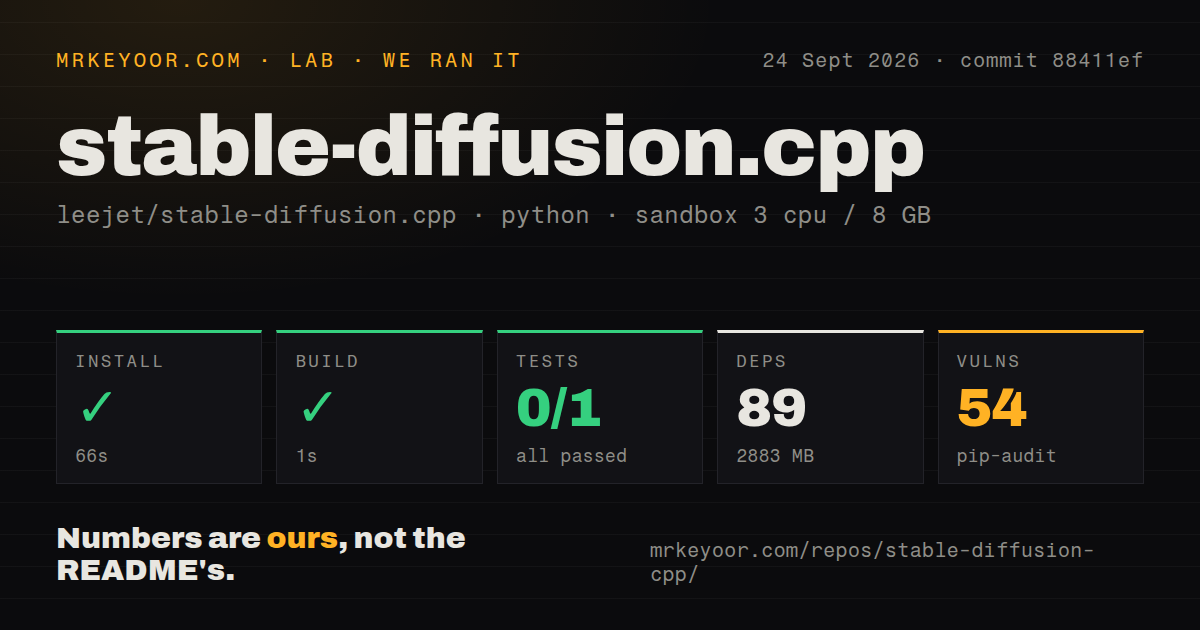
Our sandbox identified the Python project inside ./ggml/. Installation succeeded in 66 seconds, adding 89 packages and occupying 2,883 MB. The build completed in 1 second. Pip-audit reported 54 known vulnerabilities in that installed Python environment. The checkout was tested at commit 88411ef in a fresh unprivileged Debian container with 3 CPUs and 8 GB of RAM.
Pytest stopped after 3 seconds with 1 collection or setup error and no executed tests. examples/python/test_tensor.py imported ggml, whose initializer raised ImportError: Couldn't find ggml bindings (No module named '_cffi_backend'). The message suggested running python regenerate.py or checking PYTHONPATH, but the log only proves the missing import in our environment. It does not prove which remedy would have fixed it. The main C++ generation path was not validated by that Python test result.
Memory placement is powerful and easy to misread
The backend guide lets you place the diffusion model, text encoder, VAE, and other modules on different devices. Parameters can live on a GPU, in CPU RAM, or on disk. Multi-GPU execution supports layer and row splitting for selected modules. Auto-fit estimates capacity and keeps a 512 MiB device-memory margin, while initial compute reserves use 2 GiB for diffusion and text encoders and 1 GiB for the VAE. These are planning rules, not guarantees.
One warning deserves attention: --max-vram is not a hard physical cap. Driver allocations and memory outside the managed runners can exceed its accounting. Disk placement can make an oversized model start, yet repeated weight loading may change the experience completely. The guide also says that offloading does not ensure every resolution or video frame count will fit. Treat one successful prompt as a compatibility check, then repeat it at the largest dimensions and duration you intend to expose.
Fast model support brings visible edge cases
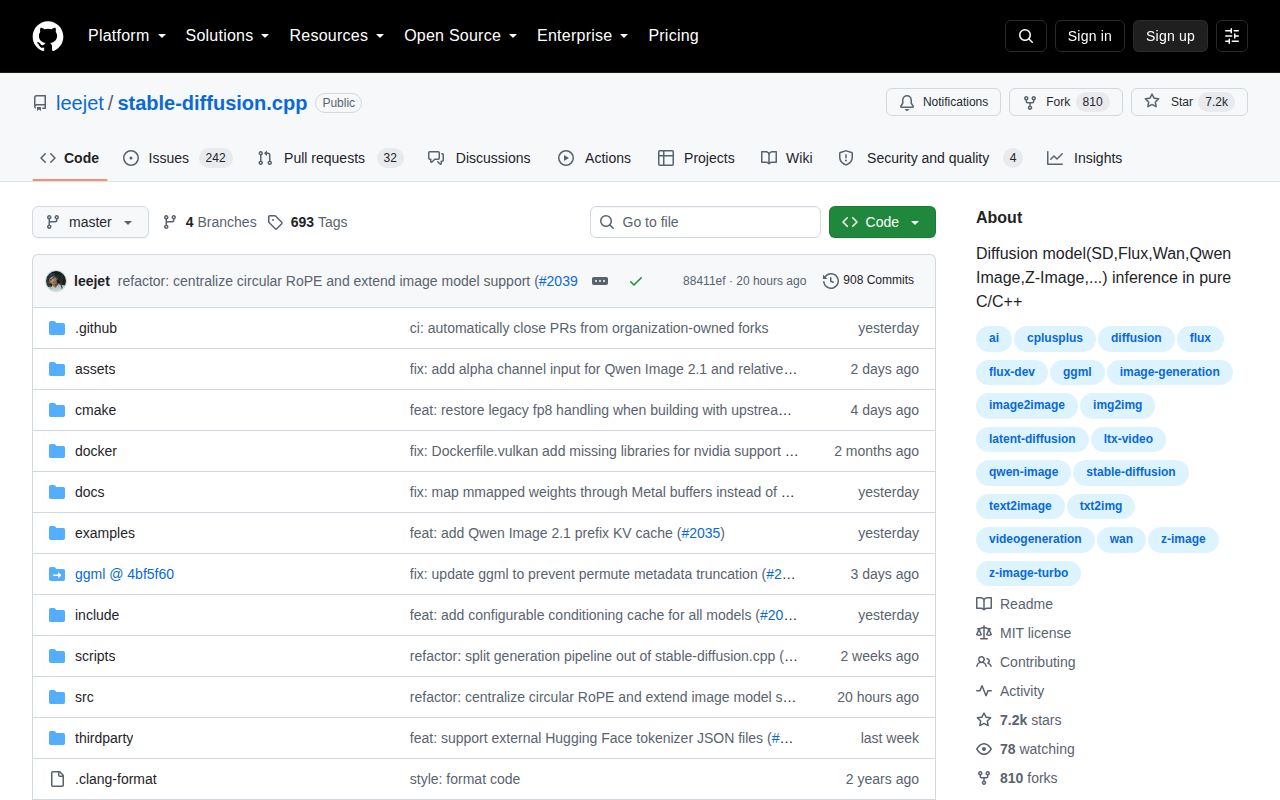
The last push and latest automated release both landed on September 23, 2026. GitHub showed 7,170 stars, 274 combined open issues and pull requests, and 242 open issues when searched separately. Recent reports included Qwen Image 2.1 grid artifacts at native 2K resolutions, opaque output where transparency was expected on Metal, a CUDA workspace miss on a 16 GB card, and video regressions on 16 GB Vulkan hardware. These are specific failures, not a reason to dismiss every backend.
They do change how you should evaluate the project. Pick the exact model, weight format, backend, driver, image size, and feature set you plan to ship. Keep representative prompts and output checks. The README itself warns that APIs and command-line options may change frequently, so pin a release identifier rather than tracking master in production. The latest release name, master-908-88411ef, points directly to the reviewed commit but contains no release notes of its own.
The server is useful, while creators may want more
The included server and embedded web UI make local trials easier, and language bindings let Go, C#, Python, Rust, and Flutter applications wrap the native engine. For a product team, the main attraction is control: the same core can run on a CPU-only box, a CUDA workstation, an Apple machine, or selected mobile hardware. MIT licensing keeps commercial integration simple.
Creative users usually need more than an inference endpoint. ComfyUI, Stable Diffusion WebUI, and InvokeAI put workflow construction, extensions, asset handling, and interactive iteration closer to the center. stable-diffusion.cpp is the better fit when your application owns that surrounding experience and needs a native generator underneath. Start with a prebuilt binary, one documented model, and output at your maximum intended size. The 3-second Python failure means the bundled binding path still needs separate repair and verification on our tested environment.