Each shell action starts a new process
Mini SWE Agent executes each action independently instead of keeping a shell session alive. Consider it if you want to inspect or extend a bash-based agent loop. Avoid the default execution model if your workflow depends on shell state carrying between actions.
The README describes a bash-only agent with a linear message history: each step appends to the messages passed to the model. This gives researchers a direct record of the interaction. It does not establish that the model will solve a particular repository issue.
The FAQ explains the practical consequence of independent actions. A directory change or exported variable does not persist into the next action. Each command needs its relevant directory and environment. The agent can change directories within an action; the limitation is carrying that state into another action.
What happened when we ran it
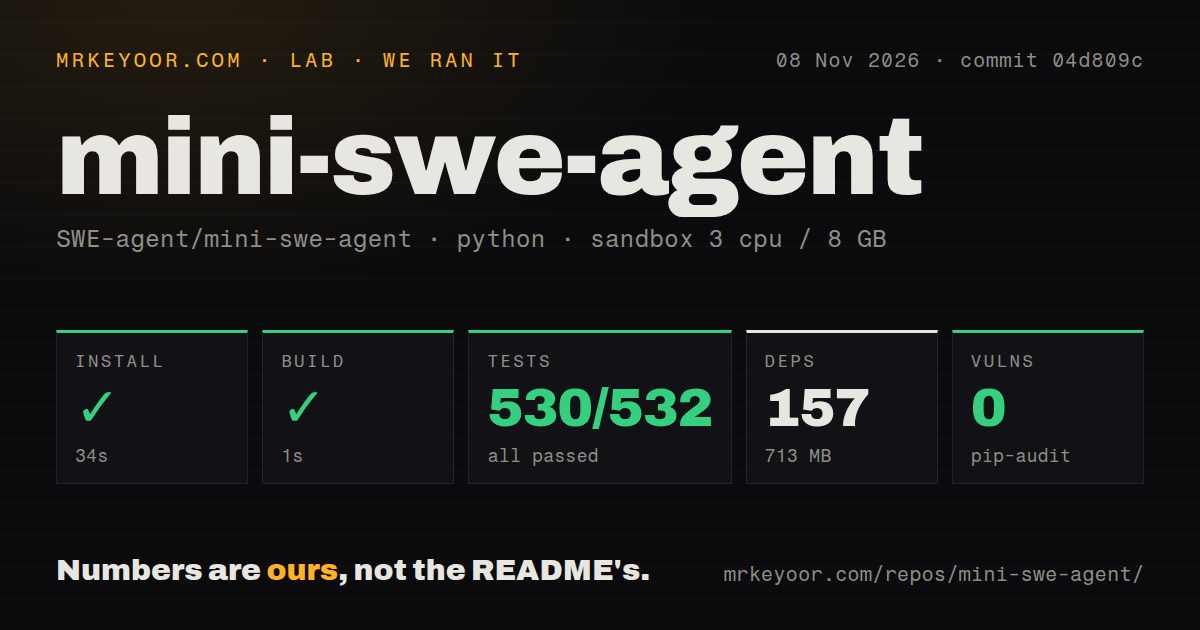
Our Mini SWE Agent run installed 157 dependencies in 34 seconds and recorded 713 MB on disk. The build step completed in 1 second. These measurements came from commit 04d809c on November 8, 2026. The checkout itself was 1.5 MB, so source-tree size did not describe the installed footprint.
The test command exited 1 after 67 seconds. Pytest reported 530 passed, zero failed, 76 skipped and two collection/setup errors. The parser's total of 532 should not be read as an exhaustive count including skipped tests. Passing assertions did not make the command successful.
The log tail contains ModuleNotFoundError: No module named 'modal' and names errors in tests/environments/extra/test_contree.py and tests/environments/extra/test_swerex_modal.py. It does not include complete tracebacks for both. The excerpt supports identifying a missing import, but not attributing both errors to it or promising that installing modal would fix the suite.
Pytest's summary reports 61.02 seconds; the outer test step took 67 seconds. Those timings cover different scopes. The log also includes a cache-control deprecation warning, without evidence that it caused either error.
The recorded sandbox configuration was 3 CPUs, 8 GB RAM and image ghcr.io/astral-sh/uv:python3.12-bookworm. The image label does not establish actual runtime or operating-system versions. Pip-audit recorded zero known vulnerabilities, an advisory lookup result rather than a security guarantee. This run did not measure coding-task completion or model-output quality.
Check the environment you intend to use
The quick-start guide says extra dependencies are not installed by default, particularly for components in an extra folder. It documents a fuller dependency option alongside CLI and developer installation routes. Check the dependencies for your chosen backend before relying on it. The supplied run does not verify a repair for either error entry.
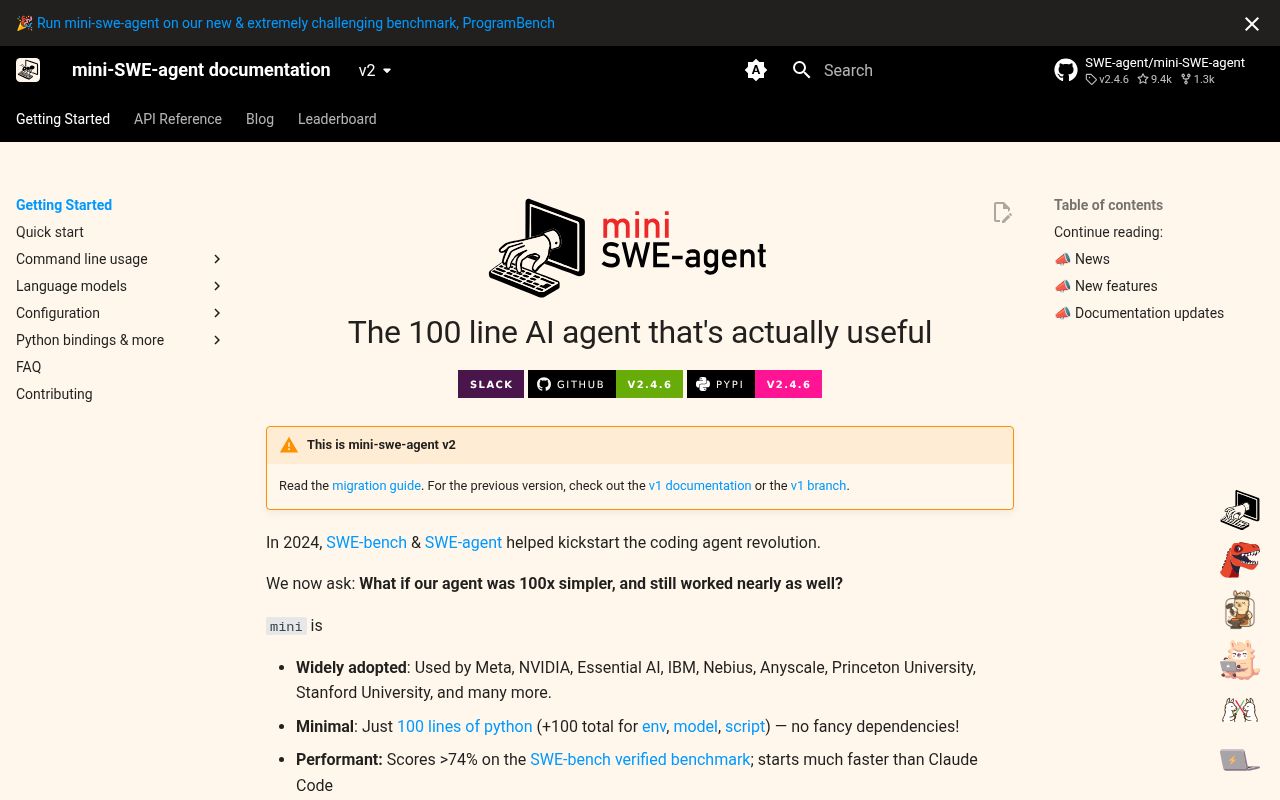
Model access needs separate configuration. The quick-start guide describes an initial setup wizard, and the FAQ explains provider API keys and the default model setting. The README lists local and container-backed execution environments. Installing the package establishes neither a working provider connection nor a suitable environment for running generated commands.
For a first trial, use a disposable checkout, choose a bounded task and inspect the resulting changes. This is a recommended evaluation step; the supplied repository checks did not complete that trial.
Decide whether the default loop fits your experiment
The bash-only interface and linear history suit researchers who want to inspect the commands and messages used by the default agent. The README also documents Python bindings and a trajectory browser. We did not measure debugging effort or research productivity.
For experiments with different tool interfaces or history processors, the FAQ points to SWE-agent. That distinction is more useful here than a claim about which agent produces better patches: the supplied run did not compare patch quality.
The supplied GitHub metadata records the last push on November 2, 2026. The latest listed release is v2.4.6, dated July 23, 2026. That release is separate from the measured checkout at 04d809c; the run should not be described as a test of v2.4.6. The last-push observation alone does not establish support responsiveness or production reliability.
Alternatives depend on the workflow
Aider documents automatic Git commits and tools for reviewing or undoing changes through Git. Its README makes it an alternative to evaluate when terminal pair programming with built-in Git handling matters to you. We did not compare its patch quality with Mini SWE Agent.
SWE-agent is relevant for custom tool and history-processing experiments. Its own README says most current development effort is on Mini SWE Agent. Account for that stated direction when choosing a base for new work.
Documentation receives 4/5 under this review's rubric: 1 means no usable setup route, 2 means partial instructions with major gaps, 3 means basic setup instructions, 4 means documented CLI and developer routes plus model configuration and execution limitations, and 5 adds independent verification of those routes. The supplied quick-start guide and FAQ meet the fourth level; this run did not verify every route.
Keep the adoption decision narrow: select the environment you need, investigate its dependency errors and evaluate an actual patch before expanding the agent's access.