A dense control room for Stable Diffusion
Stable Diffusion WebUI puts a browser front end around local image models. The basic workflow is familiar: enter a prompt, choose generation settings, and produce an image. The project then keeps adding controls. It has text-to-image and image-to-image modes, inpainting, outpainting, high-resolution repair, several upscalers, face restoration, checkpoint switching, LoRA support, prompt weighting, saved styles, batch processing, and an API. Generation settings can be stored inside PNG or JPEG metadata and loaded back into the interface.
That breadth is the reason to choose it. An artist can adjust a prompt during sampling, compare parameters on an X/Y/Z grid, interrogate an existing image, or merge checkpoints without assembling separate scripts. The UI also exposes textual inversion and training utilities. People who already understand Stable Diffusion terminology can keep many experiments in one place. New users face a wall of controls whose names make more sense after they have learned the underlying model workflow.
The application is local by design. Prompts and source images can remain on your machine, subject to the behavior of any extensions you install. There is also a callable API for applications that need generation without a person clicking through Gradio. That pairing, a deep interactive workbench plus an API, is more useful than a pretty demo for developers who prototype a workflow before automating it.
Installation is automated within strict boundaries
The README advertises one-click scripts, then immediately states the prerequisites: Python and Git. Windows instructions specify Python 3.10.6 and warn that newer versions do not support the expected Torch setup. Linux users must install system libraries and may need Python 3.10 or 3.11 on newer distributions. NVIDIA is the recommended route. AMD, Apple Silicon, Intel, and Ascend each have separate instructions, some maintained outside the main repository.
The launcher can create an environment and obtain Python dependencies, but it cannot make an incompatible GPU stack disappear. Drivers, Torch builds, available memory, and model formats still determine what runs. Models themselves consume storage and may come under licenses separate from the AGPL-3.0 application. Anyone deploying this for a team should record the exact operating system, driver, Python, Torch, checkpoint, and launch arguments that passed acceptance testing.
Extensions widen both capability and risk. The project links to community scripts and supports an extension ecosystem that can change the interface or add model workflows. This is ordinary Python code running near local files and models. The UI can also run arbitrary Python when launched with --allow-code; the README makes that an explicit opt-in. A shared installation needs a much tighter policy than a personal workstation. Review extension sources, pin revisions, and do not expose a permissive instance directly to the internet.
What happened when we ran it
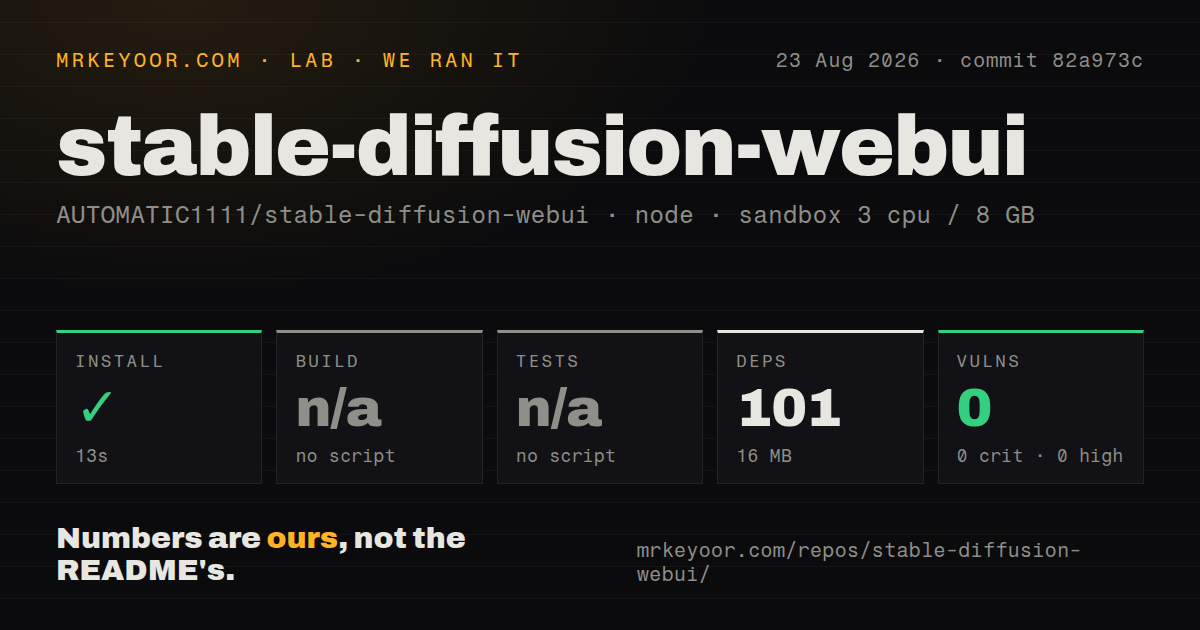
We cloned commit 82a973c into an unprivileged Debian container with 3 CPUs and 8 GB of RAM. The repository contained 315 files, about 49,337 lines of source, and occupied 3.8 MB. Our harness identified an npm surface and installed it successfully in 13 seconds. That added 101 packages and used 16 MB on disk. Npm audit reported 0 known vulnerabilities across that measured dependency set.
There was no npm build script or target, so the build step was skipped. There was also no npm test script or target, so tests were skipped. The scan did find a tests directory and three CI workflow files, but no Dockerfile. These results describe only the measured npm path. They do not prove that the Python launcher, Torch environment, GPU backend, model download, or image generation works in this container. We did not claim a successful WebUI launch from this run.
That distinction matters because a clean npm audit can sound more reassuring than it is. Python is the repository's primary language, and the README's real startup process revolves around Python, Git, system libraries, and an accelerator-specific Torch installation. The measured JavaScript dependency layer was small and clean; it was not an end-to-end application test.
Feature depth comes with maintenance debt
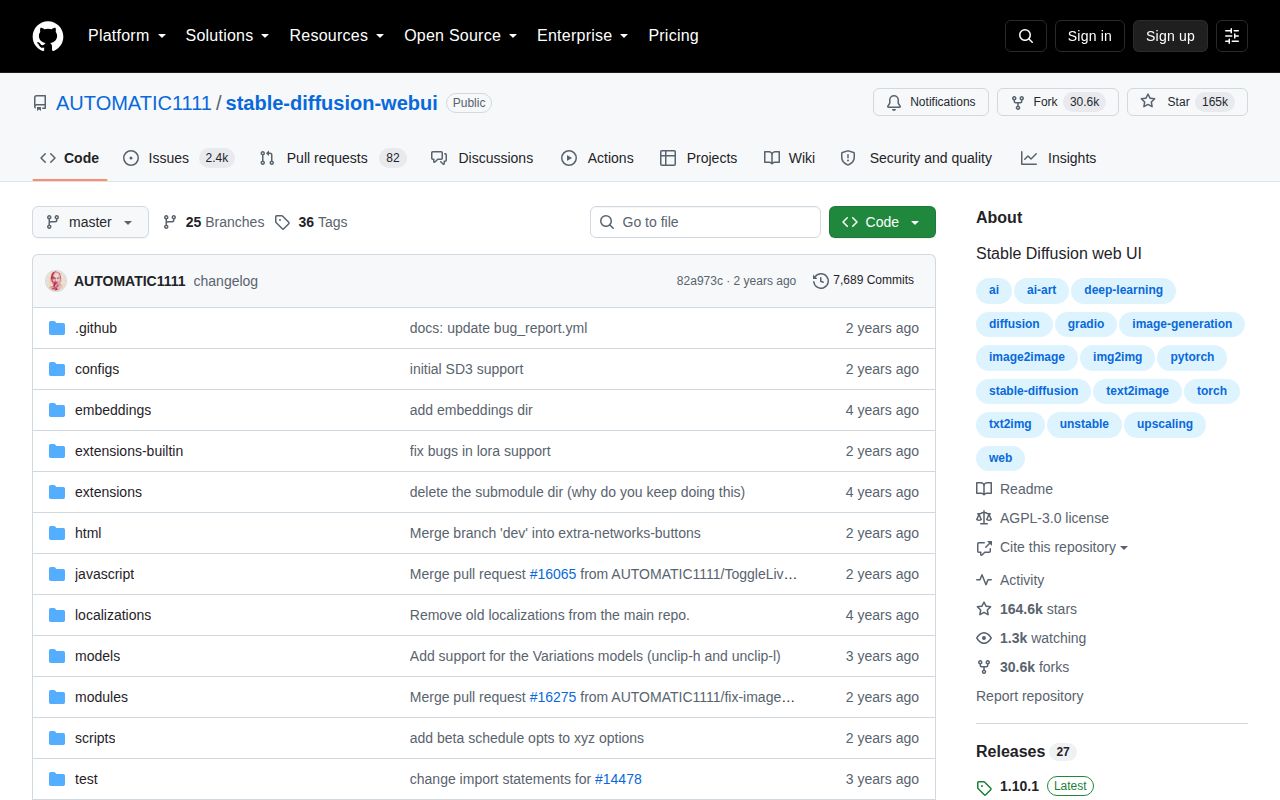
GitHub reported 2,503 open issues and pull requests. The repository's last push was March 2, 2026, while issues and proposed changes were still being updated in August. Recent activity included installation failures around CLIP and Torch, a proposed fix for hiding authentication flags in an API response, Pillow compatibility work, and a request for multi-GPU batch splitting. The queue is active even though the main branch's latest push and the latest stable tag are older.
Release v1.10.1 arrived on February 9, 2025 and contained a CPU upscaling fix. A stale release alone would not prove abandonment, and later repository activity argues against that conclusion. It does mean users should decide whether to follow the release, pin a known commit, or adopt downstream packaging. Mixing an old application release with current extensions is especially likely to create a compatibility puzzle.
The documentation has the same sprawling character as the product. The README is a feature inventory and installation index, while detailed instructions live in the wiki. Most common hardware routes have a page, but several links go to external forks or community material. Expect research when your machine falls outside the NVIDIA path.
Stable Diffusion WebUI is best for a personal or carefully managed workstation where feature access matters more than a minimal interface. ComfyUI is easier to reason about when the workflow itself should be a visible graph; InvokeAI may suit teams that want stronger studio organization. Pick this project when you want its specific controls and extension ecosystem, then freeze the working stack before serious production use.