Short answer
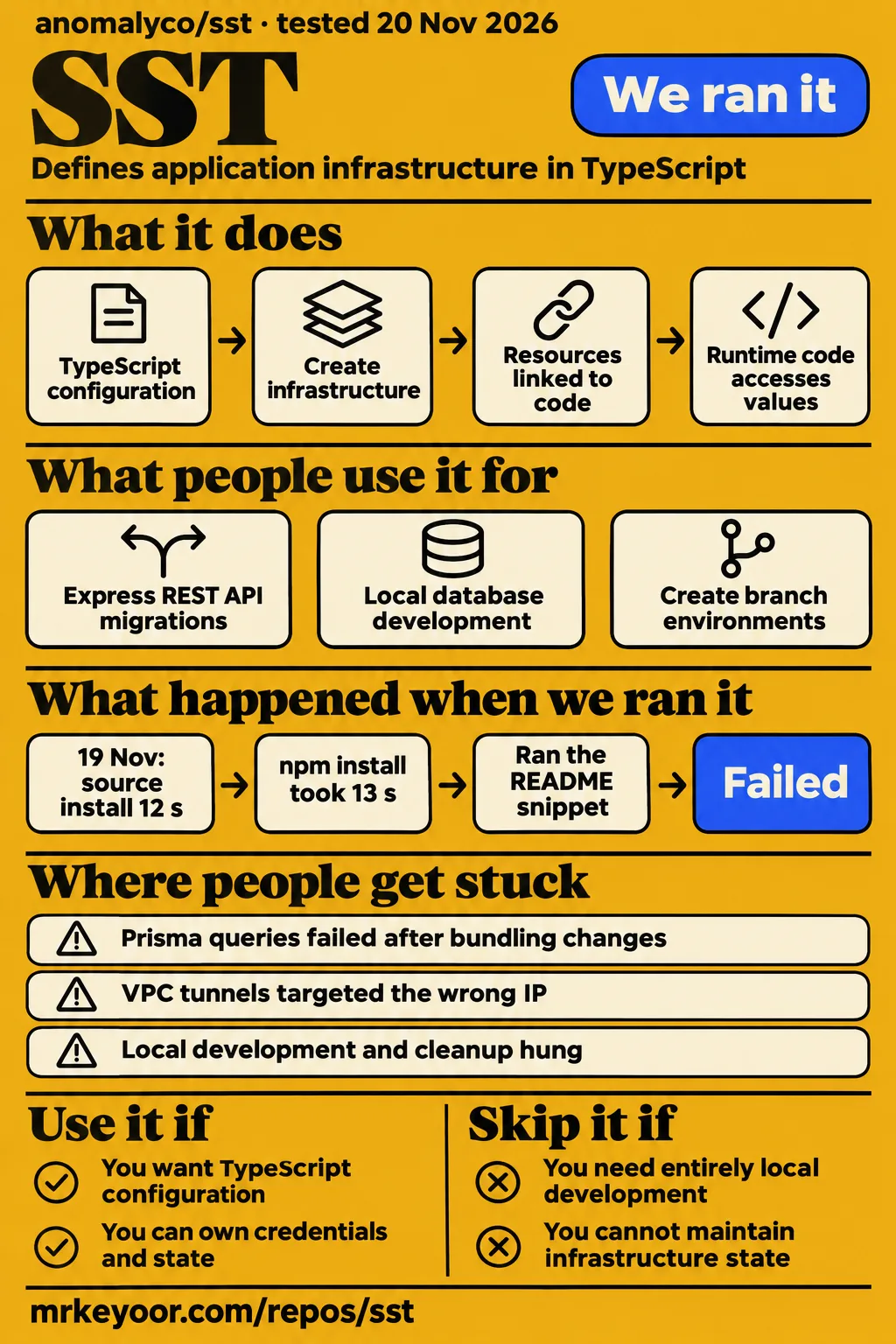
SST defines application infrastructure in TypeScript, and our source dependency installation succeeded in 12 seconds with 925 MB on disk. Use it if you want application components, resource linking and separate development stages in your own cloud account. Teams requiring entirely local development should choose another workflow: the SST development documentation describes deployed infrastructure and function requests proxied to your machine. The source installation measurement gives a concrete setup result, while the application lifecycle requires a different set of decisions.
The practical choice is whether SST's configuration and development model fit how your team builds applications. A database, frontend and scheduled job can share an infrastructure configuration, while runtime code accesses linked resource values. That convenience comes with responsibility for credentials, state and stage removal. Breakingcube's migration author chose SST's TypeScript configuration even after replacing Live development with direct handler tests. Their experience makes a useful distinction: liking the infrastructure workflow and liking the local request path are separate decisions.
What people use sst for
SST users describe Express migrations, AWS application setup, local database development and temporary branch environments. The accounts below identify the application or operation involved rather than treating a successful installation as an adoption result. They also show why the same framework can fit one part of a team's workflow while creating friction elsewhere: configuration, local requests and environment cleanup involve different operations.
| Who used it | What they did | What happened |
|---|---|---|
| Breakingcube's comparison author | Migrated a TypeScript Express REST API using Neon Postgres and a daily cron job | Chose SST's TypeScript configuration and tested handlers with mock events after Live development timeouts, according to the migration account. |
| GitHub user patrickfoley | Used AWS infrastructure creation, TypeScript project setup, secrets, local Lambda development and Console notifications | Reported satisfaction with those features and concern about communication in issue #6215. |
| GitHub user lefnire | Used Docker Postgres locally and Aurora v2 outside development | Described local database access while keeping staging and production subnets private in issue #2506. |
| GitHub user iDVB's team | Created branch environments and removed them after merge or deletion | Reported that Next.js edge-function deletion blocked adoption for a platform in issue #835. |
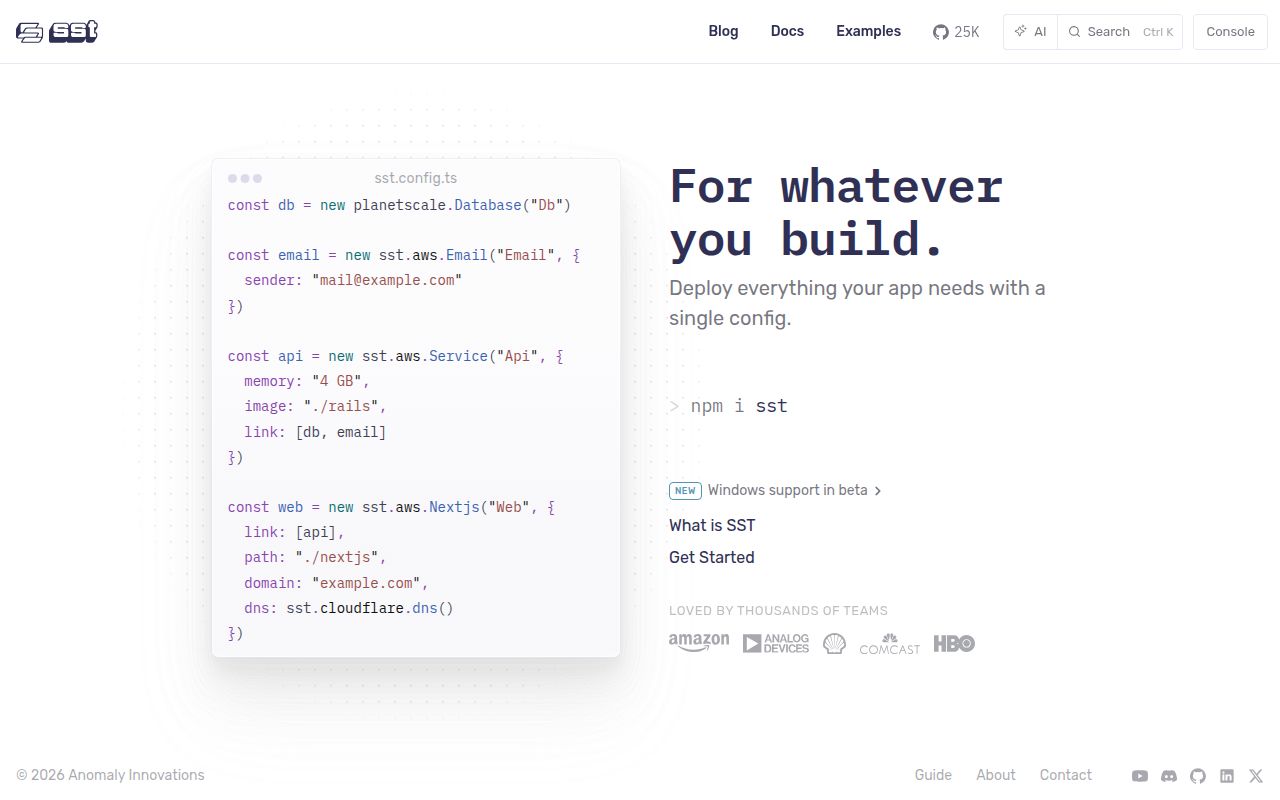
The official component documentation describes frontends, Lambda functions, container services, Postgres databases, buckets and cron jobs. Linking connects infrastructure definitions to application code through SST's SDK, including access to a linked bucket's name. Stages provide separate versions of an application, so a developer's environment can coexist with production. For teams considering SST, these are concrete workflow features to compare with their current deployment scripts and environment configuration.
What happened when we ran it
Our November 20 quickstart installed SST 4.17.2 in 13.1 seconds, then failed at the README snippet step. The package installation record identifies the version and duration. This was a separate operation from our November 19 source-workspace installation. Keeping those jobs separate preserves what each measured: installing the published package into the recipe's environment versus installing the repository's contributor dependencies.
| November 20 quickstart step | Recorded outcome |
|---|---|
| Clone | Completed in 4 seconds in the clone record. |
| Package route | Ran npm install sst@latest; installed SST 4.17.2 in 13.1 seconds in the installation record. |
| Installed size | node_modules occupied 95.8 MB in the size measurement. |
| Dependency count | Installed 34 packages besides sst in the dependency measurement. |
| Runnable snippet | Failed because the README had no JavaScript/TypeScript code block to run, according to the failed step. |
| Finding | The recipe recorded no-snippet in its finding. |
| Cleanup | Teardown succeeded in the teardown record. |
The November 20 run record identifies checkout 6bb81a17bc15 and a fresh unprivileged container configured with 2 CPUs, 4 GB RAM, image label lab-node:22, no published ports and no secrets. The recipe looked for executable JavaScript or TypeScript in the README, which instead directs readers to framework-specific guides. The stopped operation was therefore the recipe's snippet selection, after package installation and before an application task.
| November 19 source-checkout check | Result |
|---|---|
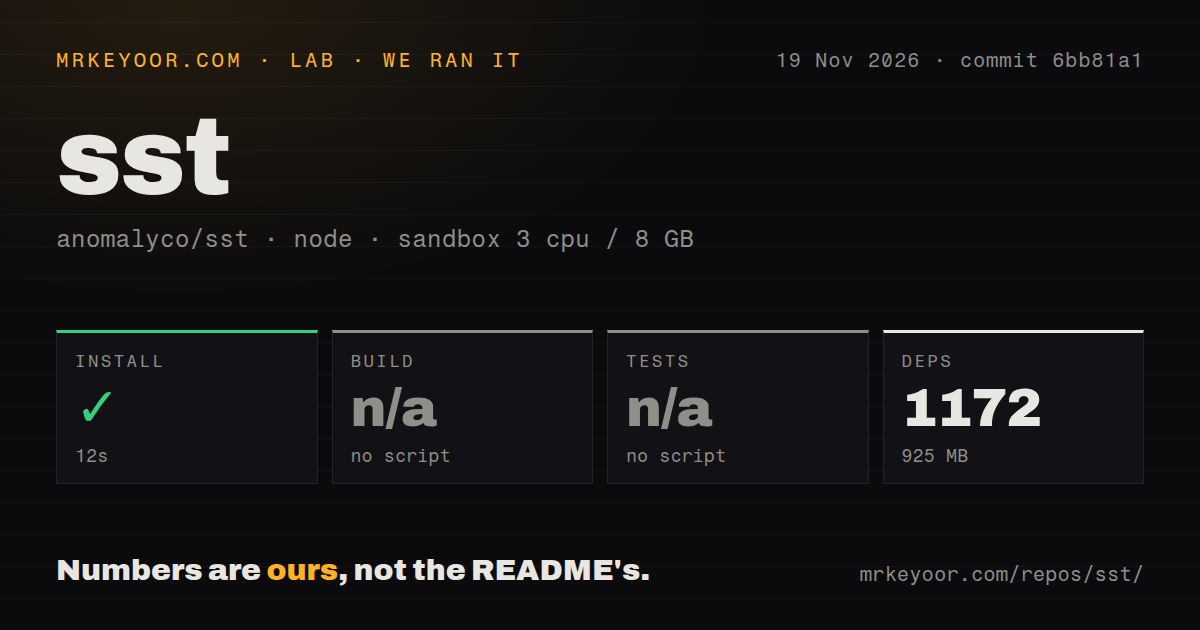
| Install | Succeeded in 12 seconds; 1,172 dependencies; 925 MB on disk |
| Build | Skipped: no build script or target detected by the harness |
| Tests | Skipped: no tests script or target detected by the harness |
| Checkout | commit 6bb81a1; 2,720 files; approximately 147,726 source lines; 60.5 MB |
| Repository signals | 2 CI workflow files; monorepo workspaces; no Dockerfile or tests directory detected |
| Sandbox configuration | 3 CPUs; 8 GB RAM; image label lab-node:22; ecosystem classified as Node with Bun |
We measured the source workspace on November 19, 2026, and the harness recorded those installation and repository figures. Its skipped targets describe its detection result. The README contributor instructions explicitly require Go and Bun, start with bun run setup and document bun run build:cli. That command creates the CLI binary. The README also describes running the CLI against examples, which is a different route from the generic snippet recipe.
Where people get stuck: deployment, packaging and cleanup
SST issue reports describe failures in tunnels, compilation, packaging, deployment and removal. The operation matters because a deployed stack can still fail when a function executes a database query, and a working preview can still fail during deletion. The following table keeps attempted remedies attached to the people and symptoms they concern. Its purpose is to help readers choose representative acceptance checks for their own application.
| Symptom and reporter | What helped, or what they tried | Operation to check |
|---|---|---|
| Production VPC tunnel failures in #5657 | A personal stage referencing the production VPC helped one user; participants also investigated target IPs and NAT/bastion reuse. Reports included success on 3.12.6 and failure on 3.13.1. | Compare the printed tunnel target with the intended bastion. |
| Decorator-dependent esbuild plugins blocked an Ion migration in #4514 | thdxr offered an experimental plugins.mjs path and subsequently reported more stability problems. | Compile and invoke a representative decorator-dependent function. |
| Windows blocked users' v3 upgrades in #4685 | Users described Linux dual boot or a Mac; an attempted Windows package installation returned E404. | Run the actual development workflow on the intended workstation. |
| Deploy printed Interrupted in #4573 | Changing stages helped one user; reinstalling SST's application-support installation helped another. Other participants reported failure with those approaches. | Capture the underlying SST and Pulumi logs. |
| Prisma runtime queries failed after bundling changes in #5077 | The reporter downgraded to 3.3.14; another participant moved the database folder to the project top level. | Execute a deployed query using the real monorepo layout. |
| Local development and cleanup hung in #5655 | Updates and NO_BUN failed for the reporter. Directory cleanup helped MaksBelenko but failed for pawelacio. | Exercise dev, refresh and remove on the affected machine. |
The Prisma reporter identified the failure at query execution, with missing Query Engine files for the rhel-openssl-3.0.x runtime. The discussion in #5077 includes a maintainer's suggestion to inspect generated copyFiles paths relative to sst.config.ts, followed by the reporter finding an empty generated Prisma directory. A deployment result and a successful database query answer different questions; include the query in an application acceptance check.
Historical database and preview reports add two more failure paths. In #2506, Aurora wake-up delays caused a Lambda timeout and a Cognito user without a corresponding database user; a participant described checking or creating that user during pre-authentication. In #3270, static generation needed a Parameter before the first deployment created it, and a user first created the stage with sst dev. In #835, delayed Lambda@Edge replica deletion obstructed branch cleanup and prompted asynchronous deletion proposals.
Maintenance changed after the initial complaints
Issue #6215 progressed from maintenance complaints to drafted volunteers and a March 31, 2026 announcement followed by closure. Its opening concerns came from November 2025, so presenting community recruitment as the latest development would omit later events. The readable discussion contains both users' concerns about contributions and subsequent collaborator updates about maintenance work.
On December 18, 2025, vimtor said the volunteers had been drafted by the SST team and expected to merge approximately 20 PRs that week. On January 19, 2026, vimtor said Console would also be maintained and described conversations about faster releases. On March 31, vimtor posted an announcement saying it was official, invited issue reports and tagging, and closed the issue as completed. These are dated statements in issue #6215, including an expectation about PRs rather than a counted result.
The repository metadata records a last push on November 14, 2026. That GitHub activity record, together with the later maintenance updates, supports a more current account than a recruitment-only summary. For a team choosing infrastructure tooling, the useful questions are who can work on a blocking issue and how that work reaches a release. The thread records changes in participation and communication rather than a service commitment.
Credentials and resource ownership shape the workflow
SST uses your provider credentials to create and manage infrastructure defined in sst.config.ts. The basics guide distinguishes managed resources, previously created resources that can be imported, externally managed resources that can be referenced, and resources shared across stages. Those distinctions determine which system owns a change and which resources belong to a preview environment rather than a shared service.
The documented removal policy retains critical resources when the stage name is production and removes them for other stage names. The same guide allows another production stage name, making the policy's actual condition worth reading alongside your naming convention. It also warns that sst remove permanently removes resources and that manual changes to managed infrastructure can put resources out of sync with state. Console is optional, and the deployment engine requires no Pulumi account.
State recovery and naming changes affect existing resources
Changing an application's name creates a new resource set rather than renaming the existing infrastructure. The SST basics guide explains that app and stage names act as namespaces, and that changing regions also involves removing resources in one location and deploying in another. These operations belong in deployment planning because they affect resource identity and lifecycle, not merely labels displayed in a dashboard.
SST stores state locally and backs it up to a bucket in the provider account. Losing both copies requires manually importing resources again, according to the same guide. An inventory of managed resources and ownership of the state bucket therefore belong beside application deployment instructions. For preview environments, a complete acceptance path includes first creation with required secrets, a real request and eventual removal; the historical binding and edge-function reports identify failures at both ends of that path.
SST vs AWS CDK, Pulumi, Serverless Framework and AWS SAM
SST's documentation distinguishes its application components, linking and unified development command from the infrastructure layer beneath them. Breakingcube's Express/Postgres account adds a narrower comparison: the author preferred SST's TypeScript configuration but reported working SAM local testing where SST Live development timed out. These comparisons concern workflow choices and an attributed application experience, with different sources answering different parts of the decision.
| Alternative | Reason to consider it | Evidence behind the comparison |
|---|---|---|
| AWS CDK | Your team prefers its existing AWS infrastructure workflow. | patrickfoley valued easier AWS asset creation in SST than CDK in #6215. |
| Pulumi | You want to manage the infrastructure layer directly. | The official SST comparison names higher-level components, resource linking and dev mode as SST additions. |
| Serverless Framework v4 | Its configuration workflow fits your application and team. | The Breakingcube author described account-setup friction and preferred SST's TypeScript configuration. |
| AWS SAM | Docker-based local API execution fits an existing Express/Postgres application. | The Breakingcube author reported working Postgres access and middleware through SAM local testing. |
The same comparison author rejected the Vercel plan they evaluated because of their daily cron's execution needs and abandoned a Workers migration after encountering changes to their Express and node-postgres application. Those are application-specific choices. For a potential move from SST to Pulumi, list the application components, runtime resource references and development processes that need replacement. Sharing a deployment engine gives a starting point for that inventory rather than a completed migration procedure.
What the other reviews get wrong
Makerstack, Startupik and DevTools Guide describe SST as AWS-only, while SST's documentation lists built-in AWS and Cloudflare components. Makerstack's review, Startupik's review and DevTools Guide's comparison each make that categorical restriction. The official provider description also describes additional Pulumi/Terraform providers, so AWS-only is the wrong boundary for choosing which deployment scenarios to investigate.
Startupik describes SST as sitting on AWS CDK without separating versions. Current SST documentation identifies Pulumi as the deployment engine. DevTools Guide also says resource linking removes manual IAM wiring; the basics guide distinguishes externally managed resources from infrastructure SST manages. Read its linking example as a defined relationship between resources, rather than an account of every permission relationship an application might need.
FAQ
SST means Serverless Stack in the deployment-framework context discussed by Startupik; this review concerns anomalyco/sst. Its official documentation describes applications defined through sst.config.ts on infrastructure in the user's account. The questions below focus on maintenance, infrastructure choices and reported application failures, so a reader evaluating this repository can connect each answer to a deployment decision.
Is SST still actively maintained, and what is the plan for reviewing its backlog?
Issue #6215 records drafted volunteers in December 2025, Console-maintenance reassurance in January 2026 and a March 31 announcement followed by closure. The discussion's dated updates supersede its initial recruitment-only account. Vimtor's December expectation of approximately 20 PR merges was a forward-looking statement, while the later replies describe continued participation and an invitation to report issues.
Should teams worried about SST's future consider migrating to Pulumi?
SST uses Pulumi for its providers and deployment engine, according to the official documentation. A migration assessment should inventory the SST application components, linked runtime values and development commands the application uses. The maintenance discussion includes interest in Pulumi as an exit route; the practical comparison is how your team would own those application-level functions after changing infrastructure tools.
Why does my SST VPC tunnel work in a personal stage but fail in production?
Issue #5657 includes reports involving wrong target IPs and reuse of an EC2 NAT instance as a bastion. Participants described a personal-stage workaround and a separate bastion arrangement in the tunnel discussion. Compare the host printed by the tunnel with the intended instance, then match the network arrangement to the report rather than treating a production-stage symptom as its own diagnosis.
Why are my Function esbuild plugins ignored, and can SST support NestJS decorators?
Issue #4514 reports custom esbuild options not being applied and a decorator-dependent migration blocker. Thdxr offered an experimental file-based plugin approach and later reported stability problems in the plugin discussion. A representative function should exercise the decorator-dependent compilation and invocation path; the relevant outcome is whether that application code builds and runs through the chosen development workflow.
Does SST support native Windows development, and is there a workaround if its Windows package is unavailable?
The historical Windows discussion includes an E404 package-installation error and accounts of using Linux dual boot or a Mac. Those are the concrete fallback experiences described in issue #4685. For a team standardizing workstations, installation, development requests and cleanup belong in the same workstation acceptance check because the report concerns the development workflow rather than configuration syntax alone.
Why does sst deploy print Interrupted without a useful error message?
Issue #4573 describes stage-dependent failures and differing results from reinstalling SST's application-support installation. Changing stages helped one participant, while others reported that suggested remedies failed in the deployment discussion. Capture the underlying SST and Pulumi logs so the failure can be compared with the reported operation; Interrupted alone does not identify which dependency or deployment step failed.
Why does sst dev hang during deployment and cleanup on only one developer's machine?
Issue #5655 describes a local hang affecting development and removal operations while colleagues could continue working. Clearing directories helped MaksBelenko but failed for pawelacio in the local-hang discussion. The reporter also tried updates and NO_BUN. Those differing outcomes make the affected machine's logs and exact command sequence more useful than repeating directory removal as a general remedy.
How can I use Aurora Serverless v2 with SST while keeping development access practical and production subnets private?
Lefnire described Docker Postgres locally and Aurora v2 outside development, with private staging and production subnets. The Aurora discussion separates the database connection used during development from the infrastructure used by other stages. It also describes earlier wake-up delays and inconsistent Cognito/database user creation, making connection behavior and user-creation handling distinct parts of the application design.
Why do newly added SST Secrets or Parameters break Next.js static generation?
Issue #3270 describes a first build reading a Parameter before its creation. A participant first created the stage with sst dev, then built the website, according to the binding discussion. For a fresh preview stage, the useful check is the ordering of resource creation and static generation, including values introduced by the same application change.
How do I package Prisma's query engine correctly in an SST monorepo deployment?
Issue #5077 records missing engine files during query execution, a downgrade to 3.3.14 and another user's successful move of the database folder to the project top level. The Prisma discussion also includes a suggestion to inspect generated copyFiles paths. Use the deployed query and actual directory layout as the acceptance case, since package deployment alone did not expose the reported failure.
How can Next.js preview environments be deleted reliably when Lambda@Edge replicas delay cleanup?
Issue #835 discusses retaining edge functions and deleting them asynchronously through helper infrastructure. IDVB described deletion failures blocking a branch-environment workflow in the edge-cleanup discussion. Include the final removal operation in a preview-environment acceptance check, alongside its initial deployment and request handling, because the reported obstruction occurred after the environment had served its purpose.
What we have not tested yet
Our runs establish dependency installation and a stopped snippet recipe, not a deployed SST application. Cloud provisioning, credentials, linked permissions, live requests, VPC tunnels, preview creation and removal, state recovery, retention policies, Windows development, decorator compilation and Prisma queries remain outside our measurements. The source harness skipped build and tests; its directory detection does not establish the repository's complete testing arrangements. The snippet failure concerns the selected README recipe rather than a failed cloud deployment.
The source run used commit 6bb81a1; the separate quickstart checked out 6bb81a17bc15 and installed SST 4.17.2. Container image labels and configured resources do not identify actual operating-system or runtime versions. Historical issues describe their reported versions and outcomes, and neither open nor closed status establishes present compatibility with SST 4.17.2. The Aurora sample was described as untested, and the edge-cleanup discussion contains proposals rather than a demonstrated general remedy.
Maintenance updates establish dated statements and participation changes, without measuring actual backlog throughput or support capacity. Numerical setup, documentation, community and maturity assessments therefore remain unassigned. Current Console pricing, total operating cost and production-scale performance are also outside these results: the official docs describe optional Console with a free tier, while individual bills and Breakingcube's five cold-start observations provide narrower evidence. The next useful application result would combine a deployed request, a real database query and a complete preview-stage lifecycle.