Pulumi turns infrastructure into an ordinary program
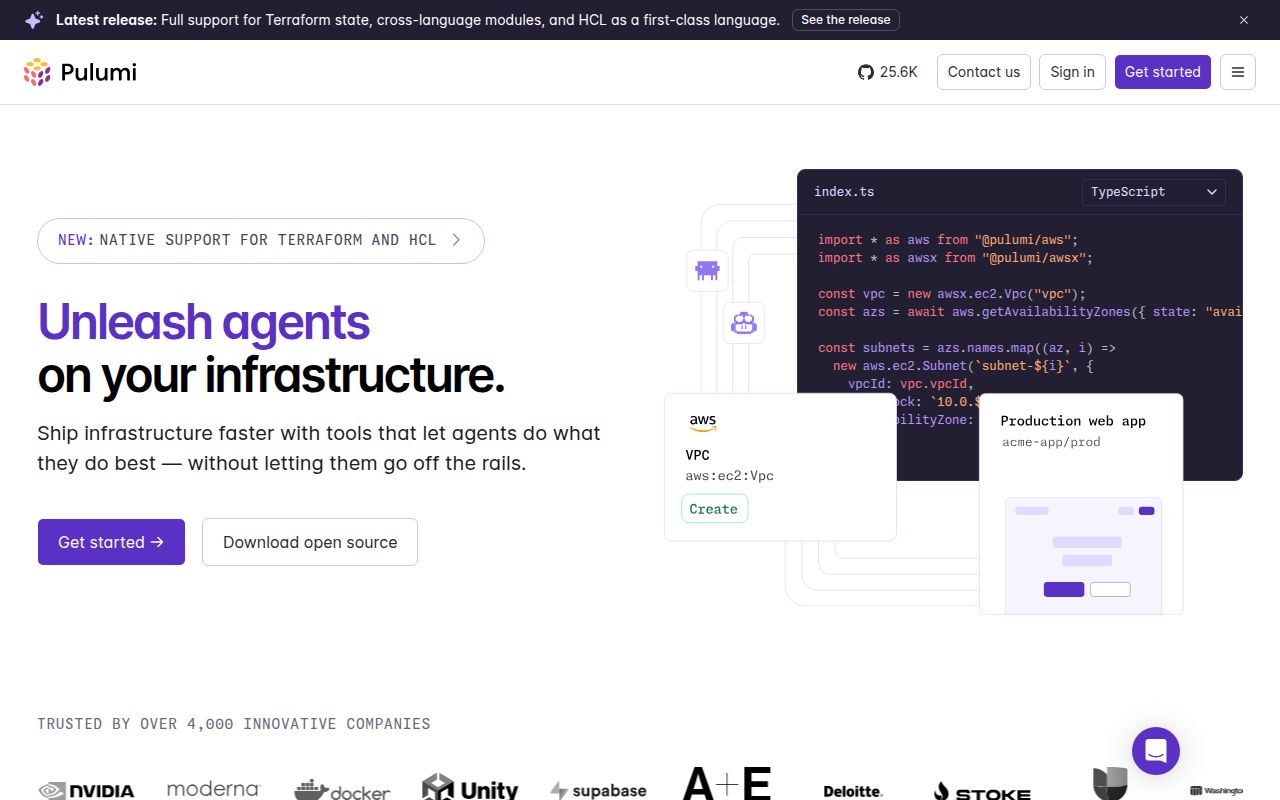
A Pulumi project declares cloud resources with a supported language and provider package. The engine evaluates the program, builds a resource graph, compares it with the selected stack, and shows a preview before applying changes. TypeScript and JavaScript are common choices, but Python, Go, .NET, Java, and YAML are also documented as stable. The same repository contains the CLI, language SDKs, and the core engine; provider packages live in separate repositories.
That model is useful when infrastructure has repeated structures, computed configuration, reusable classes, or a close relationship with application code. Developers get familiar editors, package managers, functions, and test tools. The cost is that a resource definition can now hide behavior inside normal code. Reviewers need conventions that keep previews understandable and prevent a clever abstraction from obscuring which resources will exist.
The first deployment needs credentials and persistent state
The README's quick start installs the CLI, creates a TypeScript AWS project, runs pulumi up, reads a stack output, and later destroys the resources. It is a coherent path, but it is not a harmless offline example. The deployment needs AWS credentials and permissions, creates billable resources, and records stack state. A team must also decide whether that state belongs in Pulumi Cloud or another supported backend.
Secrets and configuration sit beside that state decision. Provider credentials should come from an approved identity path rather than source files, while protected stack values need a secrets provider and recovery procedure. CI also needs non-interactive authentication and policy around who can approve an update. Pulumi makes the resource code approachable; it cannot decide the organization's access model.
What happened when we ran it
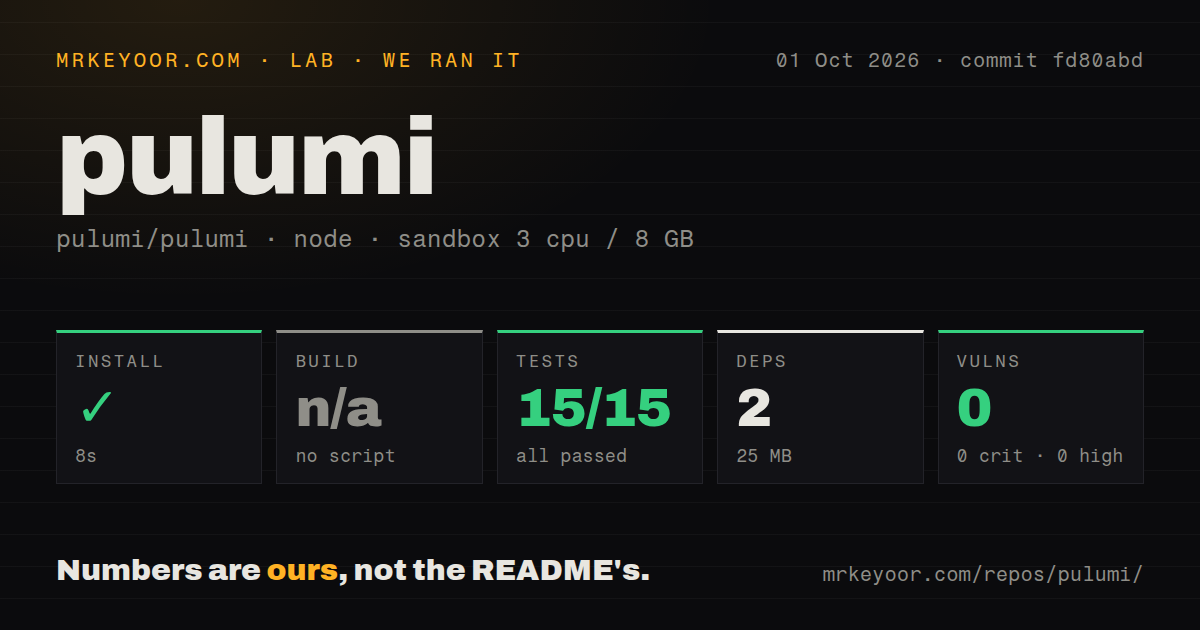
Our sandbox cloned commit 1b59498 into a fresh unprivileged Debian container with 3 CPUs and 8 GB of RAM. The repository contained 44,132 files, about 1,737,765 lines of source, and occupied 114.1 MB. The measured Node project lived under npm/, where npm installed 2 packages in 16 seconds and used 25 MB on disk.
No build script or target was available in that measured project, so the build step was skipped. The test command completed in 14 seconds: Node's test runner reported 15 passed and 0 failed out of 15. Npm audit reported 0 known vulnerabilities across critical, high, moderate, and low severities. The checkout also had 30 CI workflow files, no Dockerfile, and a tests directory.
Those 15 passing tests are good evidence for the small npm surface we executed. They are not a verdict on a multi-language engine with more than 1.7 million source lines. Our run did not compile the Go CLI, contact a cloud provider, create a stack, exercise a provider plugin, preview a change, or test state recovery. An adoption trial should do all of those with a disposable account and cost limits.
Language freedom does not remove provider behavior
Pulumi can target AWS, Azure, Google Cloud, Kubernetes, and hundreds of registry providers. The language layer does not make those APIs uniform. Each provider still has its own permissions, eventual-consistency cases, quotas, replacement rules, and version changes. A preview is valuable, but it cannot guarantee that an outside API will accept every operation or that a resource replacement will finish cleanly.
Provider packages also become application dependencies. Teams should pin versions, review release notes, and update in controlled batches. Generated SDK types improve authoring, yet a provider schema change can still alter accepted inputs or returned outputs. The safest Pulumi codebase treats provider upgrades like production library upgrades and tests the resulting preview against a representative stack.
Automation API is useful when infrastructure is part of a product
Automation API embeds Pulumi operations inside another program. That can power an internal platform, a self-service environment creator, or a product that provisions isolated customer infrastructure. It avoids wrapping the CLI with fragile shell parsing and gives the host application structured control over previews, updates, logs, and outputs. This is a real advantage over a workflow designed only for humans at terminals.
Embedding deployments raises the stakes. The host service now holds cloud authority, manages concurrent updates, stores logs, handles cancellation, and reports partial failures. Release v3.259.0 removed an Automation API output buffer limit and changed cancellation, package, code-generation, engine, and state-backend behavior. A service built on the API needs version tests and a queue that prevents two operations from racing on one stack.
Daily activity supports a mature but fast-moving tool
GitHub recorded 25,610 stars, a push on August 26, 2026, and 2,450 combined open issues and pull requests. Release v3.259.0 arrived August 19. Current pull requests covered Python generation, state migrations, retry behavior, SDK types, and CLI work. The large combined queue reflects both user reports and active development across a broad engine; it should not be described as 2,450 defects.
Pulumi deserves a trial when its programming model solves a specific pain, such as repeated environments, shared components, or infrastructure inside a product workflow. Run that trial against a disposable cloud account, inspect the preview with someone who knows the provider, and test stack backup and recovery. If existing Terraform or OpenTofu modules already work and the team values a constrained declarative format, switching for syntax alone is weak justification.