AWS deployment gets simpler, but v4 requires a sign-in
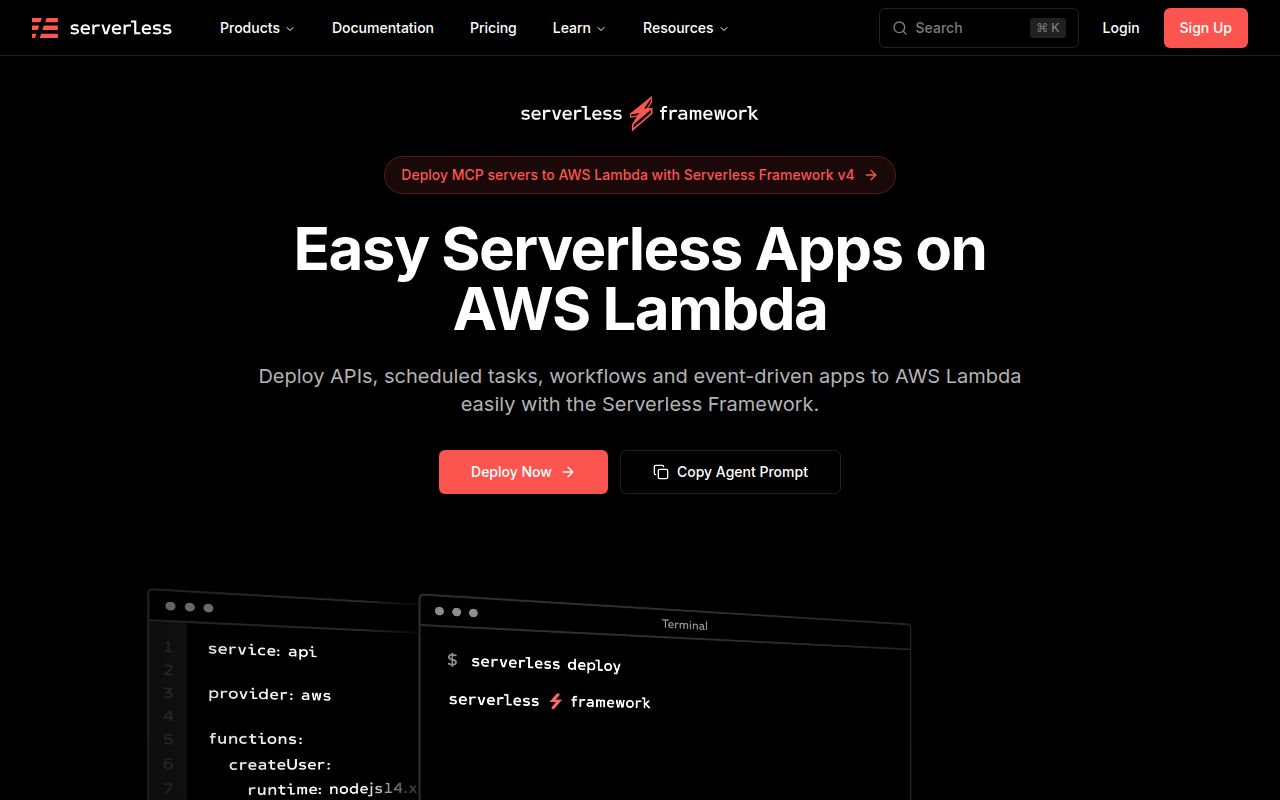
Run serverless deploy and the framework updates your application code and the AWS resources around it together. A serverless.yml file describes functions, their triggers, and supporting infrastructure such as database tables. That's a useful deal for a developer shipping an HTTP API or scheduled job. Before accepting it, read the README's authentication and licensing sections: v4 requires CLI authentication, and the distributed npm product includes proprietary software.
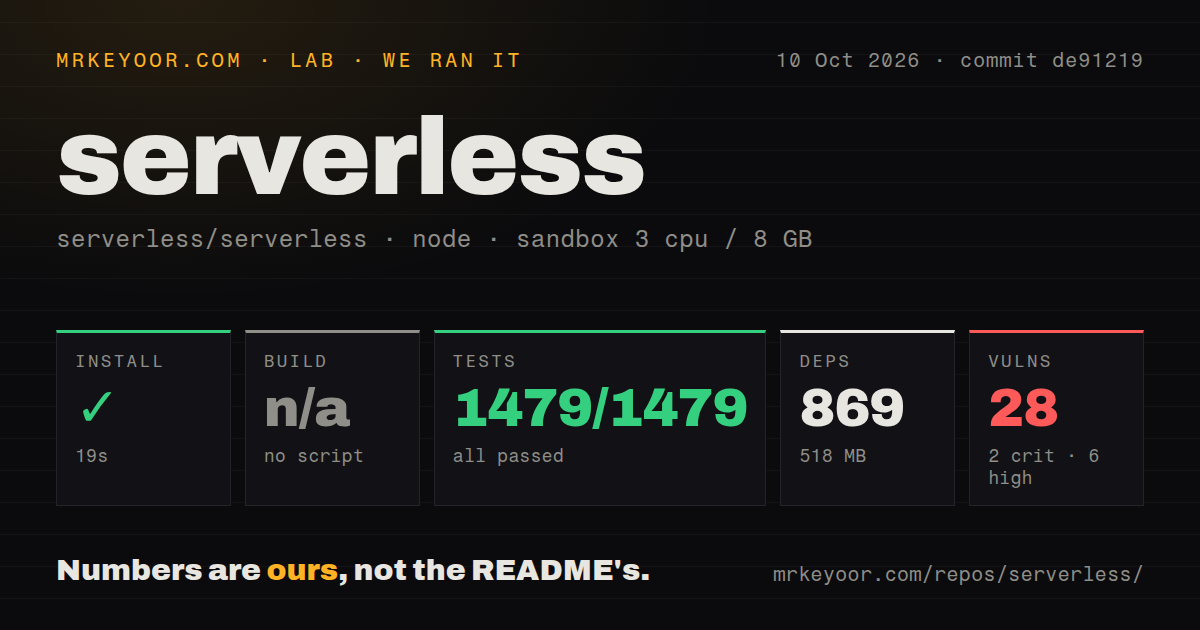
Our source checkout installed 869 packages and occupied 518 MB. That measures the contributor environment, so don't treat it as the footprint of the globally installed CLI. It does show that working on the framework means maintaining a substantial Node workspace. The larger adoption question is whether its AWS workflow saves enough work to justify another vendor relationship alongside your cloud account.
One service file can describe an API and its infrastructure
The README's service example puts a Lambda application and its supporting AWS resources under one configuration. You can keep a small application together, then use Compose to order deployments and pass outputs between services when it grows. I like that the README recommends starting with a single service until splitting it becomes necessary. There's no reward for turning a small API into several deployment units prematurely.
The 12.6 MB checkout contained 2,242 files and roughly 279,792 source lines. Users needn't learn that whole implementation: the service file is the interface. Stage-specific parameters let development and production share a definition, while per-function permissions can limit what each handler accesses. Read the generated infrastructure changes with serverless diff before deploying. Shorter YAML still creates real AWS resources, with their own permissions and bills.
What happened when we ran it
Our sandbox installed commit de91219 in 19 seconds on October 10, 2026, adding 869 packages and using 518 MB on disk. We used a fresh Debian container with 3 CPUs, 8 GB of RAM, the lab-node:22 image, no secrets, and no elevated privileges. The build step was skipped because the run found no build script or target. That is a skipped step, not a successful build.
The test command exited 1 after 166 seconds. Its log names test/unit/lib/plugins/package/lib/zip-service.test.js as the failing suite and reports 1 failed suite alongside 227 passing suites. That summary lists 1 failed test and 4,416 passing tests out of 4,417, with 174 passing snapshots. The supplied tail does not include the failed assertion, so it cannot establish why packaging failed.
The run's headline summary separately lists 1,479 passing tests and zero failures. Another summary in the tail lists 19 passing suites and 130 passing tests. These are distinct reported summaries, not figures we can add into a trustworthy overall total. The tail also contains a CloudWatch Alarms tool error. It doesn't establish that this error caused the packaging failure. The command's failed exit remains the finding.
Npm audit reported 28 known vulnerabilities: 2 critical, 6 high, 19 moderate, and 1 low. Those counts describe this checkout's dependency environment, without establishing an exploitable deployment path. They warrant dependency review before adoption. The run also found 11 CI workflow files. Neither those workflows nor the many passing tests turn this particular run green, and the sandbox supplied no evidence of a successful AWS deployment.
Dev Mode sends live AWS events to your local code
The sf-core@4.44.0 release, published October 14, describes Dev Mode routing a deployed stage's invocations to your working copy. Responses go back to the original callers, and handlers use their deployed environment and IAM role. That makes a queue-triggered bug easier to investigate than an isolated local invocation. It also means your laptop participates in an actual cloud application while the session runs.
Those release notes postdate our October 10 sandbox run. We haven't measured the new workflow. The README restricts Dev Mode to personal or development stages and says it refuses stages named prod and production. Use a separate development stage, check what it can access, and learn the restoration command before attaching it. A local editor doesn't make the incoming events or cloud credentials disposable.
Skipping Dashboard features does not remove authentication
The v4 upgrade guide requires authentication even for CLI use. Access keys or license keys handle noninteractive pipelines. Omitting the optional app property avoids Dashboard features, but doesn't remove that requirement. The README also distinguishes MIT-licensed source under packages/serverless from proprietary components covered at the repository root. Teams requiring an entirely permissive deployment tool have a concrete reason to choose something else.
Maintenance is active: GitHub records a push on October 15, 2026, following the October 14 release. The repository had 46,924 stars and 1,208 open issues and PRs when checked. Recent activity includes merged Dev Mode fixes, while open reports cover packaging and deployment behavior. That shows ongoing work alongside unresolved reports. Our 28 audit findings belong to the older measured checkout and should not be presented as an audit of the newer release.
Choose SAM for a narrower AWS workflow, Pulumi for several clouds
AWS SAM CLI is my first comparison for a Lambda application using SAM templates. AWS CDK fits infrastructure expressed through code and reusable constructs. Pulumi is worth comparing when the same team manages several clouds. Serverless v4 deprecated non-AWS providers, so its name shouldn't suggest a portable deployment contract. Choose it when its service configuration and AWS development loop match your work. Before making it your deployment standard, resolve the failed packaging check on the exact revision you'll maintain.