Build and recorded tests pass; validator setup remains incomplete.
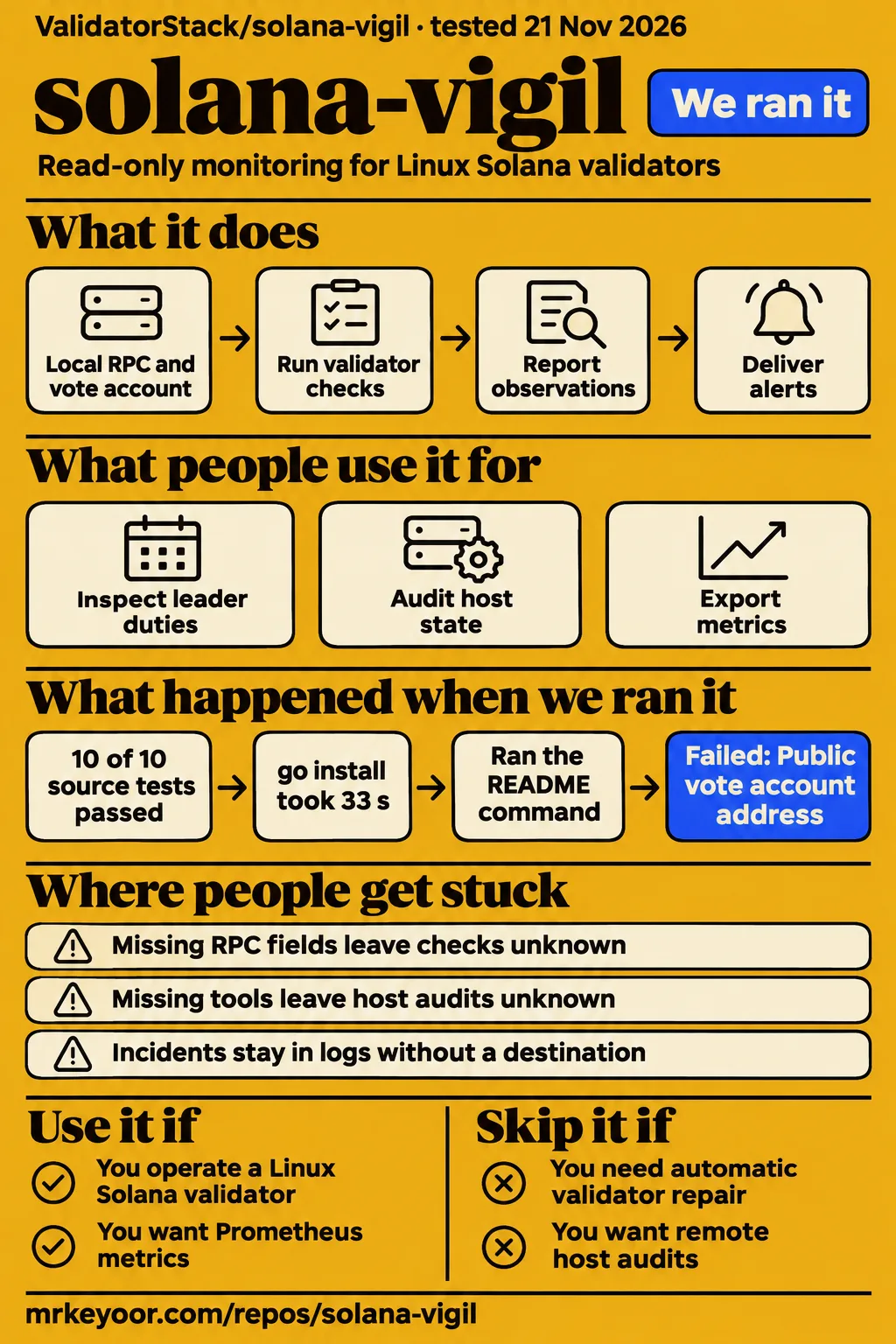
Our sandbox build of solana-vigil succeeded in 18 seconds, and all 10 recorded tests passed in 6 seconds. Use it if you operate a Linux Solana validator and want to assess read-only observations alongside existing monitoring. Skip it if you need automatic repair: the README excludes transactions, validator restarts and identity switching. The separate interactive exercise reached guided setup and stopped at its required public vote-account prompt. Those are two concrete outcomes: a successful source build and test run, followed by an incomplete configuration task in another environment.
ValidatorStack/solana-vigil brings vote-account funding, consensus registration, leader production and Linux host observations into one command-line program. The README describes missing RPC fields and failed observations as unknown, rather than treating missing information as a healthy result. That distinction is useful when connecting a new checker to existing scripts: the result needs to retain whether Vigil observed a problem or lacked the information needed to judge one. Its score command also reports observation coverage alongside its numerical summary.
What you can do with solana-vigil
Vigil documents one-shot health checks, continuous alerts, host audits and Prometheus metrics for Linux Solana validator servers. The README command list separates check, watch, audit and export, so operators can choose a single report, a persistent watcher or a metrics endpoint. Linux AMD64 and ARM64 are the documented production platforms. The deployment instructions place one instance on each validator, pointed at that server's local RPC and public vote account; RPC is the interface used to request node data.
VAT runway expresses how many epochs the spendable vote-account balance covers at a configured fee. The README calculation subtracts the account's rent-exempt minimum before dividing by the configured VAT per epoch. Its documented default is 0.8 SOL, or 800000000 lamports, per epoch. A runway below 1 is critical by default, while a runway below 2 warns. This gives operators a funding question tied to a stated calculation instead of a balance displayed without its reserved amount.
The documented BLS check distinguishes a valid base58 value decoding to 48 bytes, an explicitly empty or malformed value, and an absent field. The command list also includes epoch rewards, disk growth, leader duties and a fleet roll-up. These outputs answer separate questions: duties reports assigned slots and production, disk estimates days to full from an observed slope, and fleet summarizes nodes listed in fleet.json. The coverage printed by score supplies context for its 0-100 number.
What people use solana-vigil for
ByteSprint describes combining validator observations through vigil check, vigil score and vigil audit in its monitoring guide. Its checklist covers consensus registration, delinquency, vote lag, leader duties and host state, including CPU, memory, time synchronization and network interfaces. These are concrete workflows an operator can compare with an existing setup. The guide places the instance directly on the monitored validator and uses that validator's local RPC, with http://127.0.0.1:8899 as the default endpoint.
| Source | Workflow | What the description contributes |
|---|---|---|
| ByteSprint monitoring guide | Combine check, score and audit |
Groups consensus, duty and host observations into CLI tasks. |
| HotRepo project description | Export metrics and deliver alerts | Describes Prometheus metrics, supported destinations and HTML/JSON reports. |
| githubdecoded review | Inspect vigil score |
Describes the 0-100 summary and fixes for failing checks. |
The githubdecoded review recommends testnet first, while HotRepo describes observation and paging as the intended role. Product identity also matters here: the vigyl-cli listing describes the VIGYL keeper network, which creates automation jobs and runs a keeper daemon. That is a different project from ValidatorStack/solana-vigil. Keep the repository name attached to installation instructions and operational discussions so a similarly named command does not become evidence about this validator monitor.
What happened when we ran it
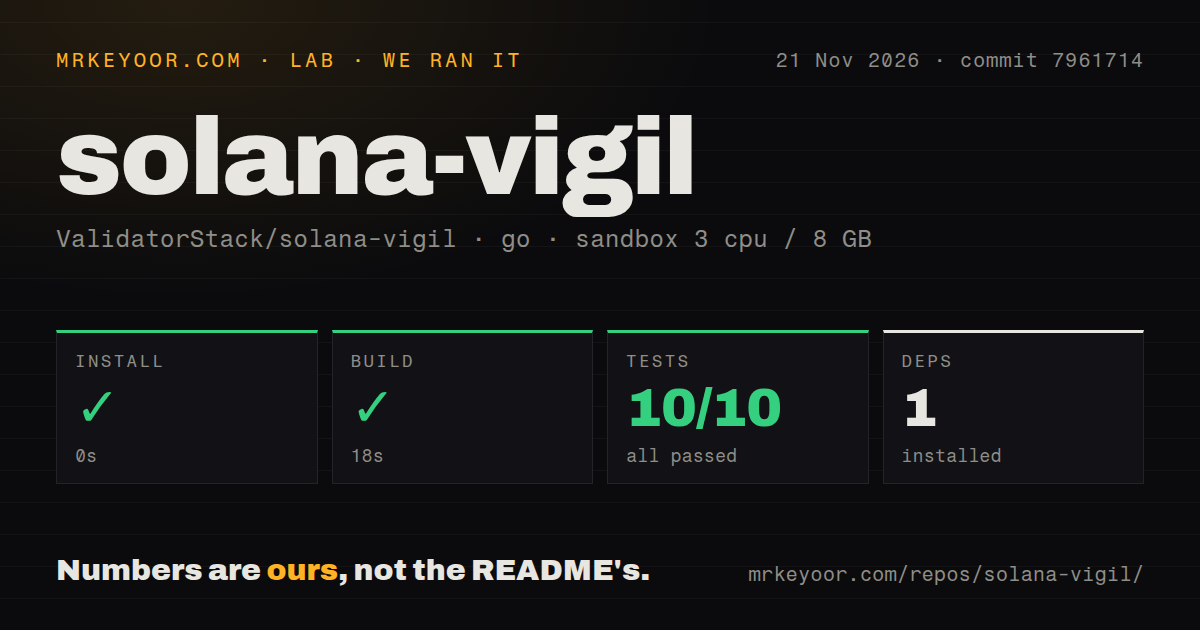
Our run built commit 7961714 in 18 seconds and passed 10 of 10 tests in 6 seconds on November 21, 2026. The source sandbox configuration was 3 CPUs, 8 GB RAM and image label golang:1.24-bookworm. Installation succeeded in 0 recorded seconds with 1 dependency. The checkout contained 66 files and approximately 5,319 source lines, occupying 0.2 MB. The scan recorded two CI workflow files, a Dockerfile and no tests directory in our sandbox measurements.
| Question | Answer | Verdict | Why |
|---|---|---|---|
| Did the source installation finish? | Yes, in 0 recorded seconds; 1 dependency | Passed | The harness recorded success and exit 0. |
| Did the source build finish? | Yes, in 18 seconds | Passed | The harness recorded success and exit 0. |
| Did the recorded tests pass? | 10 passed, 0 failed of 10 in 6 seconds | Passed | The harness recorded a successful Go test run. |
| Did the separate CLI exercise clone the project? | The clone step recorded 1 second | Completed | Clone record. |
| How was the CLI installed? | go install github.com/ValidatorStack/solana-vigil/...@latest; 12.9 MB in 33.3 seconds |
Completed | Installation record. |
| Did the version command work? | Exit 0 in 0.1 seconds; vigil 0.2.0-dev (commit unknown, built unknown) |
Passed | Version output. |
| Did help work? | Exit 0 in 0.1 seconds | Passed | Help output listed setup, checks and monitoring. |
| Did guided setup finish? | Failed in 0.1 seconds with exit 2 | Failed | Usage step stopped at the public vote-account prompt. |
| Did teardown finish? | teardown: ok |
Completed | Teardown record. |
The separate CLI exercise recorded checkout 7961714bbb0b in a fresh unprivileged container configured with 2 CPUs, 4 GB RAM, no published ports and no secrets. Its installation command used @latest, rather than building that checkout explicitly. The version command printed vigil 0.2.0-dev (commit unknown, built unknown). Keep those identifiers separate when reading the results: the checkout identifier and the executable's displayed development version are different recorded facts.
Guided setup failed in 0.1 seconds with exit 2 during our vigil init usage step. It printed Vigil will NEVER ask for a seed phrase, private key, or keypair file. before requesting the public vote account. The recorded finding states Setup failed: Public vote account address (required) is required. This names the failed step and the missing input without turning a configuration failure into a claim about validator health.
Where people get stuck: unknown observations and log-only alerts
An absent BLS field produces unknown, while an explicitly null, empty or malformed value produces critical according to the README's BLS rules. These states call for different responses: one concerns missing observation data, the other concerns the returned registration value. Host audits likewise report unknown when required evidence is missing. Preserve the distinction when interpreting JSON, command exit codes or dashboard cells; otherwise an integration can erase information that the checker deliberately retains.
| What you see | Documented explanation | Next action |
|---|---|---|
| BLS is unknown | The expected RPC field is absent | Inspect the endpoint and client schema. |
| Host audit is unknown | Tools or read permissions can be missing | Supply the required tools and read permissions. |
| Host or duty results concern the wrong machine | These checks depend on placement | Run the instance on the actual validator with its local RPC. |
| Incidents appear only in logs | No external destination is configured | Configure a destination and use vigil test-alert --config vigil.json. |
| Guided setup stops at the vote account | The public address is required | Enter the monitored validator's public vote-account address. |
The README documents audit tools including ethtool, timedatectl and chronyc, as well as the local placement requirement. Its setup command asks for public addresses and RPC URLs, then writes vigil.json with mode 0600. It refuses to overwrite an existing file unless --force is explicit. That makes an existing configuration file another concrete setup consideration: rerunning setup and replacing configuration are separate actions, and the command makes replacement explicit rather than silently overwriting the file.
Read-only operation still needs protected alert secrets
The README says Vigil never signs transactions, restarts validators or changes host settings, while alert credentials come from environment variables. Its security guidance separates observation from incident response and excludes automatic identity switching. The watcher and exporter need outbound HTTP(S) and local RPC access. The documented systemd units remove capabilities and restrict write access outside /var/lib/vigil, giving operators a concrete deployment configuration to inspect alongside the application's stated read-only behavior.
RPC URLs may contain provider credentials, and the README says embedded userinfo is rejected. It also says endpoints stay out of normal logs. The exporter binds to loopback by default; the deployment instructions use private networking, firewall rules, a reverse proxy or a secure tunnel for a remote Prometheus collector. The host audit runs separately from the persistent watcher because inspecting /proc, /sys and network interfaces can need broader read permissions than continuous RPC monitoring.
Missed-slot monitoring waits for confirmation
Vigil's documented watcher uses a default confirmation depth of 32 slots before deciding assigned-slot outcomes. The README describes caching the leader schedule and checking confirmed assigned slots with getBlocks. This changes when a missed-slot incident becomes eligible for a page. Per-slot events also stay out of permanent Prometheus labels, so individual duty events do not each create a lasting label value in the documented exporter design.
The README's alert defaults require two consecutive observations for warnings and unknown states, and two healthy observations for recovery. Critical conditions and severity changes notify immediately; an active incident repeats at most once per hour. Delivery failures retry on the next observation. vigil test-alert --config vigil.json tests delivery without changing incident state. These are separate controls over detecting a condition, changing its incident state and delivering its notification to a destination.
solana-vigil vs shell scripts, Prometheus and Node exporter
Choose Vigil for validator-specific observations, Prometheus for metrics collection and alert rules, and Node exporter for host metrics. The Prometheus README describes collection, rule evaluation and alert triggering, while the Node exporter README describes hardware and OS metrics. These roles can coexist: Vigil documents a Prometheus exporter and repository configuration files for scraping, alert rules and a Grafana dashboard, so adding its observations can extend an existing metrics setup.
| Choice | Documented role | Choose it when |
|---|---|---|
| Vigil | Validator checks, host audits and direct alert destinations | You want a common CLI and configuration for Solana-specific observations. |
| Existing scripts, dashboards and bots | Separate checks described by ByteSprint | You want to retain established individual checks while comparing their outputs. |
| Prometheus | Metrics collection, rule evaluation and alerts | You need a metrics system across services. |
| Node exporter | Hardware and operating-system metrics | General host visibility is the immediate requirement. |
ByteSprint groups the validator and host checks under three commands: check, score and audit. Prometheus instead collects from configured targets, and Node exporter exposes host measurements for collection. That makes the missing observation a useful selection criterion: account funding and BLS interpretation point toward a validator checker, while CPU and filesystem visibility point toward a host exporter. The README also warns that using both Vigil watch and Alertmanager for the same destination can generate duplicate pages.
What the other reviews get wrong
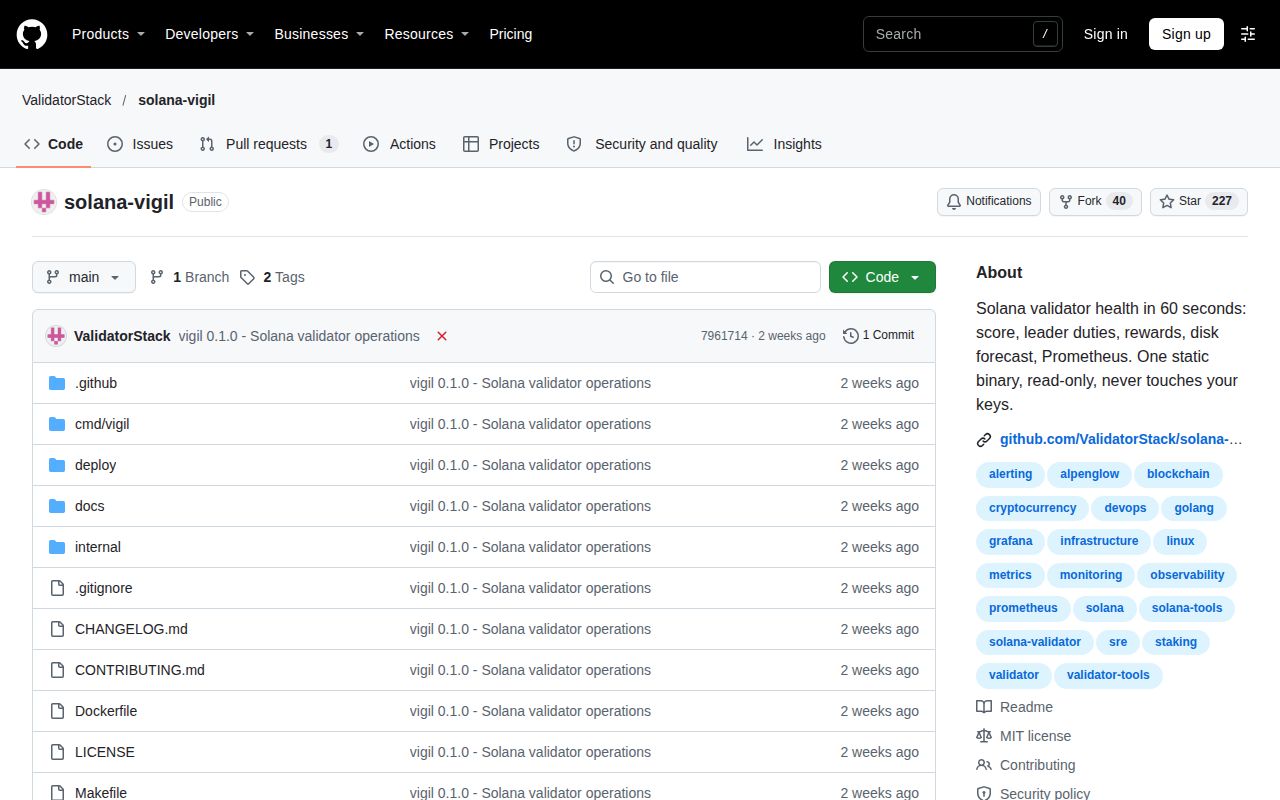
githubdecoded's review says “241 stars in 1 day. That is about 241 a day,” but Kopass later records 227 stars. The Instagram review's daily-rate wording describes an early snapshot. Kopass records 241 stars on November 12, 2026 and 227 on November 21, 2026, which contradicts reading 241 a day as sustained growth. Those dates and counts describe attention to the repository, rather than the number of validators running it.
RepoAlerts labels star authenticity “No data” and says it has not checked the stars for fakes in its project listing. That wording describes an absent authenticity check, rather than a finding of fake activity. githubdecoded's concrete operational recommendation is to start on testnet, and the README also directs operators to test configuration and thresholds there. Neither the early star count nor its rate calculation answers whether an alert reaches the right operator during an incident.
Questions people ask
Vigil targets Linux mainnet-beta validator servers, and its README directs operators to test on testnet before production use. The production-target and safety instructions answer the mainnet question with a deployment target and a staging step. The questions below come from ByteSprint's monitoring guide and the trust question raised by RepoAlerts and githubdecoded. Their answers distinguish documented commands and defaults from the execution results recorded above.
Can I trust solana-vigil on a mainnet validator?
The README targets mainnet-beta and directs operators to test configuration and alert thresholds on testnet. It documents a read-only boundary and one instance per validator server. For an evaluation, the practical sequence is to supply the public vote account and local RPC, compare the resulting observations with known node data, and test the intended alert destination. The recorded source build and the separate guided-setup failure give specific starting evidence for that assessment.
What is Solana validator monitoring?
ByteSprint's checklist covers consensus registration, delinquency, vote lag, leader duties and Linux host state in its validator-monitoring guide. The README adds vote-account VAT runway and identity consistency to Vigil's command descriptions. Monitoring these observations together lets an operator inspect funding, assigned work and host conditions through distinct checks. Vigil's command list separates one-shot results, persistent monitoring and host audits instead of presenting each task as the same kind of observation.
How do I check my Solana validator's health from the command line?
The README documents vigil check --config vigil.json after vigil init creates the configuration. Its quickstart lists exit codes 0 for OK, 1 for warning, 2 for critical and 3 for unknown. Setup requires the public vote-account address and the validator's local RPC. Scripts consuming the result should preserve all four codes so that missing observations remain distinguishable from healthy checks and from explicit critical findings.
Why does my Solana validator show unknown instead of healthy?
Missing RPC fields and failed observations become unknown under the README's documented rules. For BLS, an absent field differs from an explicitly null, empty or malformed value, which is critical. Host audits can also lack evidence when permissions or tools are missing. The relevant next step follows the affected observation: inspect the RPC response and client schema for registration data, or the host tools and read permissions for audit results.
How do I monitor missed slots without getting false alerts?
Vigil documents a default 32-slot confirmation depth for per-slot duty decisions and two-observation thresholds for noncritical conditions. The README's leader-duty and alerting sections describe those controls alongside immediate critical notifications and stable recovery thresholds. An operator can compare confirmed assigned-slot results with the underlying node data, then separately exercise alert delivery. That keeps the duty-accounting decision distinct from whether a destination accepted and delivered a notification.
What do other validator operators monitor today?
ByteSprint lists consensus registration, delinquency, vote lag, assigned slots, produced blocks, missed slots and host state in its monitoring checklist. That is the author's checklist. The githubdecoded review asks viewers what they monitor, while describing Vigil's local RPC, public vote-account input and score command. These attributed descriptions offer concrete checks to compare with an operator's current setup without turning the question itself into evidence of a community consensus.
What we have not tested yet
The CLI exercise stopped before a configured validator check, and the installed executable's revision was not established. The recorded checkout was 7961714bbb0b, but installation used @latest and the binary reported unknown commit metadata. The source harness separately tested commit 7961714; neither its image label nor the CLI container label establishes actual runtime or operating-system versions. The 8 GB and 4 GB allocations describe sandbox configurations, not measured application memory requirements.
Mainnet reliability, alert accuracy, steady CPU and memory use, fleet load, extended RPC outages and behavior across validator client upgrades remain untested. The reviewed descriptions contain no attributable operator deployment outcome or measured comparison with an existing monitoring stack. Star counts do not establish adoption, support quality or release durability. The configured VAT fee also needs comparison with current cluster rules before its runway estimate becomes an operational input. No release-installer or signature-validation result was recorded in these exercises.
The README explicitly excludes Alpenglow block-footer certificate participation parsing, Firedancer tile endpoint normalization, SFDP version deadline tracking and client upgrade binary verification. Its plan-restart command supplies scheduling advice only, and the operator retains responsibility for double-signing prevention. These are documented scope boundaries. A configured testnet run comparing funding, registration and confirmed duty observations with known node data, followed by recorded alert receipt, would answer the next operational questions.