Skyvern trades brittle selectors for an AI decision layer
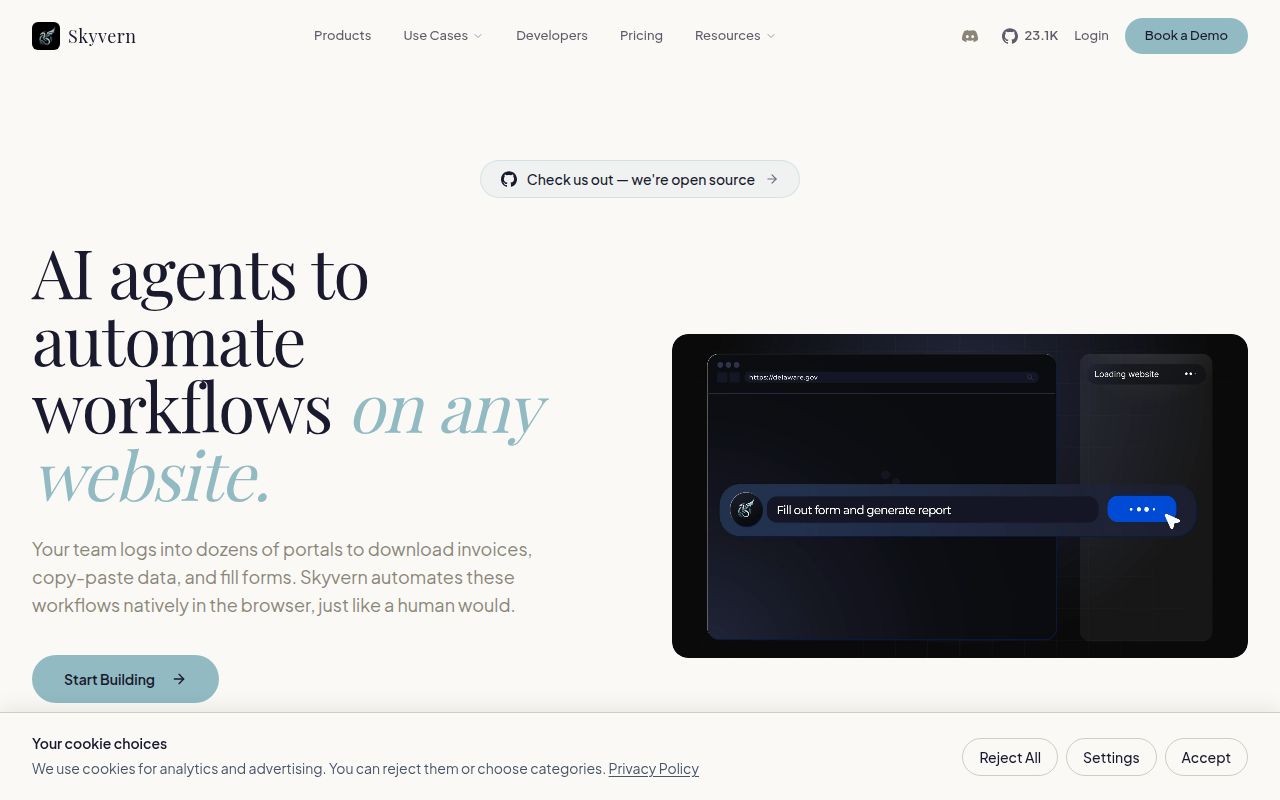
Skyvern tackles a familiar automation problem: a script works until a website moves a button, changes its markup, or presents a slightly different flow. Instead of depending only on DOM paths and XPath selectors, it uses language models and computer vision to interpret a page, decide what to do, and operate the browser through Playwright. That makes it most interesting for workflows spread across many sites or interfaces you do not control, where maintaining one hand-written script per site becomes expensive.
The project is broader than a single Python helper. Its README describes a Playwright-compatible SDK, a no-code workflow builder, a local server and packaged UI, plus a managed cloud option. Version 1.0.51 was released on August 24, 2026, and the repository was pushed again on August 30. That combination matters: this is an actively changing product rather than an old demo with a large star count.
What happened when we ran it
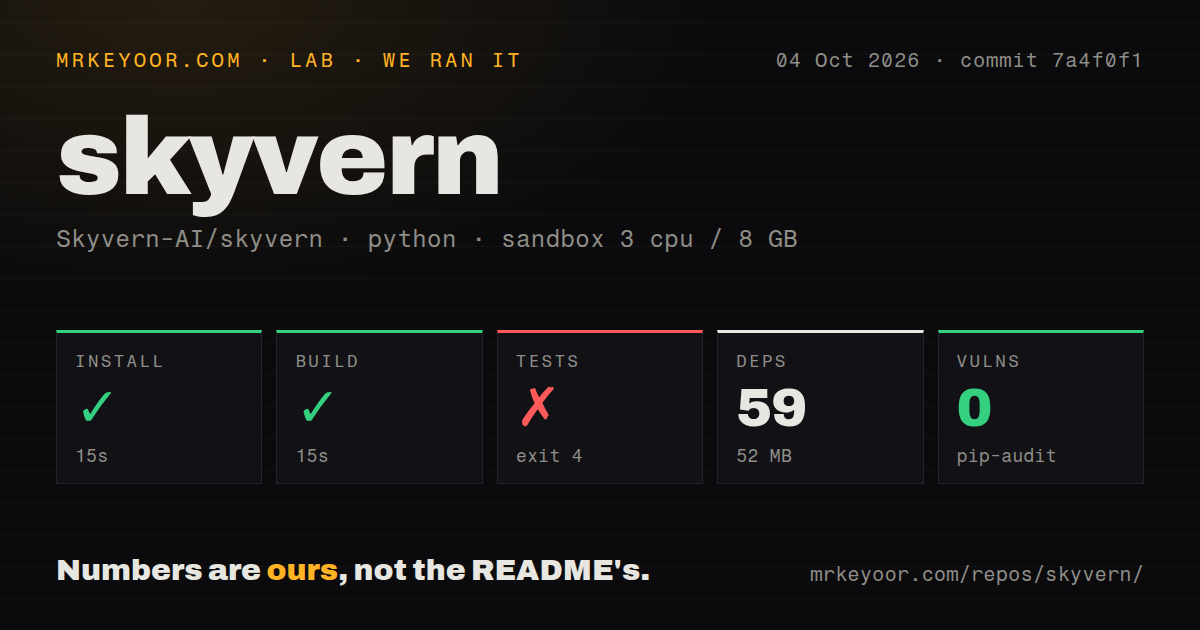
Our run used commit 96618fc in an unprivileged Debian container with 3 CPUs and 8 GB of RAM, without secrets. The checkout was substantial: 5,426 files, about 1,226,366 lines of source, and 352.9 MB. Installation succeeded in 23 seconds, adding 59 packages that occupied 51 MB, while the build completed successfully in 8 seconds. Those are encouraging first steps for a project with an API, UI, database support, and several deployment paths.
The tests were the warning sign. In 6 seconds, pytest reported 150 passed, 1 failed, 3 skipped, and 16 collection or setup errors out of 167. The visible log included multiple errors where FastAPI's Depends could not be imported, plus test_alembic_with_running_loop, which failed because async functions were not natively supported in that run. We cannot infer more than the log shows, but we can say the tested checkout did not produce a clean suite in this fresh environment.
Security scanning was cleaner: pip-audit found 0 known vulnerabilities. The repository also includes 13 CI workflow files, a Dockerfile, a Compose file, and a tests directory. Those signals show that packaging, automation, and repeatable deployment are treated as real engineering concerns. They do not cancel the failed test step, so teams should reproduce the suite with the project's intended development dependencies before promoting an image.
The SDK offers useful levels of control
The strongest design choice is that Skyvern does not force every task into a fully autonomous agent. The page object exposes four focused commands: act for natural-language actions, extract for structured data, validate for checking page state, and prompt for an arbitrary model request with an optional schema. Developers can combine those calls with ordinary Playwright logic, keeping deterministic code around login, navigation, retries, or business rules while using AI only where page interpretation is genuinely hard.
There is also a higher-level agent interface and a workflow builder for less technical operators. For local use, the documented pip route supports Python 3.11, 3.12, or 3.13 and defaults to SQLite, while Docker Compose bundles PostgreSQL, the API, and the UI. The README even records fixes for specific version 1.0.31 SQLite and dependency-resolution problems, which is unusually practical documentation even though it also reveals recent packaging churn.
The managed service adds parallel instances, proxies, anti-bot mechanisms, and CAPTCHA solvers according to the README. Those capabilities explain why the cloud offering may be easier than self-hosting for hostile or high-volume sites. They also clarify a boundary: the open repository gives you the automation system, but operating reliable browser infrastructure still involves networking, credentials, model-provider configuration, storage, observability, and site-specific failure handling.
Flexibility creates operational uncertainty
AI-directed browser steps are less predictable than explicit selectors. A visually plausible action can still be the wrong business action, and a validation prompt is not automatically a transaction guarantee. Skyvern's approach is best suited to recoverable work, human-reviewed queues, data collection, form preparation, and workflows with clear postconditions. For payments, account changes, deletion, or regulated submissions, add approvals and deterministic checks outside the agent.
The repository's AGPL-3.0 license also deserves an early legal review, particularly for organizations modifying and serving the software over a network. At 22,879 stars, Skyvern has strong visibility, but 222 open issues indicate a meaningful support and triage surface. Open issue count alone does not prove poor maintenance; paired with a push on August 30 and the August 24 release, it instead describes a popular, fast-moving project with active demand and ongoing rough edges.
It belongs inside a controlled automation service
In a real stack, put Skyvern behind your job queue, secrets manager, audit logging, and approval rules. Feed it narrow tasks with explicit success criteria, save screenshots and extracted results, and let another service decide whether an outcome is acceptable. Keep plain Playwright for stable pages and reserve visual reasoning for the sections where selectors actually fail. This hybrid layout limits model cost and makes failures easier to diagnose.
Skyvern is more convincing as an automation platform than as a drop-in replacement for every browser script. Its 23-second installation and successful 8-second build show that trying it is reasonable, while our failed test run says production adoption needs more proof. If changing sites are consuming engineering time, a supervised pilot is justified. If your target pages are stable, ordinary Playwright remains the simpler default.