Browser Use is for workflows whose page structure keeps moving
Browser Use gives a language model a browser and a set of actions. The agent can open pages, inspect their content, click, type, fill forms, and collect structured output from a task written in plain language. That is useful when a workflow crosses several unfamiliar pages or when maintaining exact selectors costs more than reviewing an agent's choices.
The project offers two entry points. Python developers embed Agent and choose a model, browser, tools, and output shape. Users of Claude Code, Codex, Cursor, Hermes, or OpenClaw can install a skill and issue one-off tasks through their existing agent. Because that skill is also an MCP-facing tool path, permissions and browser sessions deserve the same care as any automation that can submit forms or access accounts.
The open library and hosted service solve different problems
The MIT-licensed package can run on a user's machine and accept several model providers. The quickstart requires Python 3.11 or newer and shows a Browser Use API key, with Google and Anthropic keys as alternatives. A local model is possible, but the user still owns browser installation, profiles, downloads, resource limits, and the model's ability to understand the target pages.
The company recommends its cloud service for harder production work. The README assigns proxy rotation, CAPTCHA handling, browser fingerprinting, memory management, parallel execution, persistent storage, and hosted integrations to that offering. This division is important: installing the open-source package does not reproduce the hosted operating layer. Teams should price and review each piece separately.
Authentication is another boundary. Browser Use can reuse a real Chrome profile with saved logins or sync a profile to a remote browser using another utility. That is convenient, but it places valuable cookies inside an agent-controlled environment. Use dedicated accounts, narrow permissions, explicit confirmation before destructive actions, and task logs that record what the agent submitted.
What happened when we ran it
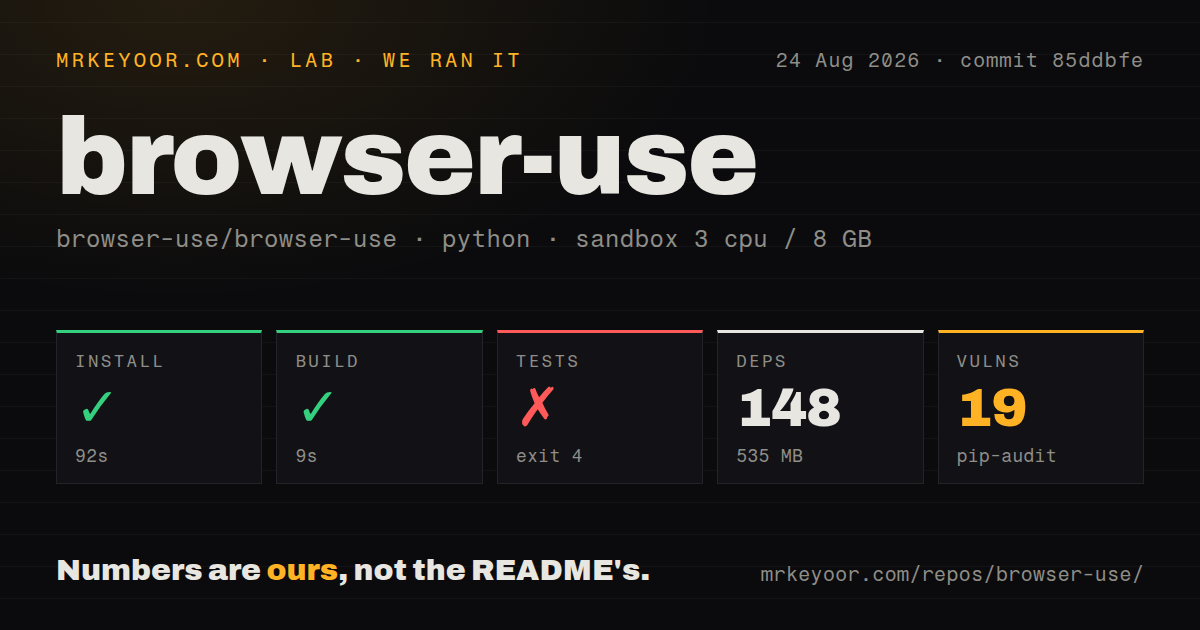
Our sandbox installed 148 Python packages in 92 seconds. They occupied 535 MB, which is large for a 494-file repository even before counting a browser runtime. The build succeeded in 9 seconds. pip-audit found 19 known vulnerabilities in the installed dependency set, so a production adopter should inspect the actual advisories and upgrade constraints rather than accepting the lock state unchanged.
The configured tests did not begin. After 12 seconds, pytest exited with code 4 because it did not recognize --dist=loadscope, an option supplied through pyproject.toml. The log identifies that argument failure but does not prove why the matching pytest capability was absent. We cannot report any passing or failing test cases from this run.
We tested commit 85ddbfe in a fresh Python 3.12 Debian container with 3 CPUs, 8 GB of RAM, no secrets, and no elevated privileges. The checkout held about 109,739 source lines, a Dockerfile, a tests directory, and 9 CI workflow files. The failed startup shows that the repository's configured test path was not self-contained in our installed environment.
Model-selected clicks need a different safety model
Traditional browser scripts specify what element to click and what result to assert. Browser Use asks a model to choose actions from page state. This can survive layout changes and handle tasks that are awkward to encode. It also introduces judgment into a channel that may send messages, accept terms, buy items, upload files, or expose account data. A plausible action is not necessarily the authorized action.
Custom tools increase both usefulness and risk. The Python API lets developers add actions that reach internal systems or application functions. Domain restrictions, confirmation points, limited credentials, and isolated browser profiles should be designed before such tools are available to the agent. Release 0.13.8 fixed domain-restricted actions appearing on an empty URL and made MCP errors surface as failed actions, which shows these boundaries are active engineering concerns.
Reliability should be measured on the team's own tasks. The README presents benchmark claims, but a pull request updated August 25, 2026, corrects one advertised leaderboard rank from first to second. More importantly, public benchmark tasks do not capture a company's login flow, regional pages, consent dialogs, or failure cost. Record completion, wrong-action, retry, and human-intervention rates on the exact sites being automated.
Fast maintenance also means frequent behavior changes
Release 0.13.8 was published August 16, 2026, and contains fixes across tool arguments, mutable agent state, browser downloads, DOM serialization, provider responses, MCP errors, file writes, cookies, and dependency pins. GitHub recorded another push on August 25, with 391 open issues and pull requests combined. This is clearly active software, but the breadth of fixes makes pinning and regression tests essential.
The README is helpful about choosing the CLI versus Python, selecting a model, authenticating a browser, and deciding between open source and cloud. It is less neutral about hosted-product comparisons, as expected from a company repository. Read the API and deployment docs for mechanics, then validate cost, privacy, and task success independently.
Use an agent where ambiguity is the expensive part
Browser Use fits supervised research, data entry, and cross-site work where pages change and a human can review the outcome. Its model flexibility, custom tools, MCP path, and active maintenance give developers room to build. Our 535 MB install and 19 audit findings make dependency review a prerequisite, while the failed pytest startup leaves upstream test health unverified in our environment.
Stable QA scripts, regulated account actions, and high-volume scraping usually need tighter control. Playwright exposes clearer assertions and failures when selectors are known. Choose Browser Use when interpreting the page is the hard part, then constrain what the agent may do after that interpretation.