The workbench changes how your agent operates
Seep Reverse Lab asks you to adopt an agent workflow around familiar reverse-engineering tools. Radare2 handles native inspection, JADX and Apktool cover Android work, and Frida supports runtime instrumentation. MCP connects those capabilities to the agent. That can save a specialist from repeatedly transferring findings between terminals and chat, but it also moves tool selection and execution into a layer that needs its own inspection.
Our October 16, 2026 assessment of commit ccddca5 has a firm limit: the harness could not execute this repository. The English README provides an accessible overview, alongside a Chinese README. The prerequisites guide and Bash installer we inspected use Chinese, and much of the issue discussion does too. An English-speaking evaluator can understand the product pitch, but may need translation while resolving the practical details that decide whether a deployment works.
What happened when we ran it
Our lab did not run Seep Reverse Lab: Lua had no supported harness ecosystem, and the checkout had no Dockerfile. The intended environment was an unprivileged container with 3 CPUs, 8 GB of RAM, and no secrets. No container image was assigned. Consequently, this review has no measured install, build, test, vulnerability, or runtime outcome for the workbench. The README's demonstration and self-check claims remain upstream claims.
That classification should not be mistaken for a description of every component. The project exposes a Python MCP server and ships shell and PowerShell setup paths alongside agent extensions. A mixed repository can fall outside an automated harness while still containing runnable software. Source inspection is useful here, but it cannot tell us whether every tool resolves correctly or whether an agent completes the advertised analysis on a real target.
The Unix installer still needs a native Radare2
The Bash installer explicitly says the bundled Radare2 executables are Windows binaries. On macOS it can attempt installation through Homebrew. On Linux it checks the system path and prints a manual-install suggestion when Radare2 is missing. That is a meaningful qualification to the README's bundled-tool story. Copying an archive to another operating system does not supply the native executable that platform needs.
This distinction matters more than the 3 CPUs and 8 GB assigned to our unused sandbox. The first adoption question is whether the actual native tools are present, callable, and appropriate for the target format. The Chinese prerequisites guide also describes Python and Git, optional Node-based integrations, and Java invocation for Apktool. An Android device or emulator belongs to a different part of the workflow again. The coordinator does not remove those underlying environments.
Installation writes into the Pi agent profile
The Bash script copies skills, system instructions, and TypeScript extensions under ~/.pi/agent, then renders an MCP template into that profile's mcp.json. Those are observable file operations in the source, not behavior we exercised. They are also a concrete reason to start with a disposable profile. An existing agent may have its own prompts or server configuration, and the destination matters as much as whether the copied files are valid.
The installer catches a Python protocol-library installation failure, prints advice, and continues toward its final completion message. A missing Linux Radare2 is likewise a warning rather than a hard stop. That makes the workbench's explicit health checks important after setup. Read the individual checks and confirm the required tool, rather than treating the last banner as proof that the environment is ready. Our unsupported harness provides no independent confirmation of those checks.
Request rewriting adds another integration boundary
The README describes terminology rewriting, model-refusal handling, and a local relay that can retry requests with different framing. Teams wanting a transparent connection between an analyst's instruction and a model request should inspect those components before adoption. A changed prompt can alter the result even when the underlying decompiler is behaving correctly. The workbench's execution contract also calls for authorization on each new target and evidence beyond a console message.
Closed PR #9 concerns provider compatibility specifically: Google-only request fields were being injected into other providers' requests, causing strict compatible gateways to reject them. It is relevant history for the request interceptor, rather than evidence that the current version still has that defect. Closed platform and skill-discovery reports add context too. They show why configuration and agent-specific behavior need checking separately from the analysis tools.
Recent maintenance does not verify an autonomous audit
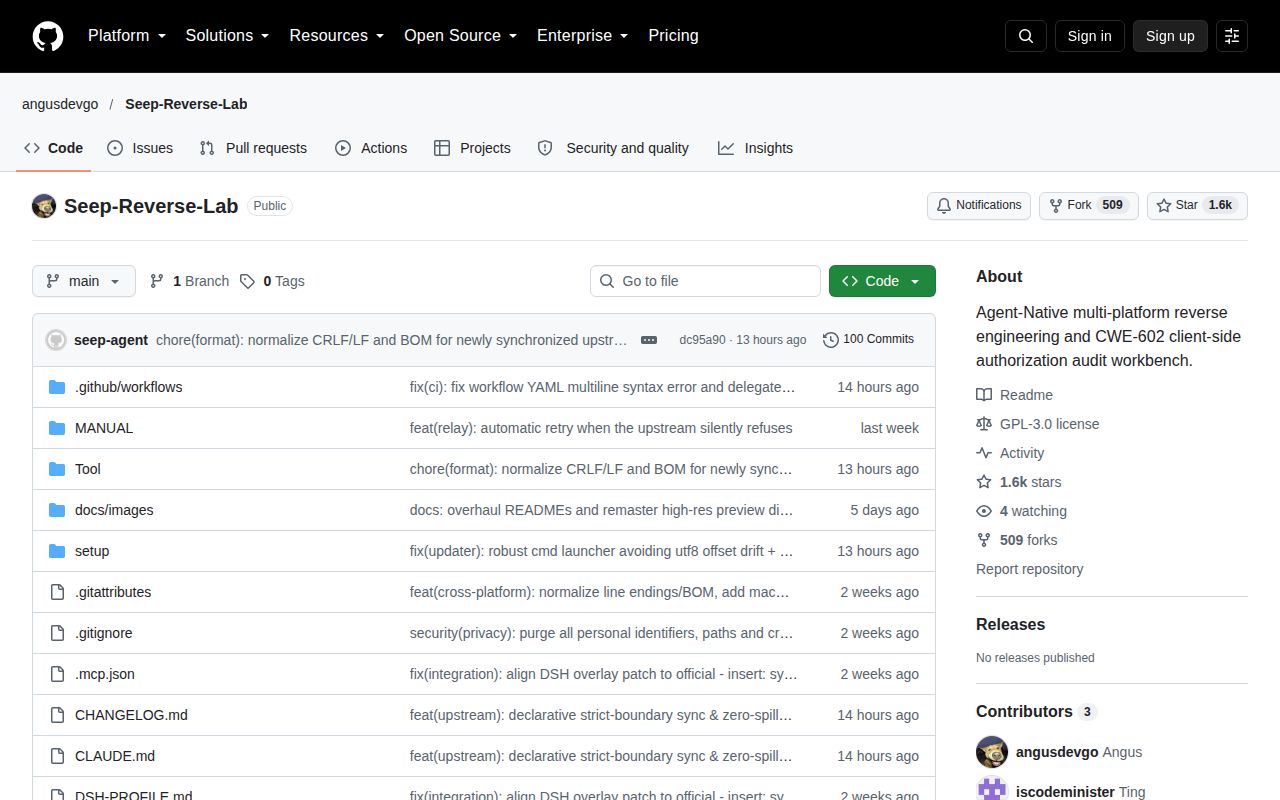
GitHub recorded an October 16, 2026 push, 1,567 stars, and no open issues or PRs. The latest-release endpoint returned no release, despite the README displaying a version badge. Recent closed integration reports show maintenance activity, so the missing release object is no basis for calling the project abandoned. Equally, an empty open queue does not independently validate the autonomous workflow or its generated reports.
I would evaluate Seep with a known sample and compare the agent's evidence against a direct tool session. Ghidra suits analyst-led native investigation, JADX is a narrower choice for Android inspection, and Radare2 gives explicit command control. Keep the workbench only if its coordination saves effort while preserving understandable evidence and acceptable profile changes. Until that comparison succeeds, its broad automation promise is a reason to investigate, not a reason to hand it an unattended workload.