radare2 is a command language for binary analysis
The 72.5 MB checkout contains a framework rather than a single disassembler. The r2 shell opens binaries, seeks to addresses or symbols, runs analysis, shows graphs, patches bytes, and connects to debuggers. Companion tools handle assembly, binary metadata, searching, and conversion. Libraries underneath those commands can be embedded, while r2pipe lets scripts drive a session from other languages. This structure rewards people who already organize work as repeatable commands.
The first session can feel hostile. The README opens /bin/ls, runs aaa, lists functions with afl, prints disassembly with pdf, and uses semicolons and tilde filters inside a compact shell grammar. Those commands become quick with practice, yet their names reveal little to a newcomer. The official book is closer to required reading than optional background. Our repository snapshot had 4,829 files and about 1,061,011 source lines, so guessing through the interface is an expensive way to learn.
Format and architecture coverage is the main reason to choose it
The README lists common desktop binaries such as ELF, Mach-O, and PE beside firmware, mobile, game-console, kernel-cache, bytecode, core-dump, and filesystem formats. Processor support ranges across current x86, ARM, RISC-V, and WebAssembly targets plus older and unusual chips. This breadth matters when an investigation moves beyond one compiler and operating system. A familiar command set can follow the analyst across very different artifacts.
Coverage is uneven by nature. Release 6.2.0 includes many corrections for PowerPC, MIPS, ARM, Mach-O, PE, DEX, PEF, QNX, and other parsers. Issue 26552 describes RELR relocation types being selected incorrectly for architectures outside the handled cases. Issue 25590 shows ragg2 generating ARM code that fails to assemble across 16-bit, 32-bit, and 64-bit modes. Verify the processor, loader, debugger, and command combination that your job depends on.
What happened when we ran it
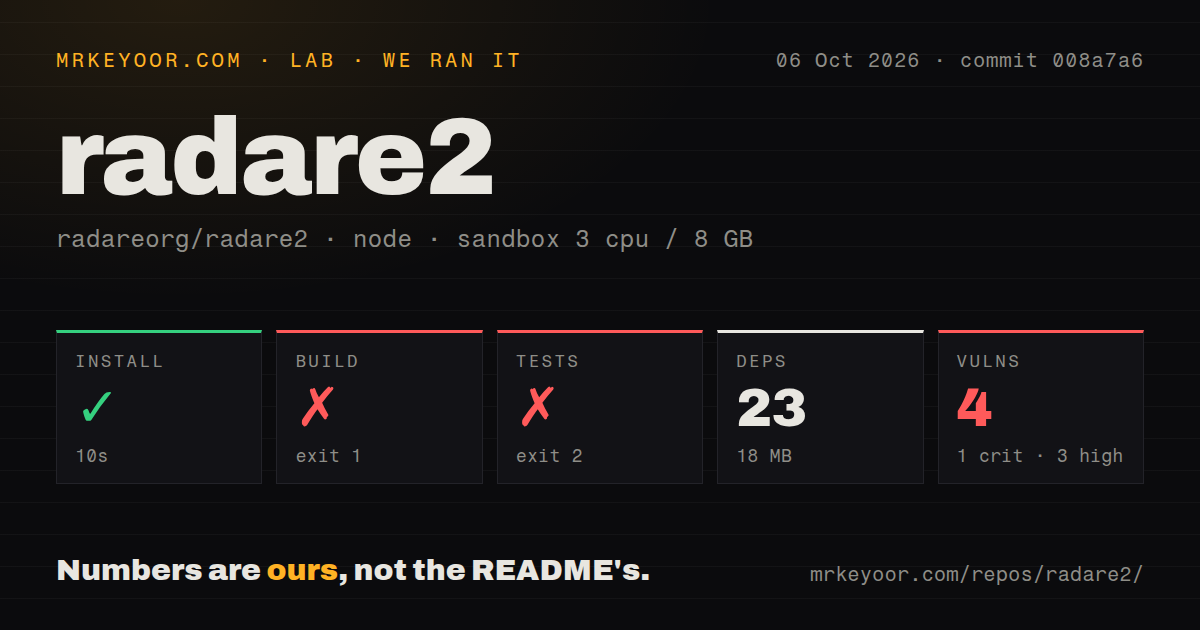
We cloned commit e9debda into an unprivileged Node 22 container with 3 CPUs, 8 GB of RAM, and no secrets. The checkout occupied 72.5 MB and held 4,829 files with roughly 1,061,011 source lines. Our harness targeted the npm project under ./dist/npm/, not the native C installation recommended near the top of the README. The repository had 7 CI workflow files, a tests directory, and no root Dockerfile.
The npm installation failed after 415 seconds with exit code 1. Its final lines show several dependency deprecation warnings, then wasm-pack running node ./install.js. That script attempted to download wasm-pack-v0.10.3-x86_64-unknown-linux-musl.tar.gz from a GitHub release and ended with connect ETIMEDOUT to port 443. The log proves a network timeout during that download; it does not prove the archive was missing or the native project could not compile.
Installation never completed, so we did not run a build or tests. There is no honest pass count to report. Teams adopting the npm package should test installation from the same network and cache the required artifacts if policy allows. Most reverse engineers should begin with a published native binary or follow the source build in the README instead of treating this JavaScript distribution folder as the default product.
Native installation has several supported routes
The README recommends cloning the repository and running sys/install.sh, which uses the project's build scripts and creates links for the command suite. Make and Meson builds are supported, along with Nix packaging and released binaries. Windows uses batch files to prepare Python, Meson, and Ninja before building with MSVC or MinGW. These options are useful, but they also mean troubleshooting depends heavily on the chosen platform and compiler.
Plugin setup is another layer. r2pm can install graphical interfaces, decompilers, Frida integration, binary diffing, YARA support, language-specific analyzers, and other extensions. Release 6.2.0 records 503 commits from 25 contributors and an ABI difference of 22. That is active engineering, but native plugin authors should expect to rebuild, inspect API changes, and check each plugin's license rather than assuming one framework license covers everything.
Hostile files deserve process isolation
A reverse-engineering tool routinely reads malformed or adversarial data. radare2 is primarily written in C, and the 6.2.0 notes include a long crash section: bounds errors, use-after-free, stack exhaustion, integer problems, malformed parser inputs, and authentication fixes all appear there. The fixes are evidence of active hardening. They are also a reminder that opening an unknown file gives complex native parsers attacker-controlled bytes.
Use an unprivileged account or disposable environment for suspicious samples, keep the tool current, and separate file inspection from debugger attachment to sensitive processes. The repository has 7 CI workflow files and a dedicated test directory, though our npm-path failure meant we did not exercise either. Release notes are detailed enough to search for affected loaders and architectures before processing a high-risk sample.
Active development comes with a large issue queue
GitHub recorded a push on August 26, 2026. Release 6.2.0 arrived on August 7, and the README says the master branch identifies itself as 6.2.1 while work moves toward 6.2.2. The open count was 822 issues and pull requests combined. Same-day architecture reports and maintenance proposals show active scrutiny, so the queue reads as ongoing work rather than abandonment.
radare2 makes the most sense when its shell becomes part of the analyst's method. Saved commands, scripts, r2pipe automation, and plugins can turn a manual investigation into a repeatable procedure. Analysts who mainly want a graphical decompiler will get productive faster in Ghidra or Cutter. For terminal-native reverse engineering across odd targets, radare2 remains difficult to replace, provided the team pins versions and tests the exact analysis path it relies on.