Japanese revisions get a record you can inspect
Yomiyasu asks your coding agent to revise awkward Japanese while keeping the original claim intact. The Japanese README targets technical articles, specifications, PR descriptions, and internal reports. You give the agent a draft and, when useful, explain who will read it. The skill directs the edit, then Python scripts flag suspicious differences. There is no English README, so comfortably reading Japanese is part of the adoption decision.
Our checkout of commit 60bf877 contained 221 files and roughly 11,690 source lines in 1.4 MB. That small repository includes more than writing instructions: its lint, diff, and final-file verification tools make revisions inspectable. The useful question is whether those checks help you catch a changed condition or missing negation before publication. They cannot decide that the resulting Japanese is good.
What happened when we ran it
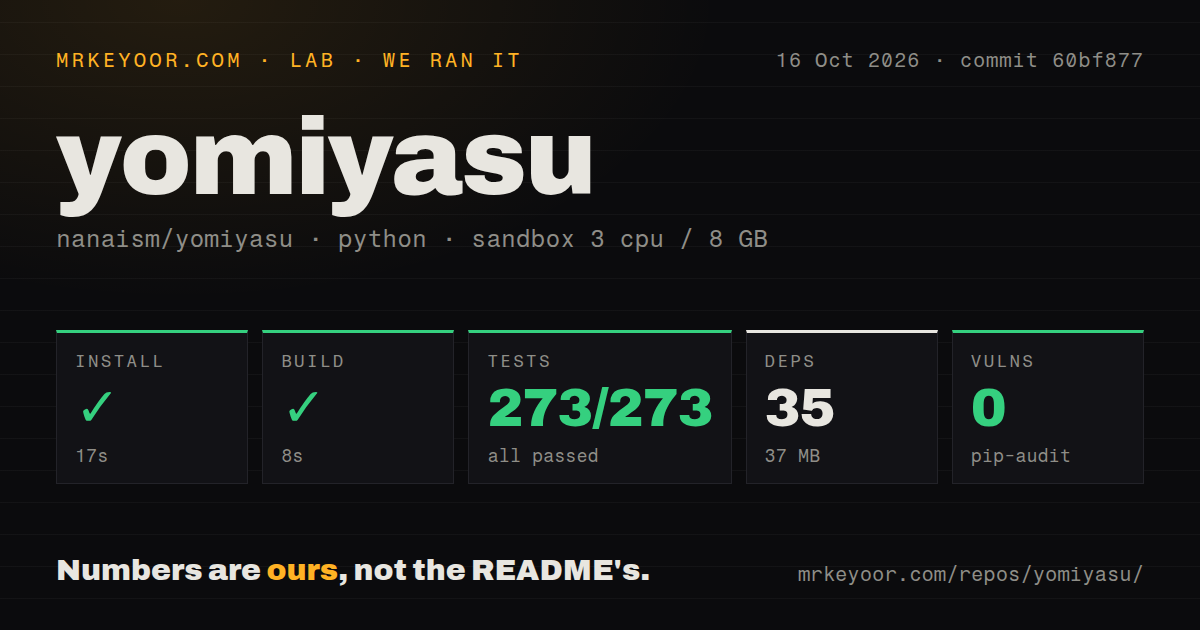
Our sandbox installed Yomiyasu in 17 seconds, built it in 8 seconds, and passed all 273 pytest tests in 11 seconds. We ran commit 60bf877 on October 16, 2026, in an unprivileged Debian container with 3 CPUs, 8 GB of RAM, Python 3.12, and no secrets. The install added 35 packages and occupied 37 MB. Pip-audit reported 0 known vulnerabilities in that environment.
The lab found a tests directory, no CI workflow files, and no Dockerfile. Passing 273 tests gives us confidence in the repository checks exercised by that command. It supplies no measured evidence about an agent's editorial judgment, meaning preservation across arbitrary documents, or the quality of a rewritten business email. Those are separate outcomes, and none was measured in this run.
The checker flags changed meaning without certifying it
The README's tool descriptions explain a useful division of work. yomiyasu_lint.py inspects expressions and formatting. yomiyasu_diff.py compares the original with the revision and draws attention to changed numbers, negation, and grammatical roles. yomiyasu_check.py runs checks together and records which final file they covered. A later verification can detect whether the delivered file differs from that checked text.
Version 2.0.0 removed the normal score display because readers could mistake it for a readability pass mark. That is a sensible product decision. An unchanged deadline can coexist with an altered obligation, and a sentence can satisfy every configured rule while remaining confusing. The README explicitly says these tools do not determine whether meaning has survived. Treat an empty warning list as a narrower result than editorial approval.
The host agent supplies the rewriting and model access
Claude Code plugin installation is documented alongside other skill-distribution routes. The project does not supply an independent editing model or a web editor. You still need a configured host agent, access to its model, and permission to give that environment the document. The checker scripts are described as standard-library Python tools. Our 35-package development install therefore should not be read as the minimum dependency list for checking a file.
A practical deployment starts with a document you can review confidently. Supply the original, any supporting material, and the relationship between writer and reader. Yomiyasu's instructions distinguish a report for a customer from a message to a colleague. They also tell the agent to avoid filling factual gaps without support. That is useful restraint for incident reports, where making an uncertain cause sound settled would be a serious editing error.
Namespaced invocation and manual copies need attention
The README warns that the Claude Code plugin's skill name is yomiyasu:yomiyasu. Calling the short name can fail to load it, leaving you with an agent response that never used the intended instructions. It also warns that a manually copied skill folder will not update itself. These are mundane operational details, but they determine whether the editor you think you invoked is the one that handled the draft.
The 37 MB environment we measured was easy to accommodate. Platform confidence is less settled: the README says the current version was checked through noninteractive commands on macOS, while interactive sessions, Windows, and several distribution routes remain outside that confirmed coverage. Other Japanese proofreading skills can also issue conflicting instructions. Start with one editing policy and inspect the final-file record before adding another.
October maintenance is visible in fixes and releases
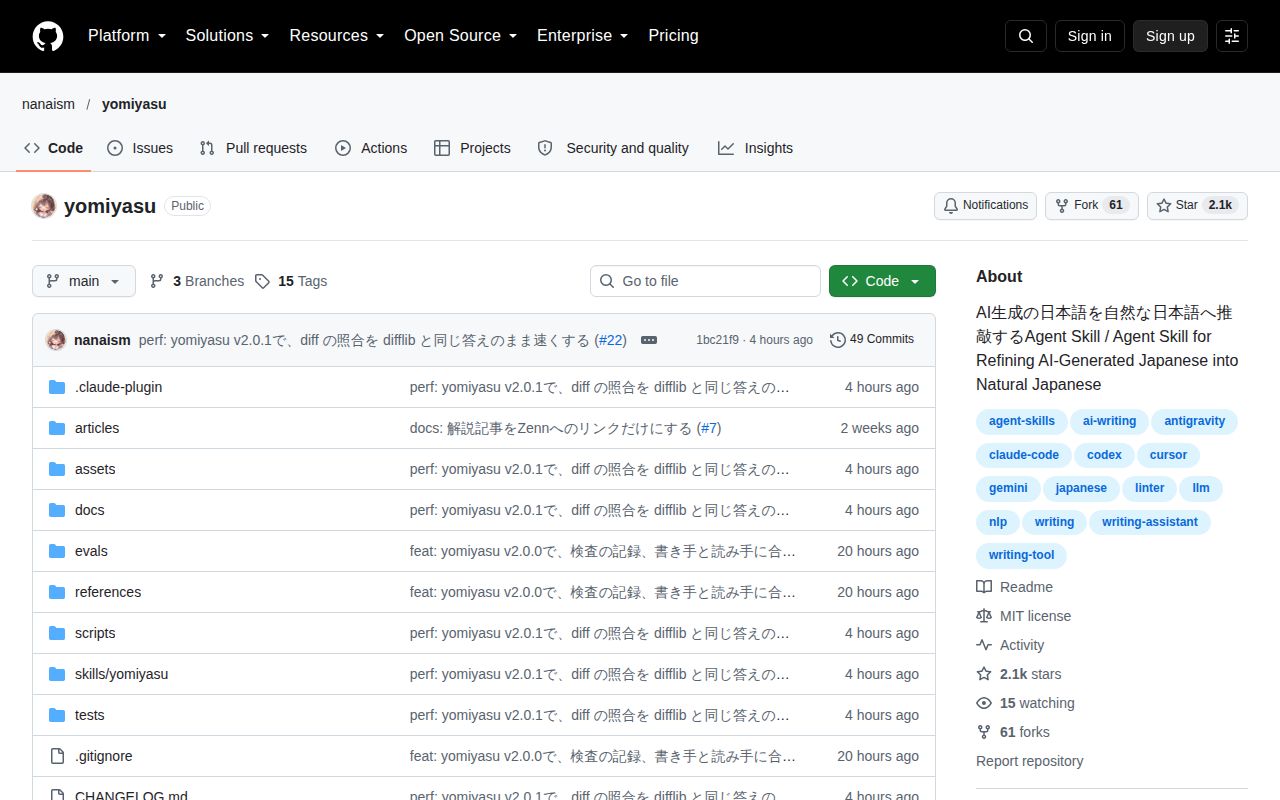
The repository's last push was October 17, 2026, and GitHub showed 2,093 stars with 0 open issues and PRs. The recent closed list includes a Windows text-encoding report and a Zenn formatting false positive, with corresponding corrective work. Those reports concern the checker itself, so they are useful evidence of maintenance. A cleared queue alone would tell us much less.
Release v2.0.1 also appeared on October 17 and changes the diff implementation. Our measured commit predates that release, so its results belong to 60bf877. For a rules-only publishing workflow, textlint or its Japanese technical-writing preset offers more direct configuration. Choose Yomiyasu when you want an agent to revise Japanese and leave evidence for an editor to inspect. Before accepting the result, compare every changed deadline, condition, and denial with the source.